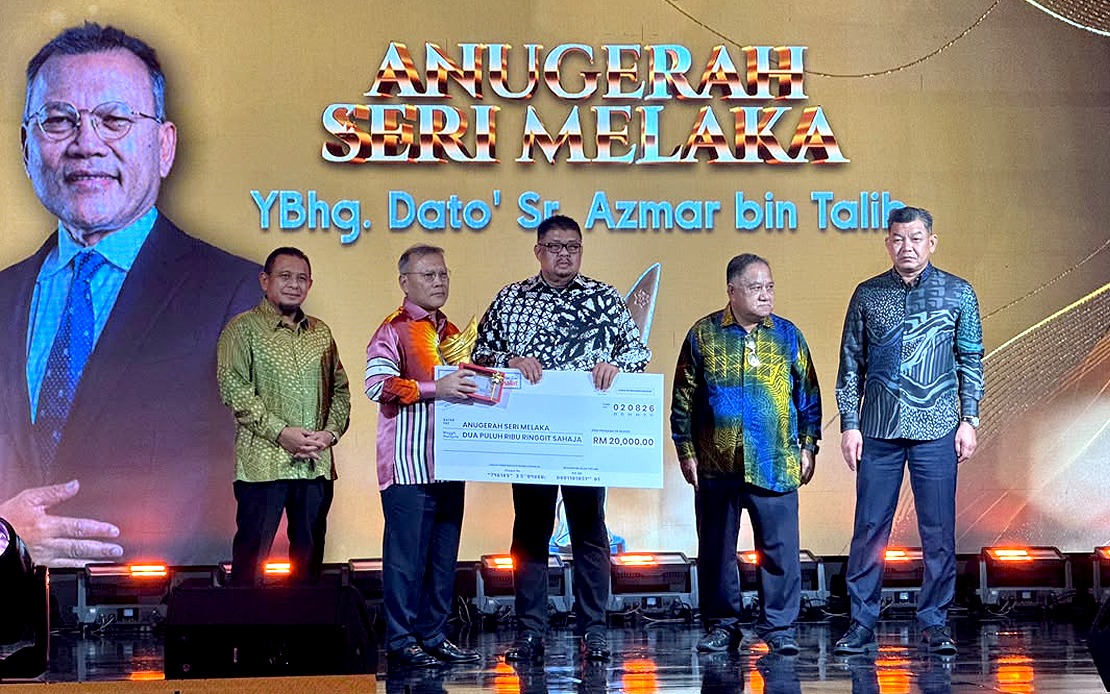
Melaka Chief Minister Datuk Seri Ab Rauf Yusoh has issued a call to the state's accomplished professionals—those who have carved out successful careers across diverse sectors—to step forward and serve as strategic collaborators with the state administration. Speaking at the Anugerah Seri Melaka (ASM) Gala Night held at the Melaka International Trade Centre in Ayer Keroh, Ab Rauf articulated a vision where individual achievements transform into collective assets that benefit the broader community rather than remaining confined to personal distinction.
Under the umbrella of the Melaka Sayang Rakyat (MeSRa) initiative, the state government has prioritised the documentation and dissemination of success stories from native Melakans. The underlying philosophy recognises that when accomplished individuals share their journeys publicly, they create blueprints that inspire and guide those still charting their professional paths. This approach converts what might otherwise be isolated accomplishments into educational resources and sources of motivation for the state's population at large.
The Chief Minister emphasised that the partnerships being sought extend beyond symbolic recognition. He specifically called upon successful Melakans to leverage the experience they have accumulated, the specialised knowledge they possess, and the professional networks they have built over their careers. These tangible assets, when deployed strategically, create tangible pathways and openings for younger individuals seeking to advance their own prospects. The initiative thus positions accomplished individuals not merely as examples to admire from afar, but as active architects of opportunity within their home state.
The ASM awards recognised excellence across four distinct domains: Public Service, Corporate, Sports, and Arts and Culture. The breadth of these categories underscores the government's intention to celebrate and leverage talent across the entire spectrum of Melakan society. The inaugural ceremony attracted over 200 nominations, a volume that itself testifies to the depth of accomplished individuals with roots in Melaka and the community's enthusiasm for recognising their contributions.
Ab Rauf contextualised the achievement of award recipients within a broader narrative about character formation and personal development. Each nomination, he observed, represents a life trajectory constructed through disciplined effort, personal sacrifice, and resilience in the face of obstacles. These biographical details matter because they demolish romantic notions of overnight success and instead foreground the deliberate, sustained labour that underpins genuine accomplishment. By highlighting this reality, the Chief Minister effectively communicated that Melaka possesses both the talent and the cultural capacity to produce individuals of the highest calibre.
The awards ceremony itself celebrated five major honourees. Datuk Azmar Talib, Chief Executive Officer of TRX City Sdn Bhd, received the top ASM award, winning the Corporate category. National badminton player Aaron Chia secured the Sports category recognition, while performing arts director Lokman Abd Ghani took the Arts and Culture award. Datuk Zamri Misman, serving as Director-General of the Legal Affairs Division at the Prime Minister's Department, claimed the Public Service category. Additionally, Dr Saiful Anuar Singar, an internationally recognised medical science researcher, received a Special Category award acknowledging contributions that transcend conventional disciplinary boundaries.
The financial structure of the awards reflects differentiated recognition of achievement. Recipients of the top ASM award received RM20,000 in cash alongside a trophy, signalling particular significance. Winners of the four category-specific awards each received RM10,000 and individual trophies. While modest in absolute terms, these monetary incentives serve a symbolic function, demonstrating tangible state endorsement and appreciation for the contributions these individuals embody.
The initiative carries particular relevance for Malaysia's competitive positioning within Southeast Asia. As the region witnesses intensifying talent mobility, with skilled professionals increasingly crossing borders in search of opportunities, maintaining mechanisms that recognise and retain accomplished individuals becomes strategically important. Melaka's approach—combining public recognition with institutional platforms for mentorship and collaboration—offers a model that other Malaysian states might adapt and implement.
For the younger generation specifically, the visibility of successful role models from their home state provides something more valuable than generic inspirational messaging. These individuals demonstrate concretely what achievement looks like within Malaysian institutional contexts and professional structures. They illustrate pathways to excellence that account for local realities, cultural nuances, and practical constraints. This specificity makes their example more actionable than distant, seemingly unattainable international benchmarks.
The emphasis on legacy and intergenerational knowledge transfer also reflects evolving perspectives on what constitutes meaningful success. Ab Rauf's framing suggests that individual achievement, however distinguished, remains incomplete unless it catalyses broader advancement within one's community. This philosophy aligns with longstanding Malaysian values emphasising collective welfare and mutual responsibility, while channeling these values toward practical outcomes through structured initiatives rather than vague exhortation.
Looking forward, the success of such mentorship-oriented programmes depends substantially on whether accomplished individuals respond to invitations for partnership with genuine engagement. The government has created the structural invitation; transformation into substantive relationships requires willingness from both established professionals and emerging talents. How actively the award recipients and other recognised achievers integrate with state-level initiatives will ultimately determine whether these frameworks evolve into meaningful conduits for opportunity creation or remain largely ceremonial.

