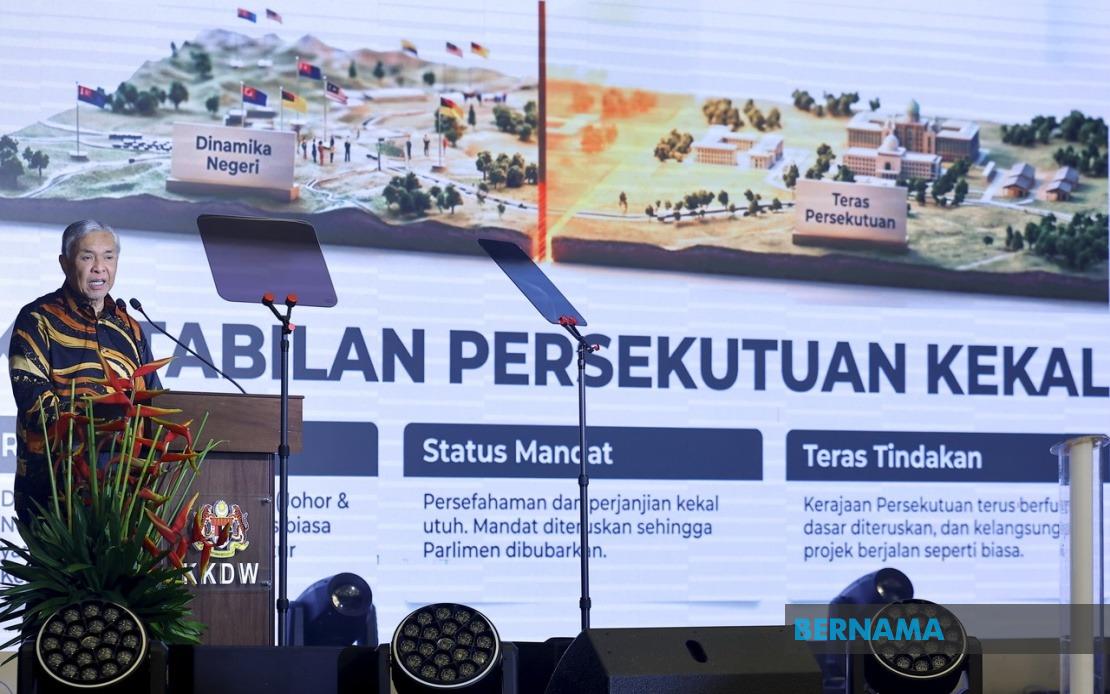
Barisan Nasional has signalled its determination to mount a comprehensive defence of its political stronghold in Melaka, with the coalition setting its sights on retaining all 21 state seats it currently holds ahead of the 16th state election. The ambitious target was announced by BN chairman Datuk Seri Dr Ahmad Zahid Hamidi, who relayed the strategic objective as conveyed to him by Melaka Chief Minister Datuk Seri Ab Rauf Yusoh.
The Melaka chief minister, who also serves as chairman of the state BN machinery, has already communicated his unwavering commitment to defending the entire slate of 21 seats, according to Ahmad Zahid. Speaking to reporters following the Rural and Regional Development Ministry's monthly assembly in Putrajaya, the BN chairman emphasised the determination underlying this target, signalling that the coalition views Melaka as a crucial electoral battleground where consolidation rather than territorial compromise is the priority.
Melaka has long represented a stronghold for Barisan Nasional, and the coalition's decision to pursue a comprehensive hold on all seats reflects both confidence in its ground machinery and anxiety about potential inroads by opposition parties. The state has historically been competitive terrain where BN's performance carries symbolic weight beyond its 21 seats, influencing national perceptions of the coalition's electoral viability and grassroots support.
However, Ahmad Zahid's remarks also acknowledge the complex political landscape that may require flexibility on the coalition's part. He indicated that despite its primary objective, BN remained receptive to potential understandings with other political partners, provided such arrangements align with the broader strategic interests of the coalition. This apparent openness suggests internal discussions about the coalition's optimal positioning in an evolving political environment.
The BN chairman clarified that any accommodation with other parties would not be a unilateral decision made at the state level. Rather, all discussions involving potential seat-sharing arrangements or electoral pacts would require consultation with and final approval from the central BN leadership, ensuring that decisions reflect the coalition's national strategy and long-term positioning. This hierarchical decision-making structure underscores the importance placed on maintaining coalition unity and preventing ad hoc arrangements that might undermine central authority.
Ab Rauf Yusoh's openness to discussions about coalition arrangements reflects pragmatism amid uncertainty about voter sentiment and the competitive dynamics likely to emerge during the election campaign. Malaysian state elections have become increasingly unpredictable, with voters demonstrating willingness to shift support based on local issues, personality politics, and perceptions of government performance. The chief minister's flexibility, while secondary to the primary objective of defending all 21 seats, suggests awareness that rigid positioning could prove strategically disadvantageous if electoral conditions shift unfavourably.
For Malaysian observers, Melaka's election will serve as a significant bellwether for broader coalition dynamics. The state's outcome could influence calculations about the sustainability of BN's current national position and provide insights into whether the coalition can consolidate support among its traditional constituencies. A successful defence of all 21 seats would demonstrate that BN retains commanding authority in at least some state-level strongholds, whereas significant losses could accelerate perceptions of coalition vulnerability.
The coalition's strategy also reflects lessons learned from recent electoral encounters across Malaysia, where overconfidence has occasionally resulted in unexpected setbacks. By emphasising the ambitious goal of defending all seats while simultaneously maintaining dialogue with potential partners, BN appears to be calibrating a message that conveys both strength and flexibility to different audiences.
From a regional perspective, Melaka's election matters because the state occupies a pivotal geographic and economic position within peninsular Malaysia, and its political orientation influences broader Southeast Asian perceptions of Malaysian governance stability. An election result that either consolidates or disrupts BN's position could carry implications for investor confidence and regional perceptions of political reliability.
The timeline for the 16th Melaka state election remains subject to the state government's formal announcement, though speculation about polling dates has periodically circulated. The coalition's early articulation of its target provides time for organisational preparation and messaging development, signalling to party members and supporters the seriousness with which leadership approaches the forthcoming contest.
Ahmad Zahid's comments represent the opening salvos in what is likely to be an intensive campaign period characterised by competing claims about governance performance, development achievements, and future visions. The assertion of ambitious electoral targets serves multiple purposes: it rallies party machinery, communicates confidence to supporters, and establishes benchmarks against which performance will subsequently be measured.

