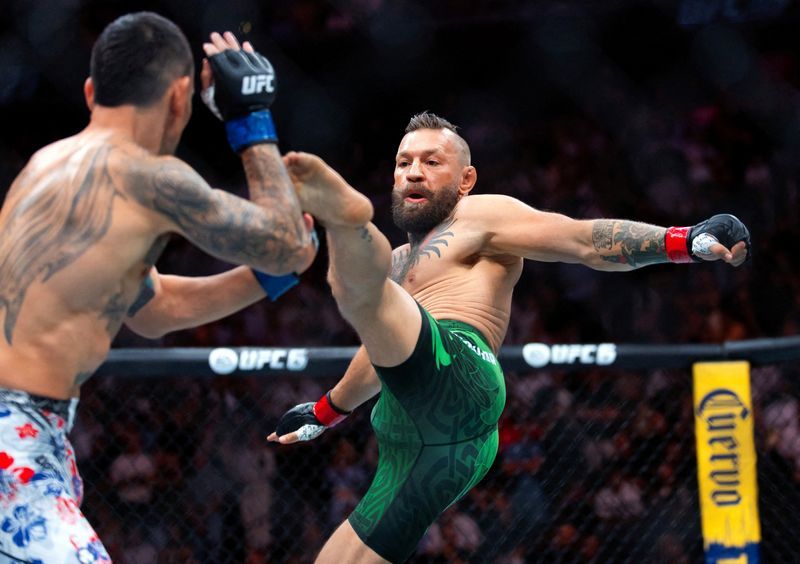
Conor McGregor's highly publicized return to mixed martial arts competition came to an abrupt end after just 69 seconds on Saturday night in Las Vegas, when the Irish fighter suffered a severe knee injury that forced him to withdraw from his bout with Max Holloway. The incident occurred in the opening moments of the fight when McGregor landed awkwardly while executing a jump kick, immediately compromising his ability to continue. Though he attempted to remain engaged for several additional seconds, McGregor quickly signalled to the referee that he was unable to proceed, bringing his long-awaited comeback to a disappointing conclusion.
Following the injury, McGregor took to Instagram to address his supporters and outline his immediate plans, adopting an optimistic tone despite the setback. The 37-year-old former two-weight champion confirmed that he will pursue surgical intervention to address the damage sustained during the brief encounter with Holloway. Beyond the operating table, McGregor indicated his intention to engage in rehabilitation exercises and pre-fight conditioning work before resuming formal martial arts training. His message suggested a commitment to returning to active competition, with particular reference to what he characterised as his final contractual obligation to the Ultimate Fighting Championship.
This latest injury represents another significant interruption in McGregor's competitive timeline, which has been marked by an unfortunate pattern of setbacks both inside and outside the octagon. Five years prior, the Irish fighter experienced a compound leg fracture during his contest against Dustin Poirier, an injury that substantially delayed his return to action. A scheduled meeting with Michael Chandler was originally arranged for June 2024, but those plans dissolved when McGregor sustained a broken toe during training sessions in preparation for that engagement.
Beyond physical injuries, McGregor has contended with substantial personal and legal complications that have further disrupted his career trajectory. In 2023, a jury in an Irish civil court determined that McGregor bore liability in connection with allegations of sexual assault against Nikita Hand, a case stemming from events in 2018. This legal judgment carried significant reputational consequences and added to the mounting list of circumstances that have interfered with his professional advancement in recent years.
Additionally, McGregor faced disciplinary action from anti-doping authorities, which imposed an 18-month suspension for what were characterized as whereabouts failures. The violation occurred after the fighter missed three separate testing collection attempts by Combat Sports Anti-Doping throughout 2024. The ban was retroactively applied and ultimately expired in March of this year, clearing the way theoretically for his recent comeback attempt against Holloway.
For Malaysian and Southeast Asian sports enthusiasts, McGregor's struggles highlight the volatile nature of professional combat sports careers, where physical resilience must be complemented by consistent availability and personal conduct standards. The regional mixed martial arts community, which has grown substantially with fighters from countries including Thailand, Malaysia, and Singapore gaining prominence on international stages, observes closely how established athletes navigate career disruptions and manage public perceptions during extended absences.
McGregor's situation also underscores the complex intersection between elite athlete performance and the broader regulatory frameworks governing modern combat sports. Anti-doping protocols, whereabouts requirements, and testing procedures represent significant administrative dimensions that athletes must navigate alongside their training and competition schedules. The consequences of non-compliance can be substantial, as McGregor discovered when his missed testing opportunities resulted in formal sanctions despite his eventual eligibility return.
The financial implications of McGregor's injuries and contractual situation warrant consideration as well. The fighter's stated intention to complete his final contracted obligation to the UFC suggests that his relationship with the organization may be approaching a conclusion. Each injury, legal complication, and suspension reduces the number of opportunities available to him within the current arrangement, potentially affecting both career legacy and earning potential during these final contractual performances.
Looking forward, McGregor's recovery trajectory will be closely monitored not only by UFC officials and fans but also by competitors and observers within the regional martial arts scene who regard his career as instructive regarding longevity, comeback potential, and institutional management of aging champion fighters. The rehabilitation process from knee injuries typically extends over many months even after surgical intervention, suggesting that any return to competitive action would likely occur well into late 2025 or beyond.

