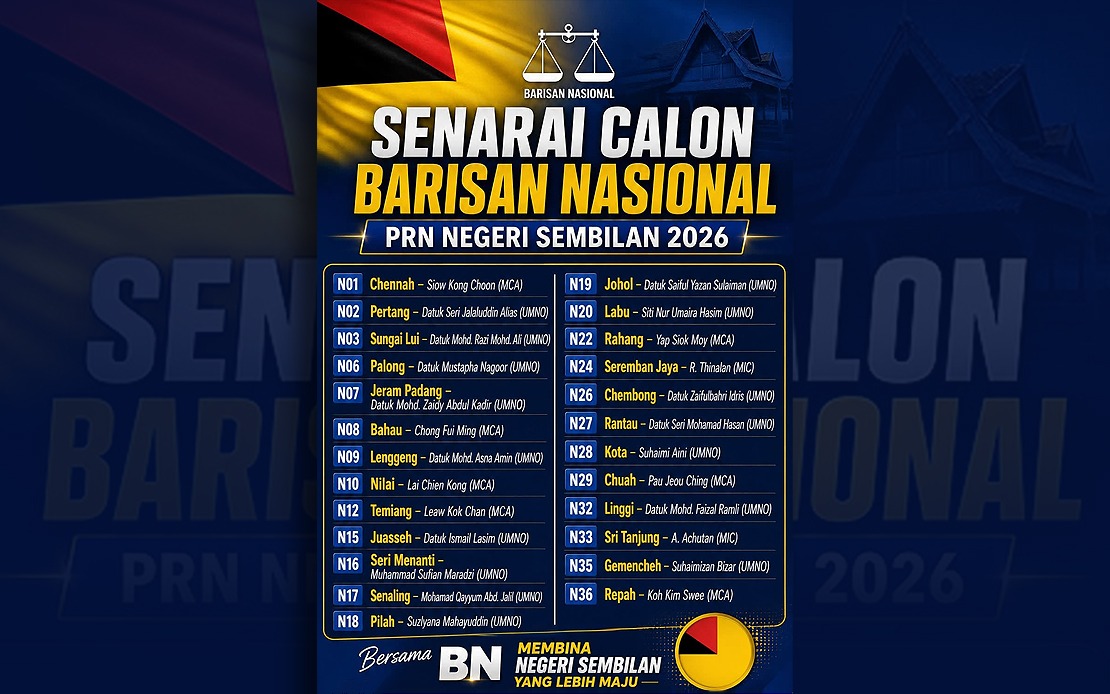
Barisan Nasional's leadership has finalised its candidate strategy for the upcoming Negeri Sembilan state election, with component parties MCA and MIC securing specific seat allocations that reflect their perceived electoral strengths across the state's constituencies. BN chairman Datuk Seri Dr Ahmad Zahid Hamidi, who simultaneously holds the position of Deputy Prime Minister, disclosed that MCA would field candidates in seven State Legislative Assembly seats, while MIC would contest four, following deliberations among the coalition's senior figures and party representatives.
The seat distribution mechanism employed by BN prioritises what party leadership terms the "projected potential victory" of individual candidates within their respective constituencies. This formula-based approach represents standard practice within the coalition structure, designed to optimise the coalition's overall performance by positioning candidates in areas where electoral data and ground assessments suggest the strongest likelihood of success. Such calculations typically incorporate factors including incumbent performance, demographic shifts, local sentiment analysis, and individual candidate profiles compiled through party machinery.
Ahmad Zahid held a comprehensive meeting with prospective BN candidates at Wisma UMNO Negeri Sembilan, during which attendees were required to sign undertakings and formally pledge their allegiance to him as BN chairman. These procedural requirements serve multiple functions within BN's internal governance framework, establishing clear chains of command and ensuring party discipline ahead of the campaign period. The Deputy Prime Minister characterised such processes as routine practice preceding state elections, by-elections, and general elections, emphasising their standardised nature within Malaysia's electoral ecosystem.
The formal announcement of BN's complete candidate slate was scheduled for later the same day at Stadium Tuanku Abdul Rahman Paroi in Seremban, where party officials would present the full list of nominees to assembled party members and media representatives. This timing reflects strategic campaign planning, as early public disclosure of candidates allows organisations to mobilise grassroots support networks and establish name recognition ahead of the official nomination period.
The Election Commission has established a structured timeline for the state election process. Nomination day is set for July 18, providing a defined window for candidates to formally lodge their applications. Early voting opportunities for eligible voters are scheduled for July 28, accommodating working voters, members of the armed forces, and others requiring flexible voting arrangements. The main polling day is fixed for August 1, concluding the electoral calendar with the determination of Negeri Sembilan's next state government.
Context surrounding this election derives partly from the performance of competing coalitions in the previous state election cycle. In the 15th Negeri Sembilan state election, BN secured 14 state assembly seats, establishing a significant but minority position within the legislature. Pakatan Harapan demonstrated stronger electoral performance, winning 17 seats and positioning itself as the dominant coalition. Perikatan Nasional captured five seats, establishing itself as a meaningful third force in state politics. The arithmetic from this previous contest indicates that BN faces an uphill challenge if it seeks to regain majority control, necessitating either substantial electoral gains or coalition arrangements with other political forces.
For Malaysian observers, the allocation of seats to component parties within BN carries implications beyond Negeri Sembilan's boundaries. MCA's seven-seat allocation represents the party's continuing role within the coalition despite broader challenges facing the party among Malaysia's Chinese-majority communities in recent years. The Chinese-majority party has experienced electoral volatility in consecutive national elections, and state-level contests provide testing grounds for party messaging and organisational effectiveness. Similarly, MIC's four-seat allocation reflects the party's position as the coalition's representative of Malaysia's Indian-majority communities, a demographic constituency whose voting patterns have shifted in recent electoral cycles.
The seat allocation methodology also reveals calculations about constituency competitiveness across Negeri Sembilan. Not all of the state's State Legislative Assembly seats have been allocated to BN component parties in this announcement, implying that UMNO will contest the remaining constituencies. This distribution suggests party leadership assessments about which areas offer the strongest prospects for each component party, based on accumulated electoral experience and current ground conditions. Constituencies allocated to MCA and MIC presumably include areas with substantial Chinese and Indian-majority populations respectively, though the specific seats were not disclosed in the announcement.
For Southeast Asian context, Negeri Sembilan's election occurs within Malaysia's broader political environment shaped by recent electoral fluctuations and coalition repositioning. The contest represents one in a series of state-level elections allowing major coalitions and parties to test political messaging, organisational capacity, and policy platforms at the sub-national level. Results from Negeri Sembilan could influence broader calculations about national political trajectories and coalition viability.
The requirement for candidates to pledge allegiance to the BN chairman underscores party discipline mechanisms within Malaysia's coalition system. Such undertakings serve to establish clear expectations regarding campaign conduct, adherence to party directives, and post-election parliamentary or state assembly behaviour. These commitments facilitate coalition cohesion during campaigns and subsequent parliamentary sessions, reducing the likelihood of candidates operating independently or crossing to rival coalitions after elections.
As campaigning intensifies toward polling day on August 1, BN's campaign will emphasise the credentials and track records of its component parties' candidates. MCA will likely spotlight policy positions appealing to Malaysian Chinese voters, particularly regarding education, business opportunities, and community development. MIC will focus on issues affecting Indian-majority communities, including economic opportunities and social infrastructure. The simultaneous campaigns of multiple component parties within a single coalition structure requires coordination to prevent contradictory messaging while allowing each party distinct platform positions.

