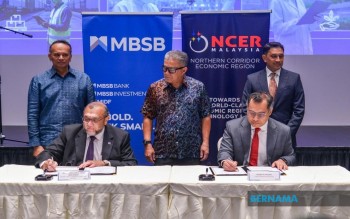
A significant financial partnership has emerged to accelerate business growth across Malaysia's Northern Corridor region. MBSB Bank Bhd and the Northern Corridor Implementation Authority (NCIA) formalized their collaboration through a memorandum of understanding on July 17, establishing a RM1 billion financing facility designed to catalyse expansion among small and medium enterprises operating within the Northern Corridor Economic Region (NCER). The agreement, signed at a ceremony in Petaling Jaya, represents a strategic alignment between banking services and regional economic development infrastructure, with potential implications for how capital flows to underutilized markets across Perlis, Kedah, Penang and Perak.
The financing initiative addresses a persistent challenge facing Malaysian SMEs: access to adequate capital for growth and market expansion. According to MBSB Bank chairman Datuk Wan Kamaruzaman Wan Ahmad, the RM1 billion fund will enable businesses to scale operations, integrate into complex supply chains, and strengthen their contribution to the Northern region's economic trajectory. This framing positions SME expansion not merely as individual business success but as a building block for systemic economic development across one of Malaysia's most strategically positioned corridors. The Northern region's geographic proximity to Thailand and its historical role as an agricultural and light manufacturing hub present distinct opportunities for enterprises willing to upgrade their capabilities and market orientation.
The collaboration pairs traditional banking capabilities with strategic investment guidance, a formula increasingly adopted across Southeast Asia to direct capital toward priority sectors. MBSB Bank group chief commercial banking officer Noor Mohamed Amin and NCIA chief operating officer Hasri A Hassan executed the formal agreement, signalling institutional commitment from both organisations. The structure reflects a growing recognition among Malaysian policymakers that SME growth depends not only on capital availability but also on alignment with broader economic planning priorities and international market linkages.
A distinctive element of the partnership involves MBSB Bank's existing arrangement with the Santander Group, a major European banking consortium. This connection creates a potential export acceleration pathway for participating firms. MBSB Bank group chief executive officer Rafe Haneef explicitly identified export-oriented SMEs as priority beneficiaries, suggesting the facility targets companies with demonstrated capacity or ambition to serve international customers. By leveraging Santander's established networks and market intelligence, MBSB Bank can offer Northern region enterprises more than capital alone—they gain access to tested platforms for expanding beyond domestic markets. This layered approach to SME support recognises that many Malaysian small businesses struggle less with initial financing than with market identification and entry strategies for foreign sales.
The agreement strategically aligns financing with NCER's declared economic priorities. NCIA chief executive Datuk Mohamad Haris Kader Sultan identified six sectors as foundational to the region's development pathway: electrical and electronics (E&E), advanced manufacturing, agri-food, logistics, digital economy and green technology. These selections reflect Malaysia's broader manufacturing competitiveness concerns and the government's commitment to sustainability. The E&E and advanced manufacturing sectors, particularly, depend on supply chain sophistication and technological capability that capital alone cannot generate. Yet targeted financing can enable capability investments—automation, skills development, quality certification—that position Northern region manufacturers for participation in higher-value production networks.
The Northern Corridor's economic profile reveals why this partnership carries significance beyond press releases. The region has increasingly attracted foreign direct investment and positioned itself as one of Malaysia's faster-expanding economic zones. Penang's established electronics clusters, Kedah's agricultural modernisation initiatives, and Perak's manufacturing base provide foundation assets. However, these regions historically struggle with SME participation in high-value supply chains. Many Northern region small businesses remain concentrated in lower-margin activities. The RM1 billion facility, should it deploy effectively, could shift this dynamic by reducing capital constraints that prevent capability upgrades.
The timing of this partnership reflects broader policy currents embedded in Malaysia's 13th Malaysia Plan. NCIA chief executive Haris Kader Sultan explicitly referenced this planning framework, indicating the partnership aligns with government priorities and likely receives supportive policy treatment. The 13th Malaysia Plan emphasises inclusive growth, regional development beyond the Klang Valley and Iskandar regions, and digital economy integration. An MBSB Bank-NCIA partnership advancing SME access to capital directly serves these objectives. Policymakers increasingly recognise that regional development cannot rely solely on multinational investment attraction; sustainable growth requires embedding local businesses into expanded economic opportunities.
For Malaysian SMEs in the Northern region, the partnership creates new financing pathways previously limited by geographic disadvantage. SMEs outside major financial centres often face higher borrowing costs and greater difficulty accessing large credit facilities. MBSB Bank's established relationship with NCIA reduces information asymmetries and transaction costs for both lender and borrower. A SME in Alor Setar or Ipoh seeking RM500,000 to upgrade manufacturing equipment or establish logistics operations encounters less institutional friction through this partnership than through traditional commercial banking channels. The financing need not be structured for immediate returns; NCIA's presence signals patient capital aligned with long-term regional development.
The logistics sector represents a particularly compelling opportunity for this partnership. The Northern region, proximate to Thailand and serving as a transport corridor toward southern Thailand and Southeast Asian markets, possesses natural advantages for logistics growth. Capital constraints often prevent small logistics operators from investing in modern facilities, tracking systems, and capacity expansion. The RM1 billion facility, if effectively marketed to logistics SMEs, could unlock supply chain improvements benefiting entire industries. Similarly, agri-food businesses—particularly those pursuing export certification and value addition—depend on capital for processing facilities, cold chains, and quality infrastructure. A SME producing organic agricultural products or processed food items faces competitive disadvantages without these investments.
The partnership's success depends substantially on execution and marketing. MBSB Bank must establish accessible application pathways for SMEs unfamiliar with formal financing processes. NCIA must communicate the facility's availability and terms to dispersed small business communities across four states. Historical experience with similar programmes reveals that administrative complexity and unclear eligibility criteria often prevent intended beneficiaries from accessing dedicated funds. The memorandum of understanding commits both parties to collaboration, but translating this commitment into deployed capital requires sustained attention to SME engagement and streamlined lending processes.
Looking forward, this partnership creates potential templates for other Malaysian regions. The Corridor approach to regional development has gained currency across Southeast Asia, with similar frameworks emerging in Indonesia and Thailand. Malaysia's investment in dedicated financing for Northern Corridor SMEs could provide evidence regarding whether targeted credit facilities effectively support regional economic diversification. If successful, similar partnerships might follow in East Coast and Sabah-Sarawak corridors, creating more geographically dispersed capital access. Conversely, limited uptake or deployment would suggest that SME growth requires more fundamental interventions beyond financing access.
The MBSB Bank-NCIA partnership also carries implications for Malaysia's broader SME financing landscape. The banking sector has increasingly retreated from small business lending, viewing it as higher-risk and lower-margin. Dedicated facilities partnered with development authorities represent a policy response to this market gap. MBSB Bank's participation signals that some Malaysian financial institutions recognise strategic value in underserved markets. The Santander partnership adds an international dimension, suggesting that European financial institutions see growth potential in Southeast Asian SME markets, particularly those positioned to serve export-oriented manufacturing and logistics networks.
Ultimately, the RM1 billion facility's impact will be measured not in its announcement but in its deployment. The Northern region possesses latent capability waiting for catalytic capital. Businesses across Perlis, Kedah, Penang and Perak operate with constrained growth trajectories, often unable to invest in the capability and technology upgrades that would unlock market opportunities. If MBSB Bank and NCIA successfully channel this funding toward genuine capability development and market integration, the partnership could materially reshape Northern region economic dynamics. The coming months will reveal whether this memorandum of understanding translates into sustained capital deployment or becomes another development initiative with limited practical impact.

