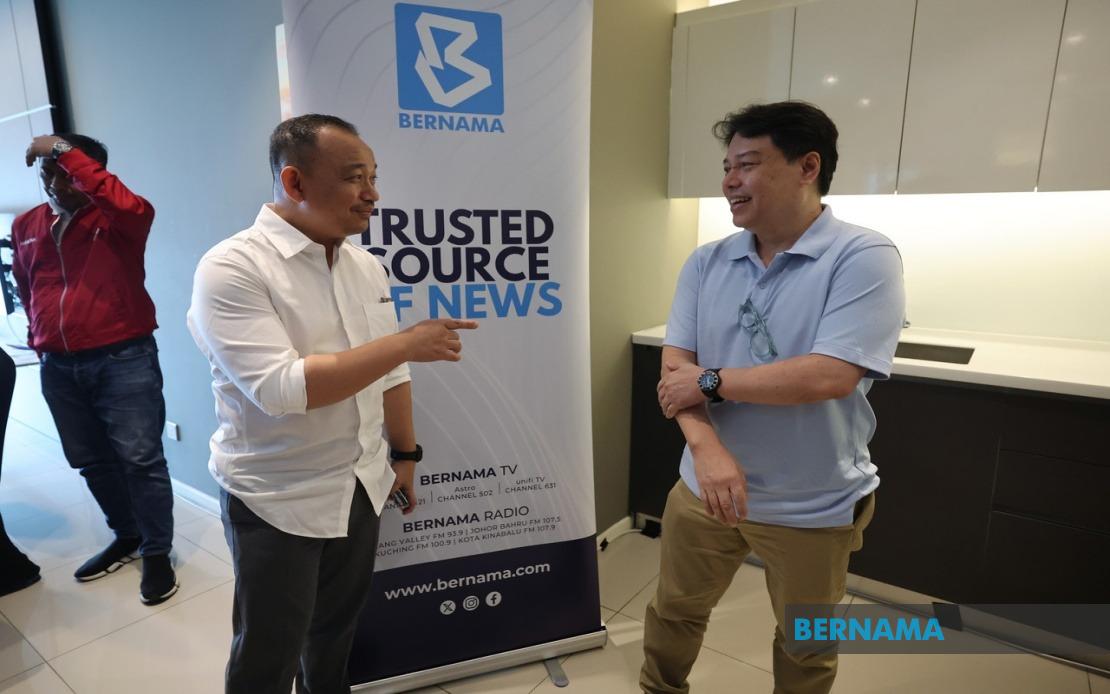
In a move designed to demonstrate his responsiveness to community concerns, Maszlee Malik, the Pakatan Harapan candidate contesting the Puteri Wangsa state seat, accepted a social media challenge to drive a Perodua Myvi across roads he had previously only discussed theoretically. The journey from Kampung Melayu Tebrau through Pandan, Kangkar Tebrau, and onwards to Ulu Tiram served as more than political theatre—it offered the former federal education minister and Simpang Renggam parliamentarian an unfiltered encounter with the infrastructure grievances that have dominated local discourse for years.
The test drive route encompassed several areas where residents have persistently complained about deteriorating road surfaces and chronic congestion. Rather than rely on briefing documents or constituent feedback, Maszlee positioned his personal experience behind the wheel as the foundation for understanding what ordinary motorists endure during their daily commutes. This approach resonates particularly in Johor, where infrastructure development has frequently lagged behind rapid urbanisation, leaving pockets of the state with roads that fail to meet the demands placed upon them by modern traffic volumes.
Maszlee's vivid description of his experience revealed both the physical reality and psychological impact of navigating these routes. He compared the sensation of driving over the uneven surfaces to riding in a traditional wooden boat at Tanjung Surat, complete with constant swaying and jolting that would test even the sturdy reputation of the Myvi. Such metaphors might seem colourful, but they encapsulate a genuine quality-of-life issue that extends beyond mere inconvenience—poor road conditions accelerate vehicle wear, increase accident risk, and add immeasurable frustration to already lengthy commutes.
The traffic congestion element featured prominently in Maszlee's observations, particularly regarding peak-hour gridlock in localities such as Taman Daya, Taman Pelangi Indah, and surrounding Tebrau areas. He identified a pattern familiar to urban planners across Malaysia and Southeast Asia: rapid residential and commercial development that outpaced corresponding investments in road networks and traffic management infrastructure. This mismatch between growth and capacity planning has created bottlenecks that no amount of individual behaviour modification can resolve without systemic intervention.
Maszlee's analysis attributed much of this dysfunction to insufficient coordination between different government agencies and inadequate strategic urban planning at the municipal level. He highlighted the need for closer collaboration with the Public Works Department (JKR), urban planners, and other stakeholders—an acknowledgment that infrastructure challenges cannot be solved through electoral promises alone but require sustained institutional cooperation. This observation carries weight given his previous service as a federal minister, positioning him as someone with direct experience navigating bureaucratic processes and inter-agency dynamics.
The candidate framed infrastructure renewal as a long-term proposition demanding comprehensive planning rather than quick fixes. This realistic assessment distinguishes his position from more populist approaches that promise immediate solutions to problems accumulated over decades. However, it also places Maszlee on notice: voters will measure his commitment not merely by his stated intentions but by concrete progress in the months following any election victory.
Maszlee emphasised that his approach, if granted the electoral mandate, would prioritise listening to residents before establishing priorities and formulating solutions. This citizen-centred methodology aligns with broader trends in Malaysian politics where candidates increasingly recognise that top-down policy implementation without genuine community engagement produces poor outcomes. The Puteri Wangsa constituency, with 128,723 registered voters, represents a substantial population whose infrastructure concerns cannot be dismissed as peripheral electoral issues.
The Puteri Wangsa state seat will feature a competitive five-way contest in the July 11 Johor state election. Beyond Maszlee, voters will choose between Rashifa Aljunied representing MUDA, Teow Chia Ling from Barisan Nasional, Nicholas Paul Vincent of Parti Bersama Malaysia, and independent candidate Wang Wee Siong. This fragmented field suggests that infrastructure quality and responsive governance could prove decisive factors in determining which candidate captures the seat, particularly if dissatisfaction with current conditions translates into voting patterns.
Early voting for the Johor state election commenced on July 7, with the main polling day scheduled for July 11. The timing presents candidates with limited opportunity to convert campaign activities into electoral support, making Maszlee's on-the-ground infrastructure tour a calculated effort to generate momentum in the final campaign phase. The stunt's effectiveness ultimately depends on whether voters perceive it as evidence of genuine commitment or merely strategic positioning ahead of polling day.
For Malaysian voters across Johor and beyond, the Maszlee Malik test drive illustrates a broader tension within electoral politics: the gap between understanding problems and solving them. Infrastructure failures represent concrete, measurable grievances that resist spin or rhetorical flourish. A politician willing to physically experience these conditions and publicly acknowledge their severity at least demonstrates the awareness necessary for eventual remediation. Whether such awareness translates into effective governance depends on factors extending far beyond individual candidate virtue, encompassing budgetary constraints, institutional capacity, and political will at multiple governance levels.

