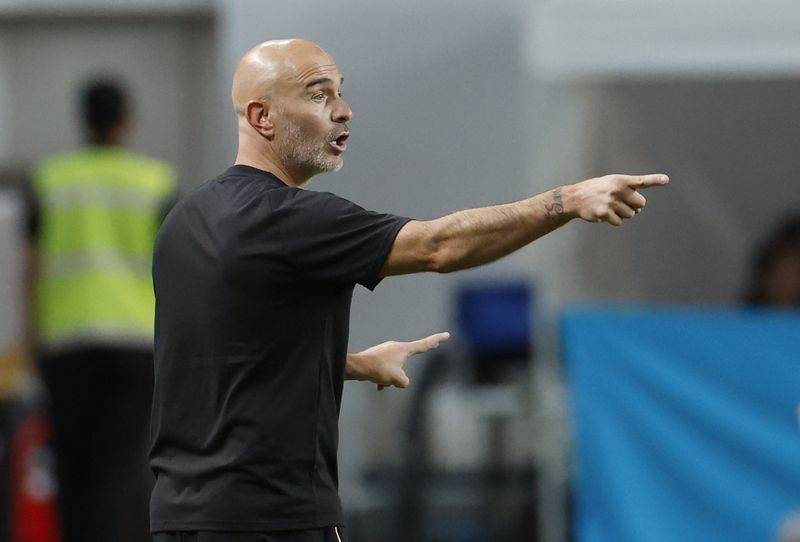
Manchester City enters uncharted territory this season without Pep Guardiola directing operations from the technical area for the first time in a decade. The Spanish tactician's exit marks the conclusion of the most prosperous period in the club's modern history, a tenure distinguished by six domestic league championships, continental glory in Europe, and the transformation of City into English football's preeminent force. Now the responsibility for maintaining that supremacy falls to Enzo Maresca, an appointment that reflects the club's deliberate choice to pursue evolutionary rather than revolutionary change during this critical transition.
Maresca's elevation to the Manchester City position carries particular resonance given his existing familiarity with the club's ecosystem. The 46-year-old Italian has previously worked within City's organisational structure, having served as a member of Guardiola's coaching apparatus during the treble-winning campaign that crowned the club as champions of England, the FA Cup, and the Champions League. This insider experience proved decisive in City's recruitment thinking, though his credentials as a standalone manager are equally impressive. Before returning to Manchester, Maresca orchestrated Leicester City's promotion back to the Premier League and secured silverware during his tenure at Chelsea, accomplishments that demonstrated his capability to lead ambitious projects.
The philosophical foundation underlying City's managerial transition reveals much about how the club interprets its future direction. Rather than dismantling Guardiola's established tactical framework, the hierarchy has deliberately appointed someone embedded in the positional play, ball circulation patterns, and tactical malleability that sustained their competitive advantage throughout the previous decade. This calculated continuity reflects confidence that the underlying principles remain sound and transferable, rather than being inseparable from one individual. Nonetheless, Maresca cannot simply replicate his predecessor's methods; establishing a distinct managerial identity while preserving successful structures represents perhaps the central psychological challenge of his first season.
The playing personnel Maresca has inherited constitute one of Europe's most formidable collections of talent. Erling Haaland, the Norway international whose goal-scoring prowess has generated league-leading tallies in three of the previous four seasons, provides a guaranteed source of firepower that eliminates the primary vulnerability many ambitious teams face. Rodri, the Spanish midfielder whose contributions to possession dominance, positional awareness, and defensive positioning have become emblematic of City's playing style, anchors the team's structural integrity. Rodri's achievements extend beyond club football; his instrumental role in Spain's recent World Cup triumph earned him the tournament's Golden Ball, confirming his status among global football's elite operators.
Summer recruitment has further bolstered City's midfield infrastructure through the acquisition of Elliot Anderson from Nottingham Forest in a transaction valued at £116 million. The England international brings ball-winning capacity, physical presence, and compositional depth to the central zones, attributes that address practical squad requirements. Beyond established names, emerging personalities such as Rayan Cherki and Nico O'Reilly represent reserves of untapped potential and organisational vitality. These younger elements could catalyse a refreshed tactical approach while retaining philosophical continuity.
Yet alongside these acquisitions and developmental prospects, City has experienced notable departures that carry organisational consequences. Long-serving defenders including John Stones, alongside Bernardo Silva's exit, represent departures of experienced voices whose presence in the dressing room extended beyond their tactical contributions. The loss of accumulated institutional knowledge and leadership influence in the changing room adds complexity to Maresca's management task, particularly when navigating the personal dynamics and psychological preparation that extend beyond tactical instruction. These transitions are seldom reflected in statistical analysis but frequently prove decisive in determining whether squads maintain cohesion through demanding campaigns.
Guardiola's final season underscores the exacting standards that City's ownership and supporter base have internalised during his tenure. Domestically, the club secured both cup competitions available to them, achievements that would constitute landmark success for most professional organisations. Yet finishing runners-up to Arsenal in the Premier League title race generated palpable disappointment within the club, a response that crystallises how fundamentally Guardiola transformed expectations at the Etihad. Maresca will be measured not merely on stylistic preferences or tactical coherence but on immediate championship aspiration. The hierarchy expects a title challenge, not a transitional reconstruction, establishing an unforgiving evaluation framework for the new management.
The adaptation challenge confronting both Maresca and the squad transcends tactical adjustments and player deployment. Guardiola's influence permeated the organisational culture, shaping institutional values, daily methodologies, and collective identity in ways that extended far beyond technical football instruction. His departure creates a vacuum that extends into spheres of club management typically underestimated by external observers. While Maresca's previous experience within City's environment should facilitate smoother transition than a purely external appointment would achieve, the distinction between functioning as a trusted lieutenant and independently directing a globally significant organisation represents a profound escalation in responsibility and autonomy. His familiarity provides advantage but not immunity from the fundamental test of leadership.
Integration difficulties may temporarily affect City's performance trajectory, particularly given the logistical reality that numerous players will return to pre-season preparations later than usual following international competition commitments. Such factors historically generate minor adjustment periods as squads rebuild synchronisation and managers implement new operational procedures. However, City's competitive standing remains formidable despite these transitional considerations. The club retains the financial resources, playing personnel, institutional infrastructure, and talent development systems to remain genuine contenders across all competitions. If Maresca successfully synthesises continuity with sufficient tactical innovation to invigorate a squad conditioned by years under singular managerial direction, the pathway toward championship restoration remains distinctly achievable.
The forthcoming Bournemouth fixture on August 23 will provide early indicators of how comprehensively Maresca has imprinted his directional vision while maintaining the foundational principles City developed under Guardiola. This opening contest offers the new manager an opportunity to communicate priorities through on-pitch selection and tactical configuration, establishing psychological momentum as the campaign unfolds. The coming months will determine whether the transition from one era to another becomes a seamless continuation or a more turbulent recalibration for one of European football's most successful contemporary organisations.

