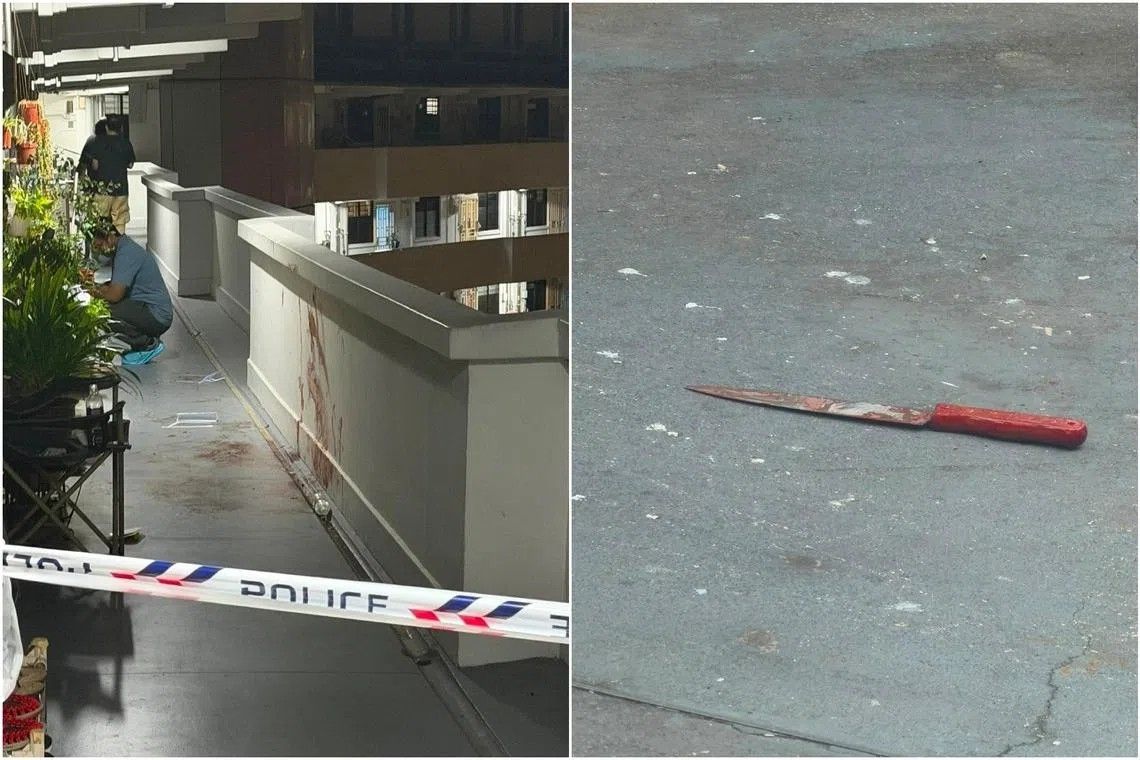
A 59-year-old Singapore resident has been formally charged with the murder of his neighbour following an incident at Block 55 Lengkok Bahru, located near Redhill Road, on July 20. Ng Swee Seng made his initial court appearance on July 22 via video link before a district court, where he was accused of unlawfully causing the death of Thiyagarajan Karunakaran, also 59 years old. The charge marks the beginning of what promises to be a high-profile criminal proceeding that has shaken the typically quiet residential community.
Police received multiple emergency calls shortly before 5 in the afternoon on the day of the incident, prompting a rapid response to the HDB block in the Redhill area. Upon arrival, responding officers discovered Thiyagarajan lying unresponsive in the lift lobby situated on the 16th floor of the building. Emergency medical services were immediately summoned, and the victim was transported to the National University Hospital for emergency treatment. Despite the rapid intervention, Thiyagarajan succumbed to his injuries and was pronounced dead at the hospital, bringing an end to what neighbours would later describe as a routine Tuesday afternoon.
Investigators visiting the scene on July 21 found stark evidence of the violence that had unfolded. Bloodstains were observed along the 16th-floor corridor, with a particularly telling bloodied footprint marking the pathway between where the victim was found and the surrounding area. The physical evidence suggested a struggle or altercation had taken place before Thiyagarajan collapsed in the lift lobby. These crime scene details would later form crucial components of the prosecution's case against Ng Swee Seng.
The two men, despite living in relatively close proximity within the same residential block, inhabited separate units on the identical floor. One resident who has occupied the block for approximately four years told journalists that the accused and the victim resided several units apart from each other, indicating that their living spaces were separated by at least several neighbouring households. This spatial arrangement raises questions about how a fatal dispute between neighbouring residents could escalate so dramatically, and whether there had been prior tensions or disputes between the two men.
For Malaysian readers and the broader Southeast Asian community, this incident underscores a concerning trend of interpersonal violence erupting within residential environments across the region. High-density public housing blocks, common throughout Malaysia and Singapore, concentrate large populations in relatively confined spaces, occasionally creating friction points between neighbours. The case serves as a sobering reminder of how domestic disputes or neighbourhood conflicts can tragically cross the threshold into violent criminality, transforming ordinary residential buildings into crime scenes.
The circumstances that precipitated the fatal encounter remain unclear at this stage of the investigation. Whether the altercation stemmed from long-standing neighbourhood grievances, a spontaneous disagreement, or other motivations has not yet been disclosed by authorities. Such details typically emerge during preliminary investigations and court proceedings as the prosecution builds its case and the defence prepares its response.
This incident carries particular significance within Singapore's context, where violent crime within residential spaces remains relatively uncommon compared to other urban centres. The public nature of the killing—occurring in a communal lift lobby rather than behind closed doors—suggests either an explosive confrontation or circumstances that escalated rapidly in a shared community space. For residents of HDB blocks across Singapore and Malaysia alike, such incidents provoke anxiety about personal safety and the security of shared residential facilities.
The formal murder charge against Ng Swee Seng indicates that investigators have gathered sufficient evidence to support the allegation that he deliberately caused Thiyagarajan's death rather than injuries sustained accidentally or through lesser levels of force. In Singapore's legal framework, such charges carry severe potential penalties upon conviction, reflecting the gravity with which the jurisdiction treats the unlawful taking of human life.
As the case progresses through Singapore's court system, further details regarding the relationship between the two men, any history of disputes, and the specific circumstances that led to the confrontation will likely emerge. For residents across Singapore and Malaysia living in multi-unit residential buildings, the case serves as a cautionary tale about the importance of neighbourhood civility and the potential consequences when conflicts between residents escalate unchecked.

