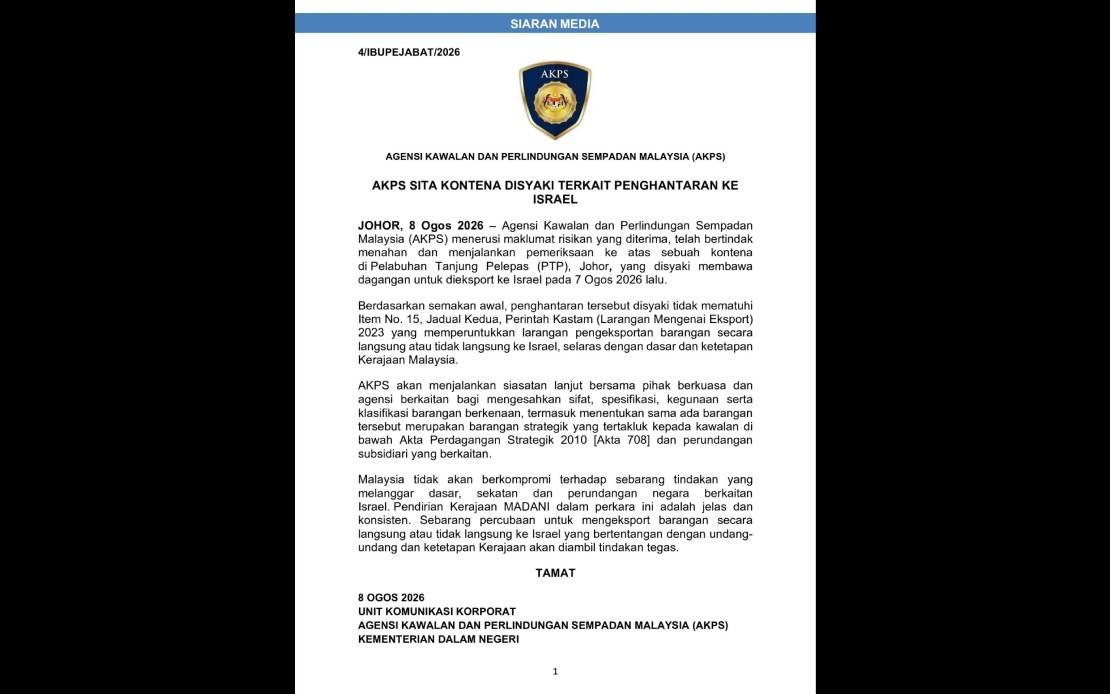
Prime Minister Datuk Seri Anwar Ibrahim has commended the Malaysian Border Control and Protection Agency (AKPS) for its decisive interception of a container believed to hold strategic materials destined for Israel at the Port of Tanjung Pelepas in Johor. The seizure, executed on August 7, underscores Malaysia's unwavering commitment to preventing the country from serving as a commercial conduit for trade that could facilitate or sustain what the government characterizes as Israeli regime activities against Palestinian populations. Through a statement shared on social media, Anwar framed the agency's actions as emblematic of Malaysia's broader diplomatic and ethical positioning on Middle Eastern geopolitical matters.
The interception represents a tangible enforcement mechanism supporting Malaysia's longstanding policy framework on Palestinian rights advocacy. By preventing the shipment from reaching its intended destination, authorities demonstrated operational capacity to monitor and intercept goods that contravene national trade regulations. This enforcement action gains particular significance against the backdrop of Malaysia's historical solidarity rhetoric with Palestinian causes and its regional leadership role in articulating perspectives sympathetic to Palestinian statehood and self-determination claims.
According to the AKPS statement, the detained shipment violated Item No. 15 of the Second Schedule of the Customs (Prohibition of Exports) Order 2023, a legal instrument that explicitly forbids direct or indirect export of merchandise to Israel. This regulatory framework reflects policy decisions made by Malaysian policymakers and demonstrates the government's intention to translate rhetorical commitments into enforceable legal restrictions on commercial activity. The specificity of the violation suggests customs authorities have developed operational protocols for identifying Israel-bound shipments and intervening before cargo leaves Malaysian jurisdiction.
Prime Minister Anwar emphasized that this regulatory enforcement aligns with Malaysia's participation in The Hague Group, an international coalition addressing collective concerns about Israeli policies and their humanitarian dimensions. This connection to multilateral initiatives suggests Malaysia views its domestic trade restrictions not as isolated unilateral measures but rather as contributions to a coordinated international position on Palestinian rights. By positioning Malaysia within a broader diplomatic framework, the government signals that its approach reflects consensus-building among like-minded nations rather than idiosyncratic national policy.
The government has maintained an embargo on Israeli shipping since December 2023, prohibiting Israeli-flagged vessels and ships transporting cargo to Israel from utilizing Malaysian ports and maritime infrastructure. This blanket prohibition on direct Israeli maritime commerce represents a more comprehensive measure than the selective cargo restrictions, effectively isolating Israeli shipping from one of Southeast Asia's major trading hubs. The combination of vessel-level bans and cargo-specific restrictions creates overlapping deterrents against Israeli commercial activity in Malaysian territorial waters.
Anwar's statement articulated Malaysia's positioning as a guardian of international humanitarian principles and international law as it pertains to Palestinian claims and dignity. By framing the seizure within this broader normative context, the Prime Minister elevated the incident beyond a routine customs enforcement operation into a statement of principle about Malaysia's values and international commitments. This rhetorical framing serves multiple audiences simultaneously: domestic constituencies supportive of Palestinian causes, regional neighbors sharing similar sentiments, and the broader international community monitoring Malaysia's consistency in human rights advocacy.
The seizure operation itself reveals institutional capacity within Malaysia's customs and border protection apparatus to detect and intercept goods destined for Israel. This suggests either enhanced intelligence-gathering capabilities regarding shipping routes and cargo manifests, or alternatively, increased scrutiny of suspicious shipments at ports of departure. The specificity with which AKPS identified the container as carrying strategic goods destined for Israel indicates either documentary evidence in shipping records or intelligence from upstream sources. Such operational competence demonstrates that Malaysia's trade restrictions represent enforceable policy rather than symbolic gestures.
For Malaysian businesses engaged in international commerce, the incident reinforces the regulatory environment surrounding Israeli-linked trade. Exporters must conduct due diligence on end-use destinations and remain aware that Malaysian authorities actively monitor shipments for Israel-bound cargo. This creates compliance burdens and potential commercial risks for traders who might inadvertently or deliberately seek to circumvent restrictions. The enforcement action serves as a warning that Malaysia's government takes these prohibitions seriously and possesses mechanisms to prevent violations.
The broader regional context illuminates why Malaysia maintains such explicit restrictions on Israeli trade. As a Southeast Asian nation with significant Muslim populations and historical commitments to the Non-Aligned Movement, Malaysia's Palestinian solidarity reflects both domestic constituency expectations and foreign policy positioning rooted in Cold War-era principles emphasizing support for anti-imperial, anti-colonial causes. Malaysia's restrictions thus represent continuity with longstanding diplomatic traditions rather than novel policy departures, though enforcement mechanisms may have intensified in recent years.
International observers monitoring Malaysian policy consistency note that such enforcement actions demonstrate the government's willingness to translate stated principles into material consequences. For countries and movements advocating Palestinian rights, Malaysia's seizures and port restrictions provide concrete evidence of official commitment beyond rhetorical declarations. Conversely, Israeli and Western trading partners observe Malaysia's determination to maintain these barriers despite potential economic costs, suggesting deep institutional commitment to the policy direction.
The incident also touches on broader questions about the relationship between national sovereignty, international law, and unilateral economic sanctions. Malaysia argues its restrictions serve international law by preventing support for activities it deems incompatible with humanitarian principles. This framing positions Malaysia as upholding rather than violating international legal norms, though perspectives differ regarding whether unilateral trade restrictions constitute legitimate expressions of national policy or problematic circumventions of World Trade Organization principles regarding non-discrimination in trade.
Looking forward, the seizure suggests Malaysia will likely maintain and potentially strengthen enforcement of its Israel-related trade restrictions. AKPS appears equipped with institutional resources and political mandate to continue monitoring Malaysian ports for non-compliant shipments. For the Malaysian shipping and logistics sector, ongoing compliance with these restrictions represents a permanent feature of the regulatory landscape requiring sustained attention and careful documentation practices.

