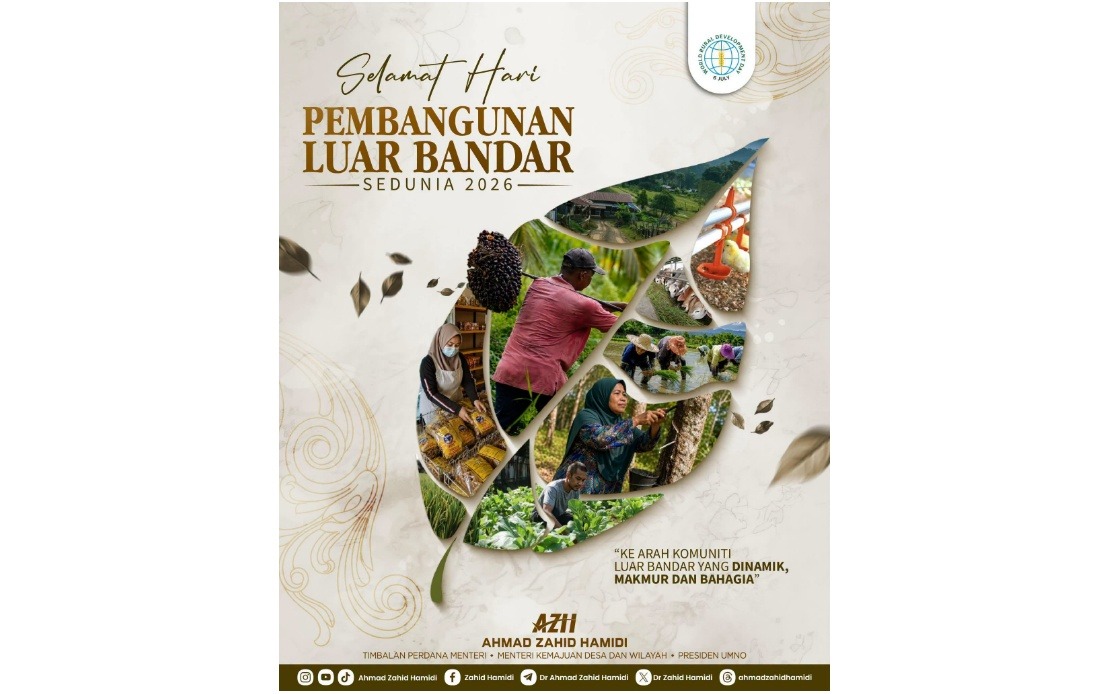
Malaysia has officially joined the global community in recognising the importance of rural development, marking its first-ever celebration of World Rural Development Day on July 6. The inaugural event, held at Tun Abdul Razak Stadium in Jengka near Maran, Pahang, represents a significant milestone for the nation's commitment to strengthening communities beyond urban centres. Deputy Prime Minister Datuk Seri Dr Ahmad Zahid Hamidi used the occasion to underscore the Ministry of Rural and Regional Development's (KKDW) pivotal responsibility in orchestrating comprehensive rural advancement across the country.
The selection of July 6 carries historical weight beyond its role as a commemorative date. Ahmad Zahid highlighted that the day coincides with the founding of the Centre on Integrated Rural Development for Asia and the Pacific (CIRDAP), an organisation that has shaped regional approaches to rural development for decades. This alignment signals Malaysia's intention to position itself within a broader Asian development narrative, leveraging decades of institutional knowledge and regional cooperation frameworks to inform its own strategies.
At its core, Malaysia's inaugural celebration addressed three foundational pillars intended to reshape rural prosperity. Community innovation serves as the first pillar, recognising that rural advancement cannot be imposed from above but must emerge from the creative energies and indigenous knowledge of farming communities themselves. The second pillar, rural digitalisation, acknowledges a critical gap in modern development—the digital divide that has left many rural areas disconnected from online commerce, digital services, and information access. The third pillar, rural entrepreneurship development, seeks to transform rural economies from purely extractive or subsistence-based models into dynamic entrepreneurial ecosystems where farmers and rural residents can establish competitive businesses.
The thematic focus of "Toward Vibrant, Prosperous and Happy Rural Communities" reflects an evolved understanding of rural development that extends beyond mere income generation. Vibrancy suggests cultural vitality and social engagement; prosperity encompasses economic security and opportunity; happiness acknowledges the quality-of-life dimensions that urban-centric policies often overlook. This holistic framing suggests that KKDW recognises rural communities not as problem zones requiring rescue but as integral components of national development deserving intentional investment and strategic attention.
Ahmad Zahid's positioning of July 6 as an annual platform carries practical implications for Malaysia's governance architecture. By establishing a dedicated observance day, the government creates a recurring focal point for policy review, stakeholder engagement, and public discourse around rural issues. This ceremonial recognition can drive institutional accountability, ensuring that rural development remains a consistent priority rather than fluctuating with political cycles or economic pressures. For rural communities, such visibility can translate into stronger advocacy leverage and clearer channels for communicating development needs to national leadership.
The location of the inaugural celebration in Pahang, a state with significant rural populations and agricultural heritage, was not arbitrary. Jengka represents a microcosm of Malaysian rural challenges—distance from metropolitan centres, reliance on traditional sectors, and infrastructure gaps—making it symbolically appropriate for launching a national rural development initiative. The choice signals that KKDW intends to engage with rural Malaysia authentically, rooted in specific community contexts rather than abstract urban perspectives.
Digitalisation emerges as perhaps the most transformative pillar, particularly for Southeast Asian readers familiar with rapid technological adoption elsewhere in the region. Rural Malaysia has experienced slower digital penetration than urban areas, constraining farmers' access to market information, financial services, and e-commerce platforms. By prioritising rural digitalisation, KKDW addresses a structural disadvantage that perpetuates income disparities between agricultural and urban sectors. Digital connectivity can enable smallholder farmers to bypass traditional middlemen, access better prices, and diversify income streams through online markets—fundamentally altering rural economic dynamics.
Community innovation, meanwhile, reflects growing recognition that rural development solutions must be contextually appropriate rather than transplanted from urban blueprints. Malaysian rural communities possess accumulated knowledge about sustainable agriculture, local resource management, and community coordination that external experts often overlook. By explicitly elevating community innovation as a development pillar, KKDW signals a shift toward participatory approaches where rural residents shape solutions to their own challenges, whether through agricultural techniques, cooperative models, or resource-sharing arrangements.
Rural entrepreneurship development addresses a critical economic transition facing Malaysian agriculture. As commodity prices fluctuate globally and traditional farming becomes less viable for younger generations, creating alternative income opportunities becomes essential for retaining rural populations. Entrepreneurship development programmes—ranging from business training to access to microfinance—can enable rural residents to establish agro-processing businesses, tourism ventures, handicraft production, or service enterprises that leverage local resources and knowledge.
The articulation of these three pillars suggests KKDW has absorbed lessons from regional and global rural development experiences. Other Southeast Asian nations, including Vietnam and Thailand, have pursued similar strategies with varying success, and Malaysia's deliberate focus on these particular areas indicates institutional learning. However, the success of these pillars ultimately depends on implementation capacity, resource allocation, and sustained commitment across multiple electoral cycles—perennial challenges in developing economies where competing priorities constantly vie for attention and budget.
For Malaysian policymakers, Ahmad Zahid's framing of World Rural Development Day emphasises that rural communities are not peripheral to national progress but integral to it. This messaging addresses a persistent bias in development discourse that treats urban growth as inherently modern and progressive while viewing rural persistence as backward or antiquated. By contrast, the 2026 celebration explicitly positions rural development as central to Malaysian prosperity, suggesting a genuine recalibration of how national advancement is conceptualised and pursued.
Looking forward, the establishment of this observance creates accountability mechanisms for KKDW. Annual celebrations will provide recurring opportunities for rural communities to assess progress, raise concerns, and hold government institutions accountable for promised improvements. Civil society organisations, agricultural groups, and community leaders can leverage the event to advocate for resources and policy changes, creating a structured forum for rural voices that might otherwise struggle to penetrate national decision-making processes.
Ultimately, Malaysia's inaugural World Rural Development Day represents both symbolic commitment and practical challenge. The celebration articulates a vision of inclusive national development that transcends urban-rural divides and recognises rural communities as agents of their own advancement. Whether this vision translates into tangible improvements in rural incomes, infrastructure, digital access, and quality of life remains contingent on the follow-through—the sustained resource allocation, institutional reform, and political will necessary to transform aspirational rhetoric into lived reality for millions of Malaysians whose livelihoods depend on rural sectors.

