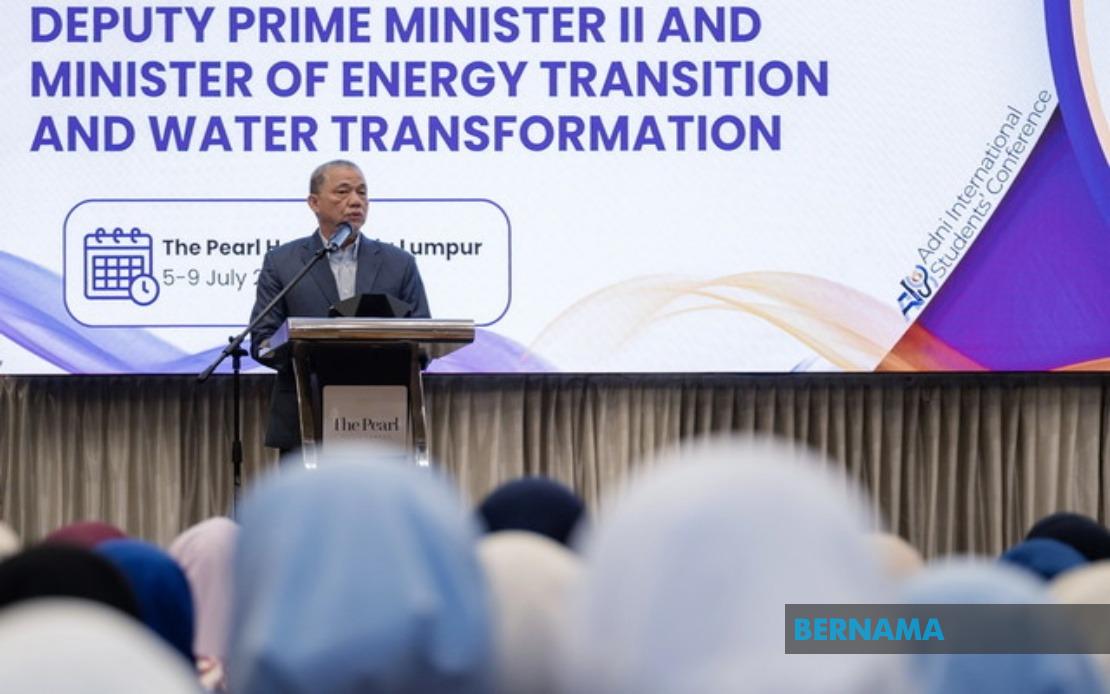
Deputy Prime Minister Datuk Seri Fadillah Yusof has drawn attention to a critical dimension of national development that extends well beyond conventional economic indicators or technological prowess. Speaking at the opening of the ADNI International Students' Conference (AISC) 2026 in Kuala Lumpur on July 6, Fadillah outlined a vision of progress that places the cultivation of capable, ethically grounded citizens at the centre of Malaysia's strategic agenda. His remarks reflect a growing recognition across Southeast Asian policymaking circles that sustainable national advancement requires investment in human qualities that machines and markets alone cannot provide.
The Deputy Prime Minister articulated that contemporary Malaysia requires individuals equipped with sophisticated cognitive abilities—those capable of rigorous critical analysis, articulate communication across diverse audiences, and nimble adaptation to the perpetual shifts characterising our globalised era. This emphasis on adaptive capacity speaks directly to the volatility facing the region, where technological disruption, geopolitical realignments, and environmental pressures demand workforces that can anticipate and respond to change rather than merely react to it. The framing represents a departure from purely skills-based workforce development narratives, suggesting instead that foundational thinking capacities and psychological resilience constitute irreplaceable competitive advantages.
Fadillah positioned complex transnational challenges—encompassing climate crisis, pandemic preparedness, digital transformation, and persistent inequality—as fundamentally insolvable through unilateral action or departmental silos. Rather, he contended that meaningful progress demands orchestrated effort spanning governmental structures, academic institutions, commercial enterprises, grassroots organisations, and emerging leaders. This ecosystemic approach aligns with how advanced economies increasingly conceptualise innovation and problem-solving, recognising that the most intractable contemporary issues operate across traditional institutional boundaries. For Malaysia, building capacity for such collaborative frameworks may prove as strategically significant as individual technical expertise.
The MADANI Government's explicit prioritisation of human capital development, as underscored by Fadillah, echoes philosophical principles articulated by Tun Hussein Onn, Malaysia's third Prime Minister, who emphasised that national strength ultimately derives from the cohesion and moral character of its populace. This invocation of historical precedent suggests continuity in strategic thinking across administrations regarding the primacy of social foundations to political stability and economic prosperity. In the Southeast Asian context, where competing models of governance and development coexist, Malaysia's emphasis on character-building and collective values offers a distinctive positioning within regional discourse.
The Deputy Prime Minister articulated a nuanced distinction between technological connectivity and genuine social integration, observing that while digital systems can link devices and networks, only cultivated values, reciprocal regard, and institutional trust can genuinely unite societies across ethnic, religious, and geographic divides. This observation carries particular resonance for Malaysia, where managing diversity and maintaining intercommunal harmony constitute permanent governance imperatives. The technological determinism sometimes prevalent in development discussions—the assumption that digital infrastructure automatically produces social progress—receives a necessary counterweight through Fadillah's assertion of primacy for ethical and relational foundations.
Fadillah's conception of authentic development encompasses education, individual and collective wellness, ethical formation, creative capability, environmental stewardship, and social cohesion functioning as integrated rather than separable dimensions. This holistic framing contrasts with narrower frameworks that prioritise economic metrics while treating social indicators as secondary considerations. The integration of sustainability and creativity into core developmental objectives suggests alignment with globally emerging understanding that resilient societies must balance material prosperity with ecological responsibility and cultural vitality.
The AISC 2026 gathering, bringing together approximately 150 participants representing Thailand, Philippines, Indonesia, and Malaysia, embodies practical instantiation of the collaborative, cross-cultural engagement principles Fadillah advocated. The conference's orientation toward United Nations Sustainable Development Goals indicates Malaysia's positioning within international frameworks addressing collective human challenges. For regional stability and prosperity, fostering among young leaders—who will shape Southeast Asia's trajectory through mid-century—shared commitment to inclusive institutions, quality education access, and strategic multilateral cooperation represents investment of substantial long-term significance.
Fadillah's reminder that artificial intelligence, despite expanding capabilities, cannot substitute for wisdom or replicate compassion addresses a critical anxiety permeating contemporary discourse across developed and developing economies alike. As automation and algorithmic systems assume increasing responsibility for consequential decisions affecting human populations, the irreducibility of human judgment, ethical reasoning, and empathetic understanding becomes more rather than less salient. For Malaysia's technology sector and educational institutions, this articulation provides useful counterweight to narratives suggesting human labour and cognition face obsolescence, instead positioning distinctively human capacities as enduring sources of competitive and social advantage.
The conference theme, 'Thriving Together: Diversity, Education and Wellness in a Digital World,' encapsulates contemporary imperatives confronting Southeast Asian societies. Amid rapid digital transformation, maintaining educational quality, psychological wellbeing, and genuine social inclusion presents multifaceted challenges requiring sustained commitment and cross-sector coordination. Malaysia's convening regional participants to collectively explore these tensions and opportunities reflects recognition that challenges transcend national boundaries and that collaborative problem-solving yields superior outcomes to isolated national efforts.
For Malaysian stakeholders—whether policymakers, educators, corporate leaders, or civil society actors—Fadillah's intervention offers strategic reorientation toward investments in human formation that may yield returns exceeding those from physical or technological infrastructure alone. The proposition that national capacity ultimately derives from the quality of citizens' reasoning, character, and commitment to collective flourishing rather than from machines or markets represents both philosophical position and pragmatic development strategy with significant implications for resource allocation, curriculum design, workplace practices, and institutional priorities shaping Malaysia's coming decades.

