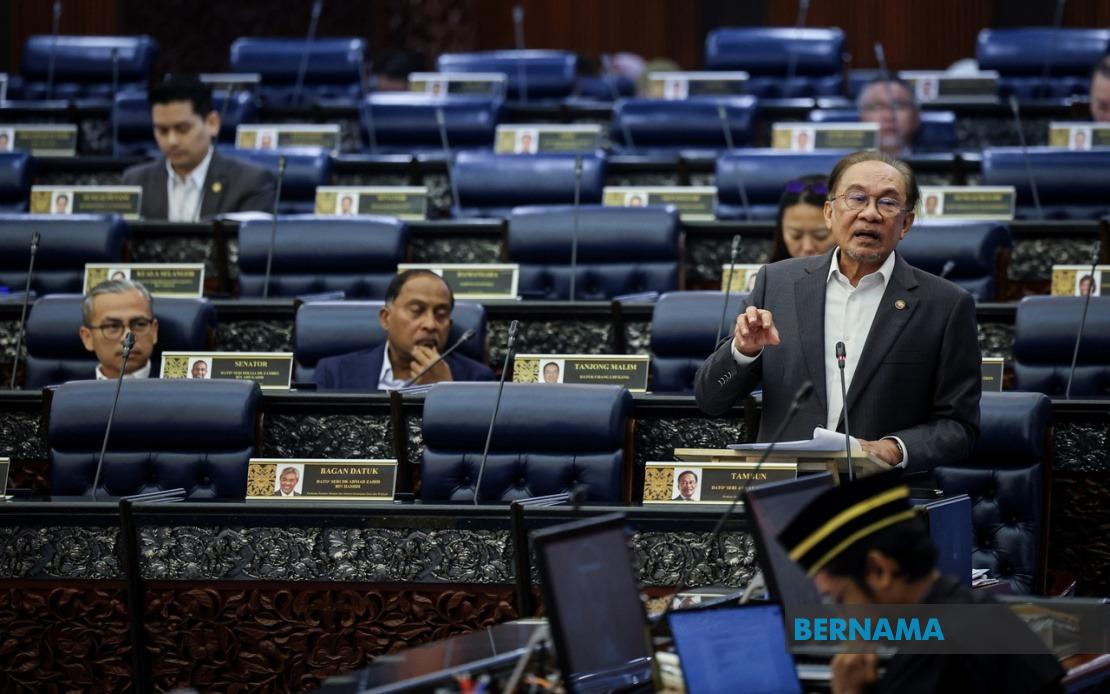
Prime Minister Datuk Seri Anwar Ibrahim has attributed Malaysia's falling position in the World Press Freedom Index to enforcement measures taken against media outlets over sensitive content, though he maintains such actions do not constitute suppression of legitimate journalism or political commentary. Speaking during Minister's Question Time in Parliament on July 7, Anwar explained that Malaysia's ranking declined to 95th place this year from 88th previously, a shift that reflects international perception of government action against several established news organisations.
The Prime Minister pointed to specific cases that have drawn international scrutiny, including enforcement against Sin Chew Daily following its publication of an inaccurate illustration of the Jalur Gemilang and against Sinar Harian over material related to the Inspector-General of Police's biography. These incidents, Anwar suggested, have been interpreted by the global media community as press freedom violations, contributing significantly to Malaysia's lower standing in international rankings. However, he emphasised that the action taken in each case was proportionate to the specific breach involved, whether concerning national symbols or institutional protocols.
Central to Anwar's defence of government policy is a distinction between enforcement targeting the 3R issues—religion, race, and the royal institution—and actions directed at ordinary political criticism or factual reporting. The government, he stressed, operates under a commitment agreed by the Conference of Rulers to closely monitor and address content that insults the monarchy or incites racial or religious tensions. This framework, he argued, represents a constitutional obligation rather than arbitrary censorship, and reflects Malaysia's unique multiethnic and multireligious context where such sensitivities carry constitutional weight.
The Prime Minister was at pains to clarify that the government does not prosecute media organisations merely for publishing inaccurate information or for offering political criticism of ministers or government policy. Instead, his administration has shifted toward public clarification and parliamentary explanation as preferred responses to disputed claims or unfavourable coverage. This position suggests a deliberate policy recalibration aimed at reducing confrontation with the media while maintaining red lines around constitutionally protected institutions and communal harmony.
Anwar highlighted recent legislative amendments as evidence of the government's commitment to broadening the space for legitimate expression. Changes to Section 233 of the Communications and Multimedia Act 1998 have specifically exempted satirical remarks directed at the Prime Minister or other leaders from criminal prosecution, a move intended to signal tolerance for irreverent political commentary. These reforms indicate an attempt to distinguish between protected satire and harmful content while still maintaining legal tools to address genuine threats to security or communal peace.
A significant dimension of Malaysia's press freedom rating, according to Anwar, stems from factors beyond direct government action. Reporters Without Borders assessment methodology incorporates multiple indicators including the political environment, legal framework, economic conditions, socio-cultural context, and security situation. This broad-based evaluation means that events or perceptions in any of these domains can influence the overall ranking, sometimes independently of government policy decisions or media regulation.
Particularly relevant to this point is the removal of online content by social media platforms based on user complaints rather than government directives. Anwar cited his own experience, noting that posts he made regarding Hamas were removed by platform operators despite the government's disagreement with their decision. This dynamic illustrates how international press freedom metrics may reflect platform moderation decisions rather than state censorship, though such removals nonetheless contribute to perceptions of a restrictive information environment in Malaysia.
The Prime Minister further noted that requests submitted by the Malaysian Communications and Multimedia Commission (MCMC) to social media platforms are not automatically accepted. Final authority over content moderation rests with platform operators themselves, limiting the direct control any national regulator can exercise over the digital information landscape. This structural reality means that Malaysia's apparent decline in press freedom indices may partly reflect decisions made by private technology companies rather than government policy alone.
For Malaysian readers and media organisations, Anwar's parliamentary statement offers both reassurance and clear parameters. The government's stated position is that it does not seek to criminalise factual inaccuracy or political opposition, and it has undertaken legislative reforms to protect satirical expression. Simultaneously, however, the 3R framework remains a non-negotiable boundary, with enforcement action likely to continue against content deemed to threaten the monarchy, inflame communal tensions, or breach racial or religious sensitivities.
The international dimension of this debate reflects a broader tension in Malaysia's media environment. International press freedom indices, compiled by organisations like Reporters Without Borders, tend to apply universal standards that may not fully account for Malaysia's constitutional arrangements or its communal context. Conversely, from the perspective of international watchdogs, enforcement action against established media organisations raises legitimate concerns about the scope of restrictions and their practical impact on editorial independence, regardless of official intent.
For journalists and editors in Malaysia, the practical implication is that a zone of protected journalism exists around factual reporting and political criticism, but certain red lines around the monarchy, religion, race relations, and national security remain firmly in place and actively enforced. The government's legislative amendments and rhetorical commitment to press freedom should be understood within this framework rather than as wholesale abandonment of restrictions. Understanding these boundaries is essential for navigating Malaysia's contemporary media landscape effectively.
The broader Southeast Asian context adds further complexity. Press freedom limitations based on protection of the monarchy or communal sensitivities are not unique to Malaysia; several regional neighbours employ similar frameworks. Nonetheless, Malaysia's specific enforcement record and the international perception of media constraints continue to place it in a middle position within regional and global rankings, a standing that reflects both the existence of genuine press freedoms and the presence of meaningful restrictions.

