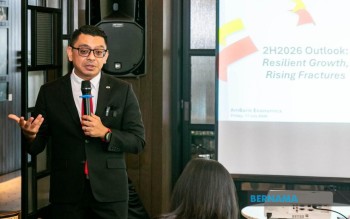
Malaysia's strategic position as a transhipment gateway is delivering tangible commercial opportunities as international trade routes reconfigure in response to geopolitical instability. According to AmBank (M) Bhd chief economist Firdaos Rosli, the country's port sector is experiencing renewed momentum from shipping diversions originating in West Asian tensions, which have prompted merchants and logistics operators to channel cargo through the Strait of Melaka rather than risk exposure to conflict zones. This reshuffling underscores Malaysia's competitive advantages: geographic centrality, operational reliability, and established port infrastructure that international traders regard as secure and predictable alternatives to historically traditional routes.
The concrete results are already visible across Malaysia's two principal container hubs. Port Klang and the Port of Tanjung Pelepas (PTP) handled 15.14 million and 14.03 million twenty-foot equivalent units respectively during 2025, demonstrating the substantial scale of traffic flowing through Malaysian terminals. More significantly, the momentum has extended into 2026, with Port Klang registering a five per cent increase in container volumes during the first five months of the year compared to the same period in 2025, while PTP achieved an eight per cent expansion. These gains are occurring despite a persistently challenging cost environment, suggesting that the underlying demand for Malaysian port capacity is sufficiently robust to absorb higher operational expenses.
Yet the sustainability of this advantage depends critically on forward-looking infrastructure investment and strategic planning. Firdaos emphasised during AmBank's outlook briefing that maintaining competitive positioning will demand ongoing capital expenditure in terminal capacity, handling equipment, and ancillary services. Malaysia faces potential competition from emerging regional rivals, and complacency regarding infrastructure adequacy could erode the advantages currently derived from supply chain diversification. Port operators and government authorities must therefore view the current favourable trading environment not simply as a windfall but as a window of opportunity to strengthen long-term competitive credentials through strategic upgrades.
Complementing the transhipment opportunity is Malaysia's emerging role in the global transition toward environmentally sustainable maritime transport. The government has articulated an ambitious Green Bunkering Regulatory Roadmap that targets low-carbon fuels constituting 40 per cent of maritime fuel consumption by 2050, positioning the nation as a regional leader in the provision of alternative marine fuels. This initiative aligns with international environmental commitments and capitalises on Malaysia's existing energy infrastructure and technical expertise. The framework encompasses liquefied natural gas and methanol bunkering operations, fuels that substantially reduce greenhouse gas emissions compared to conventional heavy fuel oil.
Port of Tanjung Pelepas has already commenced bunkering operations utilising both LNG and methanol, establishing practical proof of concept for Malaysia's green fuel aspirations. This early-mover advantage is strategically significant, as shipping lines increasingly face regulatory pressures from maritime authorities in major markets and investor demands for decarbonisation progress. Vessels requiring access to compliant fuel supplies will naturally gravitate toward ports offering convenient, competitively priced alternatives. Malaysia's investment in green bunkering infrastructure therefore addresses both environmental imperatives and commercial market dynamics, creating a compelling value proposition for international shipping operators.
The freight cost environment, however, presents a complicating factor in this otherwise optimistic scenario. The Baltic Exchange Index, a benchmark measure of shipping costs, surged more than 120 per cent year-on-year in both February and May of 2026, and remained elevated at 64.6 per cent in June. Typically, freight rates moderate sharply following temporary disruptions to maritime supply chains, yet current elevated levels have demonstrated unusual persistence. This structural elevation suggests underlying supply constraints rather than transient factors, reflecting ongoing capacity pressures within the global shipping fleet and port systems.
The West Asian conflict, while no longer directly constraining global petroleum supplies, continues to exert material impact on transportation economics. Shipping lines remain cautious regarding direct transit through regional hotspots, necessitating longer voyage distances and extended transit times that inflate operational costs. These elevated maritime expenses propagate throughout supply chains, effectively imposing a structural tax on trade. For Malaysia, the paradoxical implication is that while higher freight rates may incentivise further cargo diversions toward the Strait of Melaka route, they simultaneously compress margins for port operators and increase expenses for businesses relying on imports and exports.
The convergence of these dynamics creates a nuanced commercial landscape for Malaysian stakeholders. Port operators can expect sustained volume growth from geopolitical trade rerouting and increasing acceptance of Malaysian facilities as reliability-enhancing alternatives to traditional routes. The green bunkering initiative offers a supplementary revenue stream and a differentiation mechanism as environmental standards tighten globally. Simultaneously, however, the persistence of elevated freight costs constrains the pace of margin expansion and may dampen volume growth rates below historical precedents. Businesses dependent on maritime trade must budget for sustained higher logistics expenditures even as they benefit from supply chain diversification.
For policymakers, the strategic imperative is sustaining competitive positioning through coordinated investment in port infrastructure, regulatory frameworks enabling green fuel adoption, and diplomatic engagement maintaining Malaysia's reputation for political neutrality and operational excellence. The current environment offers a window for capacity enhancement while growth is strong and investment returns are measurable. Failure to capitalise on this opportunity risks diminishing Malaysia's relative competitive standing as other regional ports enhance their own infrastructure and capabilities. The intersection of geopolitical realignment and environmental transition presents Malaysia with a distinctive opportunity to simultaneously strengthen commercial positioning and advance sustainability objectives.

