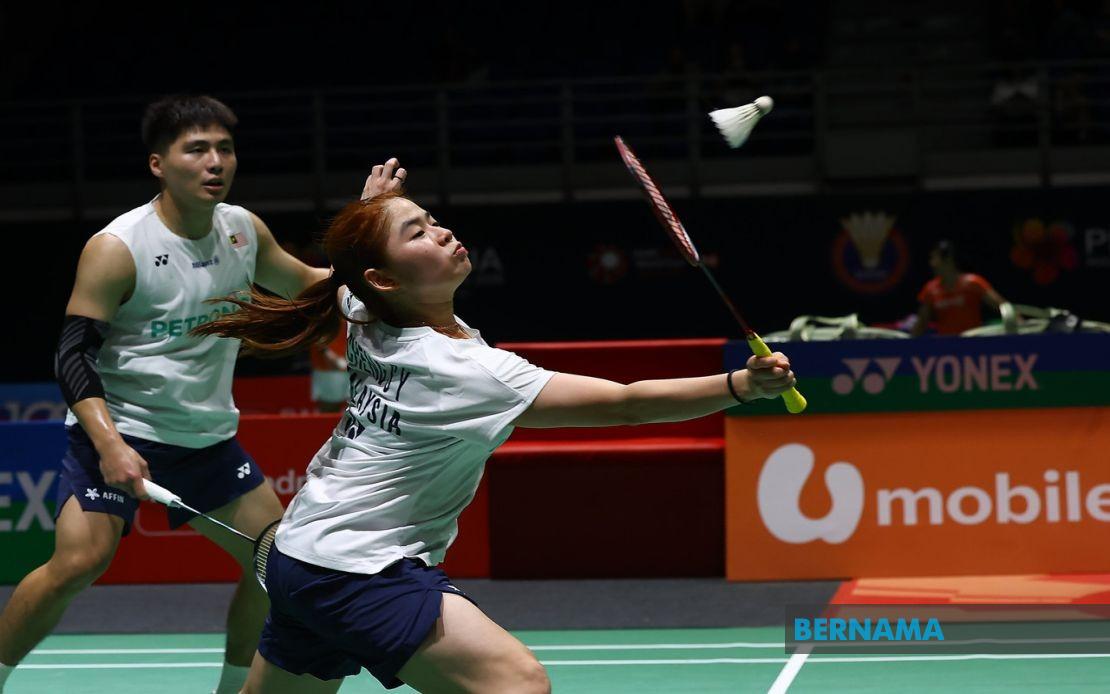
Malaysia's participation in the 2026 Japan Open badminton championship came to a close on July 18 after the country's final two pairs succumbed to stronger opposition in the semi-finals held in Tokyo. The exits of Jimmy Wong-Cheng Su Yin in mixed doubles and Goh Sze Fei-Nur Izzuddin Rumsani in men's doubles mark the end of what had been a promising run for Malaysian badminton at one of the sport's premier tournaments.
The mixed doubles pairing of Jimmy Wong and Cheng Su Yin had captured the imagination of Malaysian badminton enthusiasts with an impressive series of upsets against higher-ranked opponents earlier in the tournament. Their giant-killing trajectory finally ran into an insurmountable wall when they faced Hong Kong's experienced combination of Tang Chun Man and Tse Ying Suet. Despite a valiant effort that extended beyond an hour, the Malaysian pair fell short, losing the match 17-21, 21-18, 21-15 in a grinding 69-minute contest that saw momentum shift repeatedly between the two teams.
The competitive nature of their semi-final encounter suggests that Wong and Cheng Su Yin demonstrated sufficient capability to operate at elite levels of international badminton. Their progression through the tournament to the semi-finals, albeit as unseeded competitors, provided evidence that they possess the technical skills and tactical awareness needed to challenge top-ten pairings around the globe. For Malaysian badminton development purposes, such performances at major tournaments indicate emerging depth in mixed doubles talent, a category where sustained competitive strength remains valuable for future continental and world championship ambitions.
In the men's doubles competition, Goh Sze Fei and Nur Izzuddin Rumsani encountered an even more formidable obstacle when they drew world number one pair Kim Won Ho and Seo Seung Jae of South Korea in the semi-finals. The South Korean duo represents the pinnacle of men's doubles performance globally, and they demonstrated why by ultimately prevailing over the Malaysian challengers 21-12, 11-21, 21-13 in a 58-minute encounter. The Malaysian pair's inability to maintain consistency across all three games proved decisive in their bid to advance further.
A particularly striking feature of the Goh-Nur Izzuddin performance was their capacity for adjustment and resilience during the match itself. After being overwhelmed in the opening game, which they lost 12-21, the Malaysians mounted a substantial recovery to claim the second set decisively at 21-11. This reversal demonstrated that technical capability and competitive spirit were present, though ultimately insufficient against an opponent of Kim and Seo's world-class standing. The deciding third set, won by the South Koreans at 21-13, suggested that the Malaysian pair's reserves of energy and mental focus had been depleted by the intensity of their comeback bid.
The historical record between these two sides adds context to their semi-final encounter. Goh Sze Fei and Nur Izzuddin Rumsani have now lost three encounters against the South Korean pair across five total meetings, establishing a clear pattern of dominance by Kim and Seo. Despite this adverse head-to-head record, the Malaysian pairing's periodic competitive moments in their matches indicate that the gap in quality, while significant, remains not entirely insurmountable. For Malaysian badminton coaching and development systems, such data points suggest areas where tactical and physical conditioning improvements might yield better outcomes in future encounters against elite opposition.
The conclusion of Malaysia's 2026 Japan Open campaign raises broader questions about the nation's badminton trajectory heading into major competitions planned for the remainder of 2026 and beyond. The performance of both pairs—reaching semi-finals rather than advancing further—reflects consistent middle-tier international competitiveness rather than championship-winning capability. For Southeast Asian badminton more broadly, Malaysia's results demonstrate that while the nation maintains respectable competitive standing at premier tournaments, the dominance of established powerhouses like South Korea and certain Chinese and Indonesian pairings remains pronounced. The gap between reaching semi-finals consistently and translating such appearances into titles requires incremental improvements in preparation, tactical execution, and mental resilience at decisive moments.
Future Malaysian success at tournaments of Japan Open stature will likely depend upon whether coaching staff and sports administrators can identify specific technical or strategic weaknesses that contributed to both pairs' semi-final exits. The strong second-set performance by Goh and Nur Izzuddin particularly merits analysis, as it demonstrated capacity to elevate performance against world-class opponents when conditions aligned. Similar attention to Wong and Cheng Su Yin's upset victories earlier in the tournament might reveal patterns worth emphasizing during training cycles. Such analytical work, combined with continued competitive exposure at world-ranked tournaments, represents the pathway through which Malaysian badminton can transition from occasional semi-finalist to regular finalist and champion.

