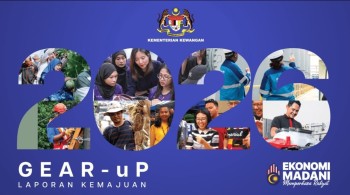
Government-linked investment companies in Malaysia have substantially escalated their domestic deployment of capital, committing RM20.3 billion in 2025 as the Government-Linked Enterprises Activation and Reform Programme (GEAR-uP) enters its third year. The figure represents a significant increase from the RM6.6 billion deployed the previous year, signalling the programme's acceleration across multiple sectors critical to the nation's economic trajectory. Prime Minister Datuk Seri Anwar Ibrahim, speaking at the release of the GEAR-uP Progress Report, framed this deployment as an expression of deliberate national strategy rather than passive investment seeking routine returns, emphasising that Malaysia remains committed to channelling its accumulated wealth towards measurable socioeconomic advancement.
GEAR-uP, launched in 2024 under the stewardship of the Ministry of Finance, aims to mobilise RM120 billion over five years in pursuit of structural economic reform and accelerated industrial modernisation. The initiative draws on the financial capacity and long-term investment horizons of six anchor institutions: Khazanah Nasional Bhd, the Employees Provident Fund, Permodalan Nasional Bhd, Kumpulan Wang Persaraan (Diperbadankan), Lembaga Tabung Angkatan Tentera, and Lembaga Tabung Haji. By pooling resources and coordinating strategic capital deployment across these established vehicles, the programme seeks to overcome the fragmentation that has historically constrained Malaysia's capacity to scale ambitious transformation projects. The momentum generated in 2025 has already begun to extend into early 2026, suggesting that the anticipated five-year deployment arc remains credible and on track.
Prime Minister Anwar's remarks place GEAR-uP within a broader narrative of economic resilience and equitable development. He acknowledged that whilst considerable progress has been registered in the programme's opening years, the agenda remains substantial and demands sustained execution. The language deployed—referencing national stability, resilience, and ensuring that economic gains reach ordinary Malaysians—reflects growing recognition that capital mobilisation divorced from genuine improvement in living standards carries limited legitimacy in an era marked by persistent inequality. This framing matters for Malaysian constituencies sceptical of top-down economic engineering, signalling that the government views GEAR-uP not as financial engineering for its own sake but as a mechanism for redistributing opportunity more equitably across society.
The technological and infrastructure dimensions of current deployment illustrate the programme's scope. KWAP's backing of Google's proposed Selangor data centre, expected to introduce 320 megawatts of capacity and generate 26,500 jobs through 2026 and 2027, represents the type of high-value, job-generative investment GEAR-uP prioritises. This initiative sits alongside Empyrion Digital's phased expansion in Johor, collectively positioning Malaysia as an increasingly attractive destination for regional digital infrastructure investment. Simultaneously, Tenaga Nasional Bhd's investment in electrical grid modernisation is projected to rise from RM12 billion in 2025 to RM15 billion by 2027, essential preparatory work underpinning the nation's renewable energy transition toward 70 per cent installed capacity by 2050. Malaysia Airports' five-year, RM11 billion upgrade programme, targeting over 100 million passengers at Kuala Lumpur International Airport, reflects parallel efforts to enhance connectivity and transport infrastructure as foundational economic assets.
Capital markets deepening represents another pillar of GEAR-uP's intervention logic. Venture and growth-stage financing vehicles—Dana Impak, Dana Perintis, Dana Pemacu, and Ekuitas—are designed to bridge the persistent funding gap that constrains mid-tier Malaysian firms seeking to transition from early-stage viability to scaled operations. Khazanah's planned Dana Ciptawan, dedicating RM200 million to Bumiputera enterprises and established mid-market companies, targets a constituency historically underserved by conventional capital markets. These mechanisms acknowledge that infrastructure and large-scale enterprise development alone cannot deliver inclusive growth; sufficient capital supply at various stages of firm maturity is requisite. The Capital Market Masterplan's ambition to reach RM5.8 to RM6.3 trillion in market capitalisation by 2030 depends fundamentally on this pipeline functioning effectively, a dependency that assigns considerable weight to GEAR-uP's success in channelling investment toward productive expansion rather than speculative trading.
Bumiputera economic empowerment forms an explicit focus of GEAR-uP's distributional intent. The programme targets ten Bumiputera company listings during 2026-2027, operating in tandem with the Bumiputera Champions Programme designed to accelerate scaling of indigenous enterprises. Zakat Wakalah—an Islamic financing instrument channelling charitable obligation into investment—is projected to expand from RM28 million in 2024 to RM100 million in 2026, illustrating how GEAR-uP integrates religious and cultural frameworks into development strategy. For Malaysian constituencies for whom Bumiputera advancement represents both economic justice and communal welfare, these initiatives signal serious commitment beyond rhetorical commitment. Government-linked companies more broadly are tracking toward RM100 billion in additional market value creation by 2028, with the MY Value Up discipline extending similar value-creation expectations to Malaysia's 88 largest listed companies, establishing a coherent framework of performance standards across the institutional ecosystem.
Minister of Finance II Datuk Seri Amir Hamzah Azizan articulated a sophisticated understanding of what capital deployment ought to accomplish, distinguishing between the mechanical measure of funds deployed and the lived outcomes those deployments generate. His emphasis that capital deployed in 2025 reached roughly three times 2024 levels, achieving an aggregate shareholder return of 8.0 per cent, situates financial performance within a larger frame encompassing employment quality, graduate placement in sustainable roles, Bumiputera firm development, and localised supply chain construction. This perspective resists purely quantitative evaluation in favour of substantive impact assessment—a rhetorical shift that, if matched by operational practice, could redefine how Malaysian institutional investors measure success. The assertion that investment value crystallises only when paired with fair employment compensation and genuine skill utilisation reflects acknowledgment of widening distributional anxiety across Southeast Asia regarding whether economic growth translates into proportionate wage and opportunity gains for working populations.
The external economic context sharpens the significance of GEAR-uP's deployment trajectory. Global volatility, trade reconfiguration, and geopolitical risk cascading through economic structures create environments where nations without robust domestic capital formation and strategic investment frameworks face heightened vulnerability. Malaysia's capacity to maintain economic stability through 2023-2024 global turbulence, the report argues, derived partly from reforms initiated earlier, establishing institutional foundations on which GEAR-uP now builds. The MADANI Economy framework—anchoring the programme's strategic direction—explicitly rejects distributional models that raise the economic ceiling (aggregate growth) without simultaneously lifting the floor (minimum living standards and opportunity access). Amid Southeast Asian competition for investment and talent, Malaysia's willingness to frame capital mobilisation around equitable outcomes and genuine capability development rather than pure return maximisation represents a differentiated positioning, potentially attractive to international investors increasingly attentive to environmental, social, and governance performance.
The report's conclusion emphasises that GEAR-uP's true test lies not in the magnitude of capital deployed but in the durability of the economic structures and capability bases those deployments generate. Converting Malaysia's accumulated capital stock into enduring productive capacity—ecosystems sufficiently robust to attract and retain investment, domestically-rooted supply chains, competitive firms capable of championship performance, and wage structures reflecting genuine value contribution—requires patient, coordinated execution across multiple institutional actors operating on multi-year horizons. The government-linked institutions orchestrating GEAR-uP are signalling commitment to sustained deployment, delivery discipline, and allowing emerging investments time to mature and generate secondary effects across broader economic structures. For Malaysian policymakers and the constituencies tracking economic reform, the next three years will provide substantive evidence regarding whether GEAR-uP functions as genuine transformative intervention or as sophisticated public relations masking distributional continuity.

