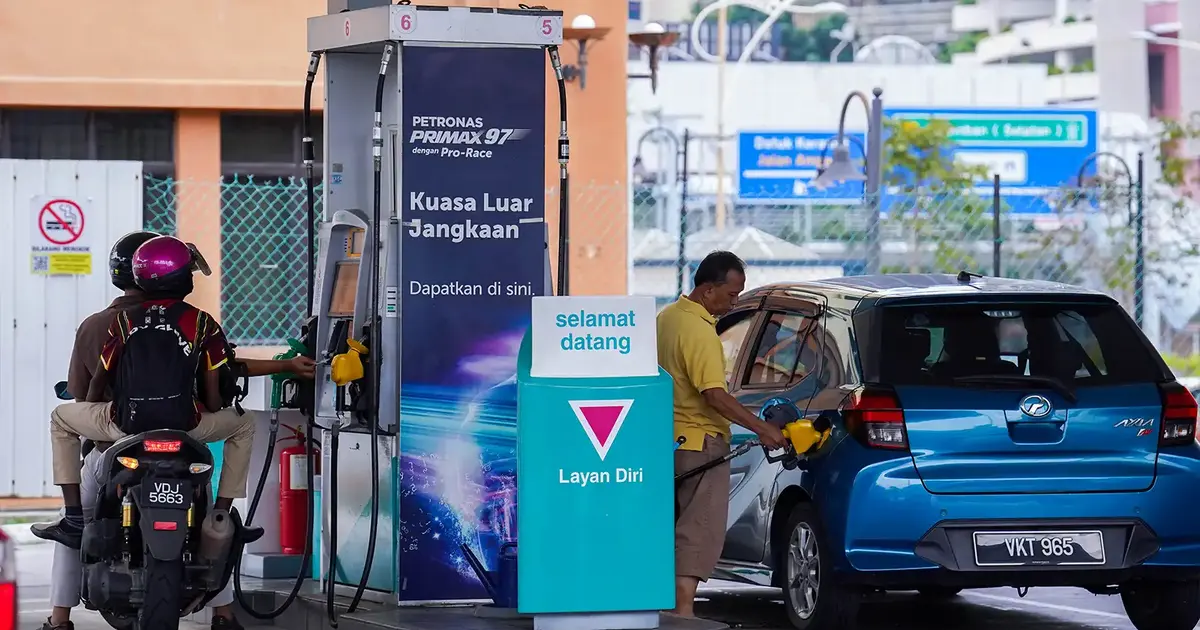
Prime Minister Anwar Ibrahim has sought to reassure the public that Malaysia's petroleum reserves and supply chains remain in sound condition, despite projections that the government's fuel subsidy outlay will surge to RM40 billion in 2026. The announcement underscores mounting fiscal pressures on the federal budget as the nation grapples with volatile global energy prices and domestic demand for affordable fuel.
The RM40 billion figure represents a substantial commitment from Kuala Lumpur's coffers, highlighting how energy subsidies continue to consume a significant portion of government spending. For context, this sum rivals or exceeds the annual budget allocations for entire government ministries, reflecting the political sensitivity of fuel pricing in Malaysia and the government's reluctance to pass sharp cost increases directly to consumers. The magnitude of this subsidy burden raises fundamental questions about fiscal sustainability and the long-term trajectory of public finances.
Anwar Ibrahim's emphasis on supply adequacy addresses concerns that may have circulated regarding Malaysia's hydrocarbon security. As a regional oil and gas producer, Malaysia has historically relied on its natural resource wealth to support economic stability, though production levels have faced periodic fluctuations due to maintenance, technical challenges, and mature field management. The Prime Minister's assurances seek to forestall anxiety about potential shortages or disruptions that might accelerate inflation or necessitate more draconian subsidy reductions.
The projected subsidy cost for 2026 arrives at a time when Malaysia faces broader macroeconomic headwinds. Global oil markets remain unpredictable, influenced by geopolitical developments, supply disruptions from major producing nations, and shifting demand patterns as energy transitions accelerate worldwide. Should crude prices climb materially, the actual subsidy bill could exceed current projections, imposing unanticipated strains on the treasury and constraining resources available for development priorities such as healthcare, education, and infrastructure.
Domestically, fuel subsidies represent a complex policy instrument. While they provide relief to lower and middle-income households and shield businesses from sharp energy cost shocks, they also distort market signals, encourage consumption inefficiency, and create dependency on government support. Economists and policymakers across Southeast Asia have grappled with whether targeted assistance to vulnerable groups might prove more cost-effective than blanket fuel price controls, yet political opposition to subsidy reductions remains formidable across the region.
Malaysia's approach to energy pricing reflects a deliberate political calculation: the government prioritises social stability and cost-of-living management over rapid fiscal consolidation in the energy sector. This contrasts with some neighbouring nations that have pursued more aggressive subsidy phase-outs or conditional subsidy schemes tied to income levels. The trade-off, however, is deferred budget adjustment and opportunity costs that compound over time.
Looking ahead, the RM40 billion subsidy projection for 2026 invites scrutiny of alternative policy pathways. Options might include gradual price adjustments coupled with targeted cash transfers to disadvantaged households, expansion of fuel-efficient public transport to reduce demand, or investment in renewable energy capacity to diversify the energy supply mix and reduce long-term exposure to volatile fossil fuel markets. Such measures, however, require political will and social consensus that has historically proved elusive.
The Prime Minister's reaffirmation of supply stability also carries strategic implications for Malaysia's position within ASEAN and the broader Indo-Pacific energy architecture. As a reliable hydrocarbon exporter with functional refining capacity, Malaysia maintains relevance in regional energy security discussions. Maintaining credible supplies supports not only domestic consumption but also exports and regional trade relationships that depend on energy price predictability.
For Malaysian consumers and businesses, the subsidy commitment signals continuity in current fuel pricing frameworks at least through 2026, barring major policy shifts. This provides a degree of planning certainty for transportation companies, manufacturers, and households, though it does not eliminate longer-term uncertainty. Economists and fiscal observers will monitor how the government intends to finance this mounting subsidy burden without further compromising its debt-to-GDP ratio or diverting critical resources from other national priorities.
Ultimately, the RM40 billion subsidy projection illustrates the tension between immediate political necessity and fiscal prudence that characterises energy policy across Southeast Asia. Anwar Ibrahim's emphasis on supply adequacy addresses one dimension of Malaysia's energy security, yet the unsustainable trajectory of subsidy costs remains an unresolved challenge demanding serious policy consideration in coming years.

