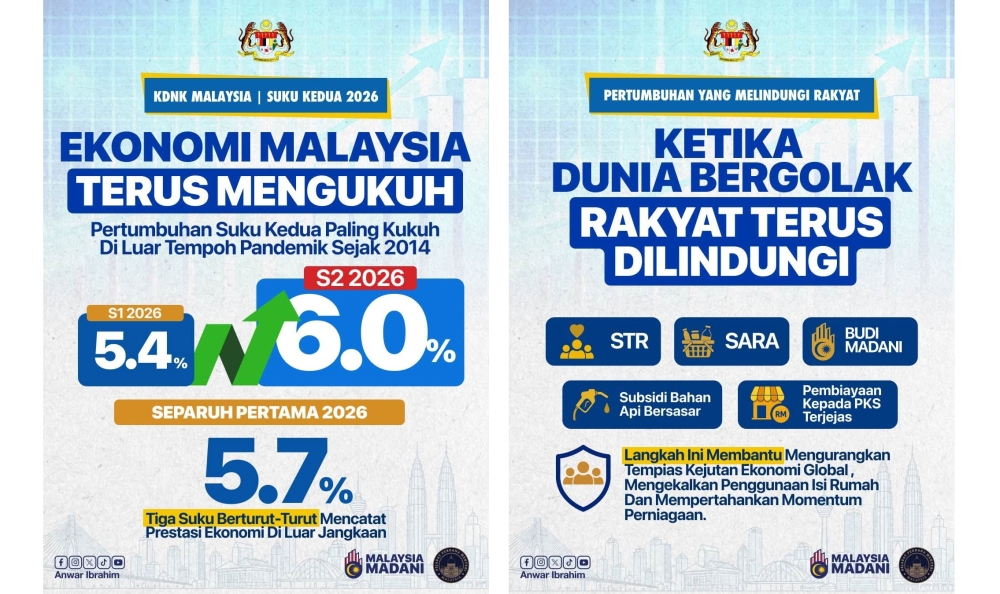
Prime Minister Datuk Seri Anwar Ibrahim expressed satisfaction over Malaysia's economic trajectory in the second quarter, pointing to expansion rates that surpassed analyst expectations as evidence of the government's effective policy framework. The remarks underscore the administration's confidence in navigating what remains a challenging global economic environment characterised by persistent inflation and uncertain growth prospects across major trading partners.
The government's emphasis on protecting household purchasing power has become a cornerstone of its economic messaging, particularly as Malaysian families continue to grapple with elevated cost-of-living pressures that began escalating in 2021. Anwar's acknowledgment of this challenge reflects growing political awareness that economic statistics alone fail to capture the lived experience of ordinary Malaysians contending with higher prices for food, fuel, energy, and transportation. By positioning the administration as an active shield against these external shocks, the government seeks to build political capital ahead of crucial economic reporting cycles.
Malaysia's economic performance assumes heightened significance within the Southeast Asian context, where the region functions as a critical manufacturing and trade hub vulnerable to global supply chain disruptions and demand fluctuations. The nation's ability to maintain growth momentum while managing inflation differentiates it from peers facing more severe stagflationary pressures, though structural challenges persist in productivity and labour market dynamics. This relative stability has attracted investor attention, yet questions linger regarding the sustainability of growth when accounting for demographic shifts and the transition to higher-value economic activities.
The government's protective measures have encompassed targeted subsidies, price controls on essential goods, and monetary policy coordination with Bank Negara Malaysia to balance growth objectives against inflation management. These interventions reflect a deliberate strategy to prioritise household welfare over strict fiscal orthodoxy, a departure from previous administrations' emphasis on deficit reduction and structural adjustment. The political calculation underlying this approach recognises that electoral fortunes rest substantially on voters' perception of their economic circumstances rather than macroeconomic aggregates.
However, the sustainability of such measures remains contested among economists and policy observers who worry about fiscal pressures and potential market distortions accumulating over time. Subsidies, while providing immediate relief, can dampen efficiency incentives and create long-term budgetary obligations that prove difficult to unwind politically. Malaysia's fiscal position, though improved from pandemic lows, still requires careful management to maintain investor confidence and preserve policy flexibility for future shocks.
The broader economic environment facing Malaysia continues to present both opportunities and risks that extend beyond government control. Global growth forecasts have moderated considerably from post-pandemic peaks, with developed economies showing signs of slowdown and developing markets facing capital outflows as international investors reposition portfolios. Malaysia's export-dependent sectors, particularly electronics and petrochemicals, face demand uncertainties as global manufacturing cycles soften and technology companies adjust inventory levels.
Labour market conditions have stabilised following pandemic disruptions, yet wage growth remains insufficient to fully offset price increases for many workers, particularly those in lower-income brackets. This disconnect between employment gains and real income improvements explains persistent consumer sentiment challenges even as headline growth figures improve. The government's focus on household protection through subsidies and price interventions thus addresses a genuine economic tension rather than purely political posturing.
Regional dynamics introduce additional complexity to Malaysia's economic outlook, as competition from other Southeast Asian economies for foreign investment and regional supply chain positioning intensifies. Vietnam, Thailand, and Indonesia pursue comparable strategies to attract manufacturing relocations from China, creating a competitive environment where Malaysia must continually demonstrate comparative advantages in stability, infrastructure, and regulatory predictability. The government's economic messaging, therefore, serves not merely domestic consumption but also signals to international investors regarding the stability of Malaysia as a business destination.
Looking forward, the administration faces the challenge of transitioning from demand-management policies that protect current living standards toward supply-side reforms that enhance productive capacity and long-term growth potential. This transition requires difficult choices regarding education investment, regulatory reform, and technology adoption that yield benefits only over extended timeframes, whereas political cycles operate on much shorter horizons. The tension between short-term household welfare protection and long-term structural improvement will likely shape Malaysian economic policymaking throughout the remainder of this administration's tenure.
The Prime Minister's emphasis on Q2 performance reflects an implicit confidence that current policy directions have arrested the worst effects of global inflation on Malaysian households, yet the statement also implicitly acknowledges that the government remains vulnerable to external shocks beyond its immediate control. As Malaysia heads toward subsequent quarters, sustained growth and inflation control will determine whether the government's economic narrative resonates with voters increasingly focused on practical improvements in their financial circumstances rather than optimistic official pronouncements about aggregate economic indicators.

