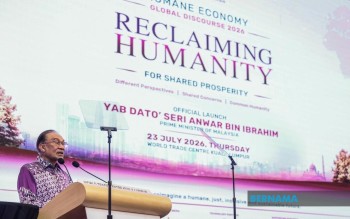
Prime Minister Datuk Seri Anwar Ibrahim has signalled that the federal government will formally begin constructing Budget 2027 in August, with the spending blueprint scheduled for parliamentary presentation in the first weeks of October. Speaking simultaneously in his capacity as Finance Minister, Anwar articulated that the upcoming fiscal framework will maintain its alignment with a foundational economic philosophy—one that measures national prosperity not simply through growth rates or consumption volumes, but through concrete enhancements to the quality of life experienced by ordinary Malaysians.
Anwar's articulation of this budgetary philosophy reflects a deliberate shift in how the government calibrates economic success. Rather than treating Gross Domestic Product expansion as an end unto itself, he positioned the economy as fundamentally instrumental—a tool whose legitimacy derives from its capacity to deliver dignified living conditions, security, and genuine opportunity to the population. This framing carries particular resonance in Southeast Asia, where disparities between headline growth figures and household economic outcomes have generated growing public discontent across multiple regional economies.
The Prime Minister elaborated on this conceptual framework during his keynote remarks at the Humane Economy Global Discourse 2026 in Kuala Lumpur. He posed a series of evaluative questions that Budget 2027 will implicitly grapple with: whether economic expansion broadens opportunity or concentrates it among fewer beneficiaries; whether development policies strengthen family and community structures or erode them; and crucially, whether governance frameworks treat citizens as active participants in building national prosperity or merely as production inputs to be optimised for output. These interrogatives suggest a markedly normative approach to fiscal policy, one grounded in examining the distributional consequences and social fabric implications of macroeconomic decisions.
Translating prosperity into improved living standards constitutes the primary lens through which Budget 2027 will be evaluated, according to the Prime Minister's exposition. This encompasses tangible policy domains that directly affect household welfare: wage growth that outpaces inflation, employment characterized by meaningful skill development and advancement potential, residential accommodation at genuinely affordable price points, healthcare infrastructure and services accessible regardless of income level, educational institutions equipped to cultivate human potential, and spatial communities—both urban and rural—that generate social connectivity and economic vitality. Collectively, these elements constitute what Anwar characterised as authentic social mobility, distinguishing it from purely statistical claims of poverty reduction or income growth.
The integration of Malaysia's semiconductor manufacturing capabilities within the broader Budget 2027 framework underscores the government's intention to leverage high-value industrial sectors as vehicles for human-centred development. Semiconductors constitute a strategic economic anchor for the nation, generating substantial export revenues and foreign investment. Yet the budget will apparently interrogate how these sector-specific advantages translate into employment creation at varying skill levels, whether technological advancement expands participation in the digital economy across demographic groups, and how supply-chain integration with global markets can be structured to distribute benefits more equitably throughout the domestic economy.
Energy transition and digital transformation, identified by Anwar as additional pillars within Budget 2027's strategic scope, pose their own distributional challenges that the fiscal document must address. Malaysia's transition away from hydrocarbon dependence toward renewable energy infrastructure carries employment implications, stranded asset dimensions, and geographic disparities in transition support. Similarly, digital transformation across economic sectors and public services creates winners and potential casualties—sectors and workers that cannot rapidly adapt may experience income erosion and labour market displacement. Budget 2027 will apparently seek to ensure that these transformative processes do not concentrate gains among technologically adept populations whilst marginalising those with limited digital literacy or capital resources.
The principle that sustainability cannot involve transferring environmental, financial, or social obligations to future generations introduces an intergenerational equity dimension to Malaysia's fiscal planning. This acknowledges that short-term economic gains achieved through resource depletion, unsustainable debt accumulation, or deferred infrastructure maintenance essentially constitute theft from subsequent cohorts. For Malaysia specifically, this carries implications for management of natural resources, budgetary deficits, and climate adaptation investments—all domains where current choices create path dependencies constraining future options.
Anwar's emphasis on innovation expanding human capabilities rather than deepening exclusion suggests heightened governmental scrutiny of technological advancement's distribution effects. In developing economies, technological change frequently generates labour-displacing automation whilst failing to create adequate reskilling pathways or social safety mechanisms. This framing indicates Budget 2027 will presumably incorporate elements designed to ensure that investments in innovation infrastructure—research facilities, tertiary education, digital infrastructure—remain accessible across geographic regions and socioeconomic strata rather than concentrating in prosperous urban centres.
The timeline for Budget 2027 formulation carries domestic political significance. With preparation beginning in August and parliamentary tabling scheduled for early October, the government signals an intention to complete fiscal planning during the current parliamentary session, providing clarity to businesses and households well before the calendar year concludes. This compressed timeline, relative to some previous budget cycles, may reflect greater governmental priority to settling economic expectations and demonstrating fiscal management competence.
For Malaysian investors and businesses, Anwar's articulation of budget principles offers interpretive guidance regarding policy direction without yet specifying particular tax rates, sectoral allocations, or expenditure priorities. The consistent emphasis on distributional outcomes and human development objectives suggests potential policy instruments including progressive taxation adjustments, targeted wage support mechanisms, and enhanced investment in social infrastructure. Multinational corporations and domestic enterprises should anticipate that regulatory and fiscal measures may increasingly incorporate social impact assessments alongside conventional economic efficiency metrics.
Regionally, Malaysia's approach to fiscal policy carries implications for Southeast Asian development discourse. The explicit rejection of measuring prosperity purely through macroeconomic aggregates challenges the dominant paradigm in regional economic policymaking, where governments typically emphasise GDP growth and foreign direct investment attraction as primary success indicators. Should Budget 2027 demonstrate that prosperity-centred governance generates positive outcomes—whether in terms of social stability, political legitimacy, or long-term economic resilience—neighbouring economies may experience pressure to recalibrate their own fiscal frameworks along comparable lines.
The appointment of a Budget 2027 formulation timeline also enables public discourse and civil society engagement during the drafting phase. Stakeholder consultations conducted between August and early October can incorporate perspectives from labour organisations, business chambers, community groups, and policy research institutions, potentially enriching the budget document's sophistication and generating broader political ownership once tabled. This differs from fiscal frameworks developed largely within technocratic confines, potentially resulting in budgets that better reflect contested values and competing development visions within Malaysian society.

