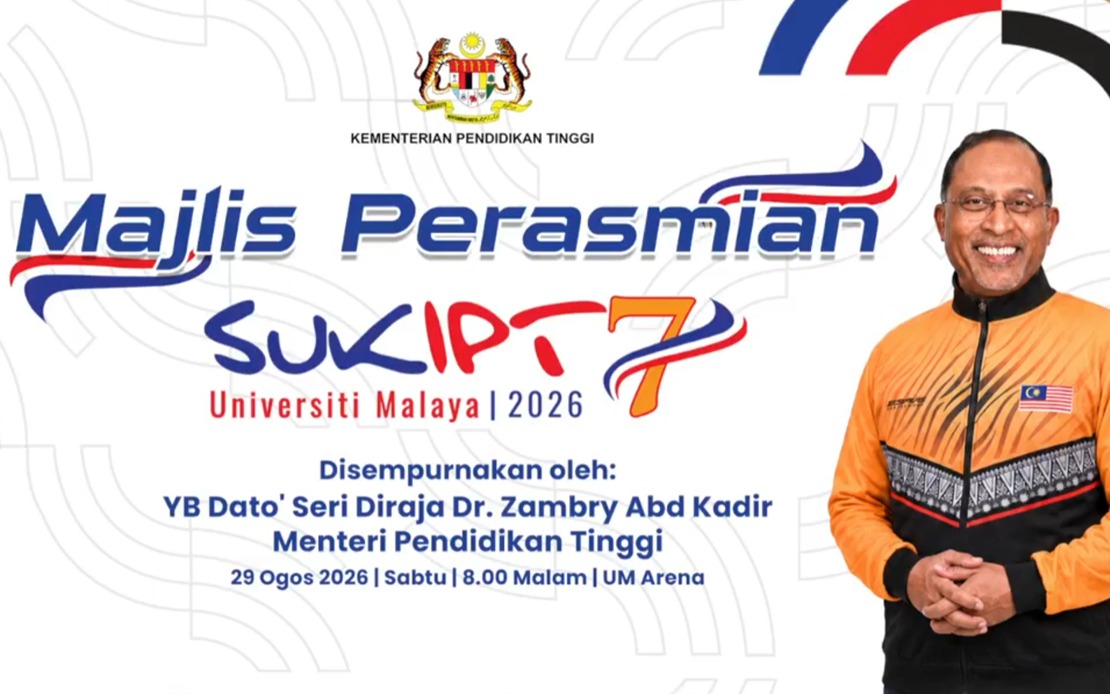
Higher Education Minister Datuk Seri Dr Zambry Abdul Kadir has underscored the growing role of Malaysian universities in developing athletes capable of competing at the highest international levels, citing recent medal-winning performances at major sporting events as evidence of the sector's potential to strengthen the country's sporting profile. Speaking at the opening of the Higher Education Institution Games (SUKIPT) 2026 at Universiti Malaya Arena in Kuala Lumpur on Thursday, Zambry framed university sports as an essential pathway for cultivating quality competitors who can carry Malaysia's colours on the global stage, particularly ahead of the Glasgow 2026 Commonwealth Games where several IPT athletes have already demonstrated their calibre.
The minister's remarks reflect a strategic recognition within Malaysia's education leadership that higher learning institutions, with their combination of training facilities, coaching expertise, and student populations, offer a distinctive advantage in talent identification and development. By positioning university sports as more than extracurricular activity, the government appears to be acknowledging that structured competition within the tertiary sector can serve dual purposes: maintaining academic institutions' appeal to prospective students whilst simultaneously constructing a sustainable talent supply chain for national sporting ambitions. This framing carries particular significance for Southeast Asia, where countries increasingly compete for sporting excellence through their university systems.
Recent achievements by IPT athletes have provided concrete validation for this approach. Muhammad Erry Hidayat from Universiti Putra Malaysia secured gold in men's 79-kilogramme weightlifting at an international level, whilst his counterpart Muhammad Aniq Kasdan from Universiti Teknologi MARA claimed gold in the men's 60kg category, demonstrating that Malaysian university athletes can excel in technically demanding disciplines where strength and precision converge. Perhaps more symbolically significant was Amir Daniel Abdul Majid from Universiti Sains Malaysia's historic judo gold medal at the Commonwealth Games—a breakthrough that makes him Malaysia's first Commonwealth Games champion in the sport, suggesting that university development programmes are reaching into traditionally underperforming sporting domains and generating unexpected breakthroughs.
Domestically, IPT athletes have continued to impress by rewriting performance benchmarks across track and field events. Omar Osman from Politeknik Sultan Ibrahim, Muhammad Fadwah from UiTM, and Danish Iftikhar Muhammad Rosli from Universiti Pendidikan Sultan Idris have shattered Malaysia Games (SUKMA) records in middle-distance running and sprinting disciplines, including two records set by UPSI's Rosli in the 200-metre and 4×100-metre relay events. These achievements underscore that the competitive environment fostered within university sports calendars is producing incremental but measurable improvements in athletic performance across multiple disciplines, creating a performance culture that transcends individual events or institutions.
The scale of SUKIPT 2026 itself signals the government's commitment to this university-centred development model. Running from August 28 through September 6 at Universiti Malaya, the seventh edition of the games assembles 64 contingents drawn from 20 public universities, 42 private higher education institutions, one polytechnic, and one community college. The competition spans 30 sporting disciplines and mobilises more than 8,200 athletes and officials, creating a competitive ecosystem substantial enough to justify investment in infrastructure, coaching, and administrative support. This scale positions SUKIPT alongside more established university games globally, suggesting that Malaysian tertiary institutions now operate within a tournament structure comparable to university sporting systems in developed nations.
The financial architecture supporting SUKIPT 2026 reflects deliberate incentivisation designed to motivate individual and institutional excellence. The games offer 227 gold medals as the primary competitive currency, but complementary cash rewards target specific categories of achievement: RM3,000 recognises individual Sportsman and Sportswoman of the Games awards, whilst RM7,000 prizes honour outstanding team performances by gender. Most notably, athletes breaking national records receive RM20,000, a significantly higher incentive that explicitly prioritises performance advancement beyond existing benchmarks. This tiered reward structure encourages not merely winning within collegiate competitions but achieving improvements that register at the national level, effectively using university games as a qualifying mechanism for national record recognition.
Zambry's invocation of the games' theme, 'Creating a Legacy of Champions', suggests an understanding that university sports cannot be evaluated solely through immediate medal counts but rather through longer-term talent trajectories and institutional memory. By emphasising legacy, the minister implies that SUKIPT 2026 is intended to establish systems and cultural attitudes within universities that will persist beyond the current games cycle, embedding sporting excellence as a persistent institutional value rather than a temporary focus. This perspective aligns with how mature university sports systems internationally operate, where games serve as visible expression of deeper structural commitments to athlete welfare, coaching development, and facility investment.
The achievements of Amirul Daniel Abdul Rahim from Universiti Malaya, who contributed a bronze medal in lawn bowls at the Commonwealth Games, illustrate a broader diversification of Malaysian university sports beyond traditional disciplines. Lawn bowls has not historically featured prominently in Malaysian youth or university sports development, suggesting that the tertiary sector is expanding competitive offerings and discovering talent in sports that might otherwise lack institutional support pathways. This diversification potentially opens multiple pipelines to international competition and addresses gaps in Malaysia's Commonwealth Games medal prospects across sports with lower domestic participation.
For Malaysian readers and the broader Southeast Asian context, the implications extend beyond sporting metrics. Universities positioning themselves as talent incubators aligns with broader higher education positioning in a region where institutions compete for student enrolment and international reputation. International sporting success generates institutional prestige, attracts prospective students, and creates visible metrics of excellence that transcend academic rankings. For Southeast Asian nations still developing comprehensive elite sports systems, university-based talent development offers a cost-efficient alternative to building standalone national training centres, leveraging existing educational infrastructure to serve dual sporting and academic missions.
The government's emphasis on university sports also reflects demographic and economic realities within Malaysia. Unlike some developed nations with distinct, heavily-funded amateur sports clubs and academies, Malaysia's student population represents an accessible and reasonably concentrated cohort within which high-level talent identification can occur. Establishing university sports as a professional pathway—through scholarships, training time allowances, and competitive opportunities—may retain talented athletes within the educational system longer than would otherwise occur, addressing retention challenges that plague many Southeast Asian sports programmes. By keeping athletes engaged with higher education whilst competing at elite levels, the system potentially generates workforce benefits beyond sporting excellence.
The backdrop of these achievements and initiatives underscores a strategic pivot within Malaysia's sports governance. Historically, national sporting success relied heavily on specialist academies and dedicated training centres; the current elevation of university sports suggests recognition that sustainable, scalable talent development requires embedding sporting excellence within existing mass institutions. As other Southeast Asian nations observe Malaysia's university sports expansion, the model may offer templates for comparable systems elsewhere in the region, where universities similarly seek to establish global competitive presence whilst serving national sporting objectives. The success of IPT athletes thus carries significance beyond Malaysia's own medals count, potentially influencing how the entire region approaches tertiary education's role in sports development.

