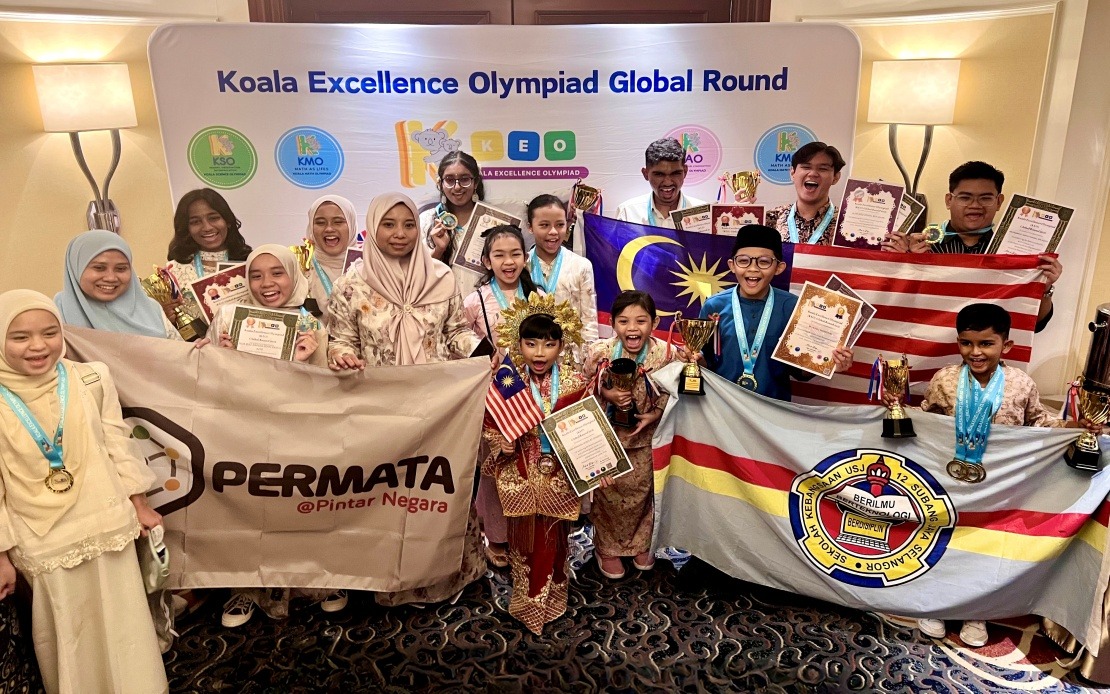
Malaysia's academic contingent has delivered a commanding performance at an international education competition, with seventeen students capturing nine overall prizes and a combined haul of 22 medals at the Koala Excellence Olympiad (KEO) 2026 in Macau. The successful campaign, which concluded on July 5, underscores the nation's growing standing in global academic contests and reflects investments in developing young talent across diverse disciplines. Aidah Misran, who coordinated the Malaysian delegation through the Malaysian Young Scientists Organisation (MYSO), reported that the team secured five gold medals, six silver awards and eleven bronze medals across multiple categories.
The competition, jointly organised by KEO and the Miss Man International Group with Malaysian coordination handled by MYSO, drew student participants from numerous countries to compete in four distinct olympiads covering English, Mathematics, Science and the Arts. The format emphasises higher-order thinking skills, imaginative problem-solving and practical application rather than rote learning methods, aligning with contemporary educational philosophy that prioritises deeper conceptual understanding. This approach contrasts with traditional examination models and reflects a growing international consensus that sustainable academic excellence requires developing adaptable, creative learners capable of tackling unfamiliar challenges.
The Malaysian delegation represented a diverse cross-section of the nation's education ecosystem, combining elite residential college students with performers from well-regarded federal schools. The contingent comprised four students from Kolej PERMATA@Pintar Negara at Universiti Kebangsaan Malaysia, six from Sekolah Menengah Kebangsaan Ungku Aziz, two from Sekolah Sultan Alam Shah, three from Sekolah Kebangsaan Convent (2) Bukit Nanas, and one student each from SMK Convent Teluk Intan, SK USJ 12, SK Seri Hartamas and SK Convent Sentul 1. This geographical and institutional spread indicates that academic excellence in Malaysia is not concentrated in a single school sector but emerges from both selective and mainstream educational institutions across the Klang Valley and beyond.
The standout individual performer was Mukridz Mardzuki, a Year Six pupil from SK Seri Hartamas, who captured the overall Science Olympiad championship in the primary school division. His victory signals that science competency and competitive excellence are being cultivated at primary levels, a development of particular significance given Malaysia's long-term technology and innovation ambitions. At secondary level, Alfie Rizq Danial Azlan from Sekolah Sultan Alam Shah earned runner-up honours in the Science Olympiad, while Sarah Isabel Maryam Ahmad Suhael from SK Convent (2) Bukit Nanas secured second place in the primary school Science category, demonstrating that strength in the sciences spans both age groups.
Beyond the science disciplines, Malaysian competitors achieved prominence across other domains. Ayra 'Adani Muhammad 'Aizat, representing Kolej PERMATA@Pintar Negara at UKM, garnered overall runner-up status in the English Olympiad, indicating that Malaysian students are developing competitive proficiency in language and communication skills on international platforms. This matters considerably for a nation increasingly positioning itself as a knowledge economy where English-language facility is essential for participation in global professional networks and advanced academic programmes.
The distribution of third-place finishes further illustrates the depth of Malaysia's competitive strength. Marvyn Zef Mark Philip registered dual category victories in both Science and English before securing a third-place overall award, demonstrating versatile capability across ostensibly different disciplines. P Prem achieved third place in Science, Muhammad Khairul Mauidz Khairul Azman in Mathematics and AK Shashini in English, collectively representing achievement across the full spectrum of competition categories. Such breadth suggests that Malaysian academic preparation extends across traditional and emerging knowledge domains rather than concentrating narrowly on mathematics or science alone.
The KEO itself represents an important benchmark for measuring Malaysian educational outcomes against international standards. Developed by Australian educational specialists, the programme was deliberately structured to align with international curriculum frameworks rather than nation-specific syllabuses, permitting genuine cross-border comparison of student capabilities. The emphasis on critical thinking and creative application rather than memorisation reflects evolving global understanding of what constitutes authentic learning, a shift that has profound implications for how Malaysian schools design pedagogies and assessments. Several Southeast Asian nations have adopted similar international competition frameworks to elevate educational standards, positioning the region as increasingly competitive in developing knowledge-based talent.
For Malaysian educational policymakers and school leaders, the KEO results provide externally validated evidence regarding student capabilities and areas of strength or development. The success of students from both residential colleges and mainstream federal schools suggests that excellence is accessible across different institutional types, provided adequate resources, motivated educators and rigorous preparation are present. The particular strength in science olympiad categories may reflect Malaysia's historical emphasis on STEM education, though the concurrent success in English olympiads indicates that language and communication remain important dimensions of national capability-building.
The implications for Malaysia's wider educational ecosystem warrant consideration. International competition success, when distributed across multiple schools and student cohorts, creates demonstration effects that motivate younger students to aspire to similar achievement levels. School principals and teachers gain credibility and leverage to secure resources or modify programmes when their institutions produce medal-winning competitors. The winning students themselves become ambassadors for academic excellence, potentially inspiring peers and younger cohorts to invest greater effort in intellectual development. Such cultural shifts in educational values, when sustained over years, ultimately contribute to lifting average achievement levels across entire school systems.
Looking forward, Malaysia's continued participation in international academic olympiads like KEO represents a strategic investment in identifying and nurturing gifted young people. Many competitors who achieve success at these events progress to leadership positions in technology, medicine, business and public service sectors. The international networks established during such competitions—friendships with peers from other countries, exposure to different pedagogical approaches, recognition from foreign educators—often catalyse long-term collaborative relationships and knowledge exchange that benefit Malaysia economically and diplomatically. As the nation pursues its higher-income economy objectives, cultivating students capable of competing and collaborating at international levels becomes increasingly central to national development strategies.

