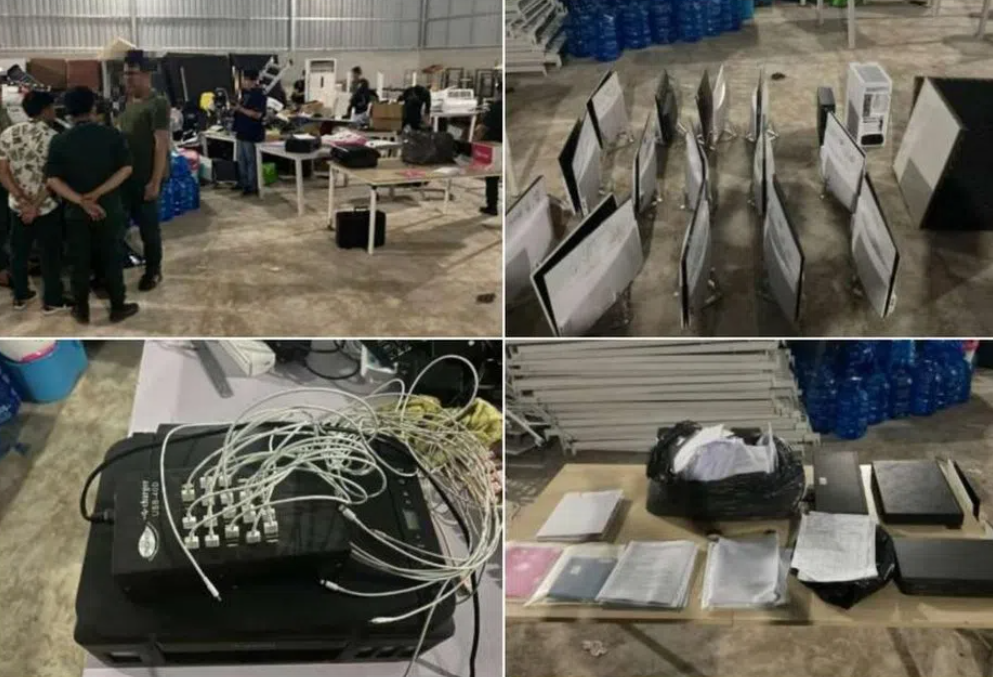
Yip Chee Ming, a 30-year-old Malaysian, has received a jail sentence of 16 months and two weeks for his involvement with an organised crime syndicate based in Phnom Penh that specialised in defrauding Singaporeans. The unusually short duration of his criminal employment—lasting merely three days in late November 2024—underscores both the scale of Southeast Asian transnational fraud operations and the legal reach of authorities across the region. His sentencing on June 26 came after he pleaded guilty to membership in an organised crime group, with a separate charge of cheating taken into consideration during the court proceedings.
The scam operation that briefly employed Yip operated from a five-storey compound in Cambodia's capital and functioned with a distinctly hierarchical structure. Leadership positions were occupied by individuals such as Tang Soon Wah, who oversaw recruitment and operations, whilst supervisors and trainers managed the day-to-day activities of callers like Yip. The trainers played a crucial role in coaching perpetrators on deception techniques, including teaching callers to adopt Singaporean accents to increase credibility during calls to victims. A separate division within the syndicate specialised in money laundering, converting stolen funds into cryptocurrency to obscure their origins and facilitate transfer across borders.
The scale of the syndicate's criminal reach was substantial. Between September 3, 2024, and September 5, 2025, the group orchestrated at least 528 reported scam cases that resulted in losses totalling approximately S$52.5 million. These figures represent only reported incidents, suggesting the true victim count and financial damage likely exceed official tallies. The organisation maintained at least 78 suspected members across various roles, indicating a sophisticated criminal network with sufficient resources and personnel to sustain operations across international boundaries. Such scale points to the growing professionalism and financial viability of Southeast Asian cybercrime networks targeting neighbouring affluent populations.
Yip's path to this brief criminal employment began conventionally enough through personal networks. In October 2024, his friend Jason informed him of an opportunity at the scam centre and invited him to participate, persuading Yip to join the venture. Tang Soon Wah subsequently enrolled both men into a Telegram group and facilitated an all-expenses-paid reconnaissance visit to the Phnom Penh compound, where armed security guards maintained perimeter control. This recruitment methodology—leveraging friendship networks and offering initial inducements—reflects standard practices within transnational organised crime groups seeking to expand their operational capacity with personnel from neighbouring countries.
The financial incentives offered to Yip were substantial relative to Malaysian wage standards. He was promised US$1,800 monthly in cryptocurrency alongside a one per cent commission derived from each victim he successfully defrauded. These compensation structures, combined with paid accommodation and transportation, represent attractive propositions for economically marginalised individuals seeking rapid income generation. The syndicate's ability to offer such remuneration underscores the extraordinary profitability of the fraud operation and explains the persistent supply of recruits willing to migrate temporarily for illicit work despite legal risks.
Yip's actual tenure proved dramatically unsuccessful. Beginning work on November 22, 2024, he was assigned to impersonate bank officers during calls targeting Singaporeans. Despite receiving scripted dialogue and training guidance from syndicate supervisors, he proved incapable of persuading a single victim to comply with the scam protocols. His failure persisted even on his second day of employment. By November 23, 2024, less than 24 hours after his second attempt, Tang terminated his employment and deleted all digital communications with Yip, erasing traces of their connection. The court records provided no detail regarding how Yip returned to Malaysia or the circumstances of his movements between his firing and subsequent arrest.
Law enforcement intervention came approximately ten months after Yip's dismissal. On September 9, 2025, police arrested Yip in Singapore as part of a coordinated operation against the syndicate involving both Singaporean authorities and the Cambodian National Police. Twelve individuals faced charges related to the operation, including Yip. Nine were Singaporean nationals: Deon Tan Ke Yuan, Lester Ng Jing Hai, Christy Neo Wei En, Heiqal Lee, Tay Jun Xiang, Ng Wei Kang, Zachary Lee Jia An, Melvin Tan Wenzheng, and Lau Haoxiang. The remaining defendants included fellow Malaysian Muhamad Asyraf Anuar and Filipino national De Villar Rizalyn Panganiban, illustrating the multinational composition typical of modern organised crime networks in Southeast Asia.
The prosecution's successful conviction of Yip despite his minimal involvement reflects evolving legislative approaches to transnational organised crime. Singapore law permits conviction for membership in criminal syndicates based on formal association with such groups, regardless of individual performance or criminal success. This approach enables authorities to pursue low-level recruits whose identities and movements are more easily tracked compared to offshore leadership figures. However, the strategy raises questions about proportionality and rehabilitation potential, particularly for individuals whose involvement was limited and ultimately ineffective.
Government official impersonation scams have become an escalating concern across Singapore and the broader region. Despite overall reductions in scam case volumes in 2025 compared to previous years, impersonation fraud cases more than doubled, rising from 1,504 incidents in 2024 to 3,363 cases by 2025, establishing it as the fifth most prevalent scam category. This dramatic surge reflects the tactic's proven effectiveness and relatively low operational complexity compared to alternative fraud methodologies. Perpetrators exploit public deference toward official figures and citizens' hesitancy to question callers claiming government authority, particularly when those callers employ culturally appropriate linguistic markers such as local accents.
The implications of this case extend beyond Yip's individual circumstances to illuminate broader trends affecting Malaysia and Southeast Asia. Cambodian territory has become an established hub for transnational fraud operations targeting affluent regional populations, particularly Singapore. The accessibility of Cambodian jurisdiction, the cost-effectiveness of operating from the country, and security challenges limiting law enforcement capacity create conditions favourable to such operations. Malaysian citizens occupy an intermediary position within these networks—geographically and culturally proximate to both recruitment sources and offshore operational bases, yet distinct enough to avoid triggering initial suspicion among potential victims. The cross-border coordination demonstrated between Singaporean and Cambodian authorities suggests increasing regional cooperation, though operational gaps remain.
Legal consequences for syndicate membership carry substantial penalties under Singapore law. Individuals convicted of organised crime group membership face potential fines up to S$100,000, imprisonment for up to five years, or both. Yip's sentence approaching 17 months places him below the statutory maximum but reflects the court's assessment of his minimal actual contribution to the conspiracy. This middle-ground sentencing approach balances deterrence objectives against considerations of limited criminal culpability. For Malaysian residents and readers, the case serves as a cautionary illustration of how temporary engagement with international criminal networks, even when individually unsuccessful, attracts severe legal consequences once detected by coordinated regional law enforcement.
The persistent attraction of such recruitment schemes for Malaysian nationals warrants examination of underlying economic and social vulnerabilities. Unemployment, underemployment, and limited wage growth in certain Malaysian sectors create populations susceptible to promises of rapid, substantial income through illicit means. The syndicate's capacity to recruit multiple participants suggests sophisticated understanding of psychological and economic pressure points within target communities. Addressing the supply side of transnational organised crime recruitment requires not only law enforcement interdiction but also broader economic development initiatives addressing wage stagnation and employment insecurity in source communities.

