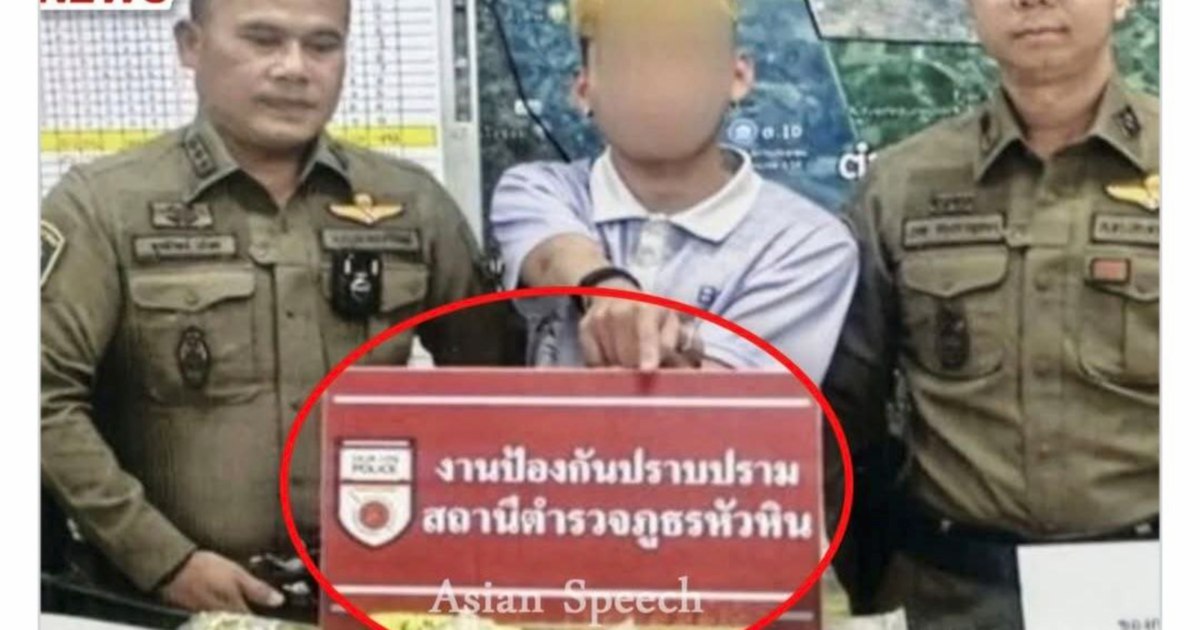
A 20-year-old Malaysian national is now in Thai police custody following the recovery of what authorities describe as a significant methamphetamine haul in the coastal province of Prachuap Khiri Khan. The seizure, made in the Hua Hin district on Saturday, represents one of the region's larger single drug busts in recent months and underscores the ongoing struggle against transnational narcotics trafficking that continues to plague Southeast Asia.
The operation began when Thai law enforcement officers manning a routine checkpoint attempted to conduct a standard vehicle inspection. Rather than comply, the driver of the BMW chose to accelerate through the checkpoint barrier and flee the scene, initiating a pursuit that would ultimately lead to his capture and the discovery of the contraband. The decision to evade authorities rather than submit to inspection proved consequential, as it drew intense police attention and eventual apprehension.
The crystal methamphetamine recovered from the vehicle amounted to 166 kilograms, a quantity that reflects the substantial scale of organised drug operations moving through Thailand's transportation networks. The estimated street value exceeding RM8 million underscores how lucrative the trade remains despite decades of enforcement efforts across the region. This particular seizure demonstrates that despite increased surveillance and interdiction operations, significant drug consignments continue to transit through Thailand with alarming frequency.
For Malaysian readers, the incident carries particular relevance as it highlights the dangers posed by domestic participation in regional drug smuggling networks. Young Malaysians, sometimes recruited as drivers or couriers, face severe legal consequences when apprehended in foreign jurisdictions. Thai drug laws impose extraordinarily harsh penalties, and trafficking offences can result in sentences spanning decades or, in the most serious cases, capital punishment. The arrested individual now confronts a legal process within Thailand's judicial system, where trafficking in large quantities of controlled substances remains among the most severely prosecuted crimes.
The Hua Hin checkpoint incident also reflects broader patterns in regional drug trafficking. Thailand remains a critical transit point for methamphetamine originating from clandestine laboratories primarily located in border regions of Myanmar and Laos. These drugs flow southward through Thailand toward Malaysia and ultimately to broader markets across Southeast Asia and beyond. The use of privately owned vehicles, particularly high-value cars like BMWs, represents a common smuggling method precisely because such vehicles can evade initial suspicion at checkpoints.
Thailand's authorities have intensified drug enforcement operations in recent years, particularly along major transportation corridors and at border checkpoints. However, the continuing detection of large shipments suggests that the volume of trafficking exceeds enforcement capacity. The Hua Hin seizure represents successful interdiction, yet it likely represents only a fraction of narcotics transiting the region daily. This asymmetry between detection and actual trafficking volumes remains a persistent challenge for law enforcement agencies throughout Southeast Asia.
For Malaysia, the arrest underscores the interconnectedness of regional drug problems. Malaysian nationals involved in trafficking operations face not only Thai prosecution but also potential charges at home upon return, including under the Dangerous Drugs Act, which itself carries severe penalties including life imprisonment and mandatory death sentences for trafficking large quantities. Families of those arrested often face profound financial and emotional consequences, yet the lucrative nature of the trade continues to attract participants despite these risks.
The incident also raises questions about how drug networks recruit and deploy individuals in high-risk roles. Young couriers and drivers often occupy the lowest tiers of trafficking hierarchies, bearing maximum legal exposure while earning minimal compensation. Operational security failures that lead to checkpoint encounters typically result in the arrest of these front-line operatives, while higher-level organisers and financiers often remain insulated from direct law enforcement contact. This structural reality means that while seizures like the Hua Hin operation generate important headlines, the networks themselves often continue functioning with replacement personnel.
International cooperation between Malaysian and Thai law enforcement agencies has expanded in recent years, including information sharing and joint operations targeting trafficking syndicates. However, the complexity of cross-border criminal networks and the resource limitations faced by regional authorities mean that comprehensive suppression of the drug trade remains elusive. The arrested individual's case will likely proceed through Thai courts, potentially involving Malaysian consular assistance and coordination between legal systems.
For the broader Southeast Asian context, incidents like this one serve as reminders of the region's vulnerability to organised drug trafficking. Despite increased awareness, improved enforcement capabilities, and stricter laws, the fundamental economic incentives driving the trade persist. Addressing these challenges requires sustained multilateral commitment to supply-side reduction through international cooperation, demand-side interventions including treatment and rehabilitation programmes, and social policies that reduce the vulnerability of young people to recruitment by trafficking networks.

