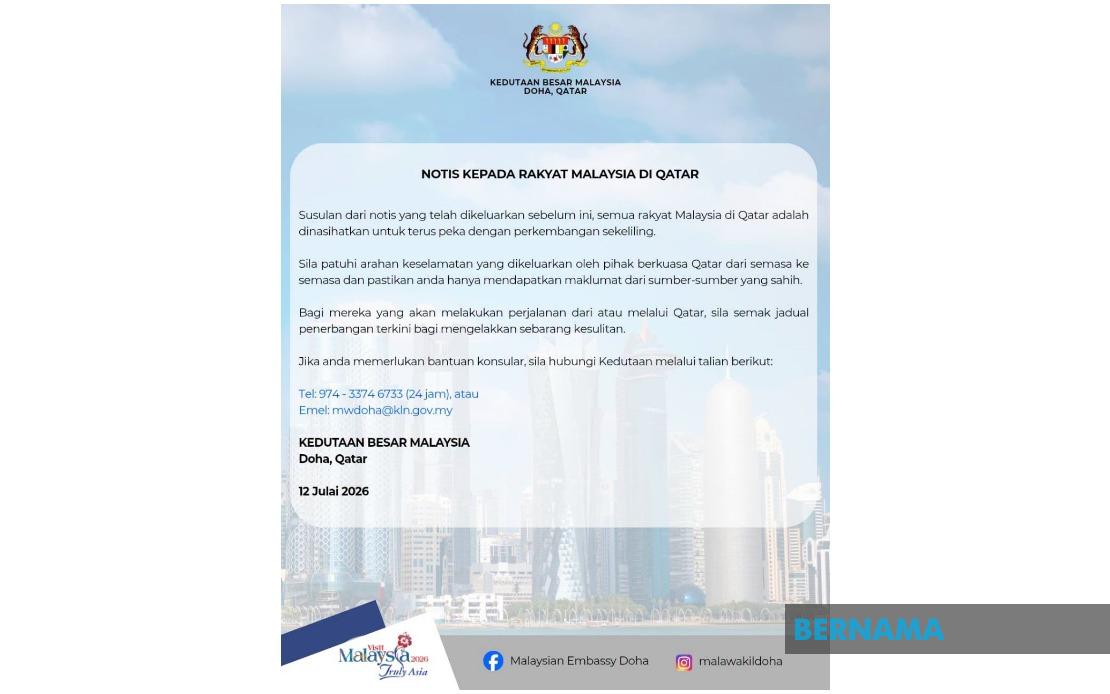
The Malaysian Embassy in Doha has directed all Malaysian citizens currently residing in or transiting through Qatar to remain vigilant and adhere to security protocols issued by local Qatari authorities in light of escalating hostilities between the United States and Iran. The diplomatic mission released the guidance through its official Facebook channels after fresh military strikes over the weekend, emphasizing the importance of staying informed through reliable news sources only and maintaining heightened awareness of their immediate surroundings.
The advisory comes at a time of considerable regional instability in the Persian Gulf. On Sunday, American military forces executed their third round of air strikes against Iranian targets within a single week, continuing a cycle of tit-for-tat military exchanges that has intensified dramatically. The escalation was triggered when Iranian forces attacked a commercial vessel navigating the Strait of Hormuz, one of the world's most critical energy transit routes through which roughly one-fifth of globally traded oil passes.
In response to the US strikes, Iran's Islamic Revolutionary Guard Corps naval component announced an indefinite closure of the Strait of Hormuz, declaring that no commercial or military vessels would be permitted passage through the waterway. The Iranian military specified that this blockade would remain in effect until Washington ceases all military interventions and involvement in the region. This represents a dramatic escalation of tensions given the strategic importance of the strait to global maritime commerce and energy security.
The current crisis is particularly concerning given that a tentative diplomatic breakthrough had seemed imminent just weeks earlier. In June, after months of mediation efforts by Pakistan, both Tehran and Washington reached a memorandum of understanding designed to conclude the broader conflict that erupted in late February. The agreement framework included provisions for an immediate cessation of all military operations across all theaters, withdrawal of the American naval blockade that has suffocated Iran's economy, and crucially, the reopening and restoration of normal traffic through the Strait of Hormuz.
Yet despite this formal accord being in place, both nations have resumed military confrontation this week over disputes concerning maritime passage through the strategic waterway. The reversal demonstrates the fragility of the agreement and the deep mistrust persisting between Washington and Tehran, with neither side willing to take preliminary de-escalatory steps that might signal weakness or compromise their security posture.
For Malaysia, a nation heavily dependent on stable global energy markets and with substantial trade flows through the Gulf region, this geopolitical volatility poses direct economic and logistical challenges. Malaysian businesses maintain significant interests throughout the Middle East, including investments in petrochemical industries, trading operations, and shipping infrastructure. Any prolonged disruption to Strait of Hormuz traffic could trigger supply chain complications and energy price volatility affecting Malaysian consumers and industries.
The Malaysian Embassy's advisory is particularly targeted at the approximately 1,000 to 1,500 Malaysian nationals estimated to reside in Qatar, many of whom work in the energy sector, financial services, or educational institutions. Beyond the resident community, the guidance also addresses Malaysians who may be transiting through Qatar's Doha International Airport, one of the region's major aviation hubs. The embassy specifically counseled travelers to monitor real-time flight schedules carefully, as regional air operations could face disruptions or rerouting due to security concerns or airspace closures.
For those needing immediate assistance, the embassy has maintained its 24-hour emergency hotline at +974-3374 6733, with email support also available. These contact points represent Malaysia's standard consular response protocol for nationals in distress or requiring urgent guidance during overseas crises. The accessibility of round-the-clock support reflects the serious nature of the current situation and the embassy's assessment that events could develop rapidly requiring immediate advice.
The Malaysian government's measured but firm approach—advising vigilance without recommending mass evacuation—suggests confidence in Qatar's internal security apparatus and assessment that the immediate risk to Malaysian nationals remains manageable. However, the advisory does signal official recognition that the situation requires active monitoring and that Malaysian citizens cannot assume normal conditions will prevail in coming weeks.
From a broader Southeast Asian perspective, this instability underscores regional vulnerabilities to external geopolitical conflicts. Southeast Asian nations, including Malaysia, have carefully maintained non-aligned positions regarding US-Iran tensions, seeking to preserve commercial relationships with both powers. Nevertheless, when major powers engage in military confrontation affecting global energy infrastructure and maritime security, the impacts ripple across the entire region regardless of official diplomatic positions.
The situation also highlights evolving patterns in Middle Eastern conflict management. The Pakistan-mediated agreement represented a potential model for regional de-escalation, yet its immediate collapse demonstrates that diplomatic agreements alone cannot sustain peace without fundamental shifts in strategic interests or threat perceptions. For observers throughout Southeast Asia concerned with stability and rules-based international order, the breakdown of the June accord offers sobering lessons about the limitations of mediation when underlying disputes remain intractable.

