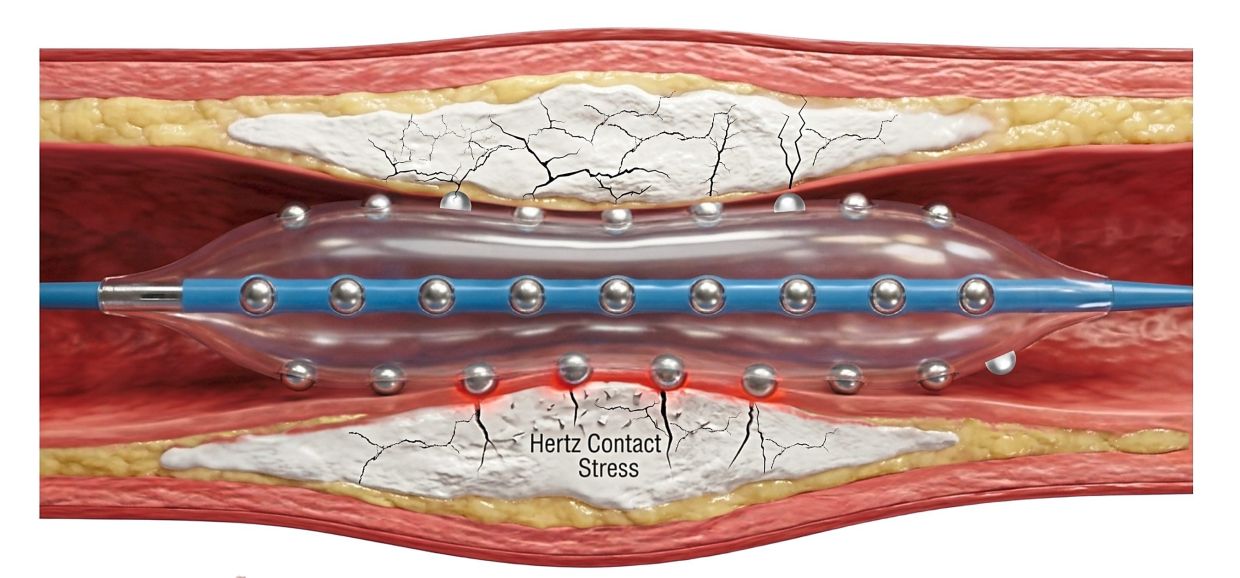
Coronary artery disease remains a leading health threat across Southeast Asia, with calcified plaque buildup presenting one of the most challenging forms to treat. Malaysian cardiologists have now begun evaluating a cutting-edge technology that promises to overcome long-standing limitations in managing severely hardened arteries. The Hertz Contact-IVL System, a novel mechanical lithotripsy device, is being studied by a team led by Datuk Dr Tamil Selvan Muthusamy, a consultant cardiologist, who believes this innovation could transform how doctors approach stubborn calcium deposits that have resisted conventional intervention methods.
Atherosclerotic plaque represents a dangerous mixture of fat, cholesterol, calcium, cellular waste and fibrin that gradually accumulates inside arterial walls. Over time, this buildup narrows blood vessels and restricts blood flow to vital organs. When a coronary artery becomes significantly restricted, oxygen delivery to the heart muscle becomes compromised, triggering serious complications including heart attacks, heart failure and strokes. The severity of these consequences has driven continuous innovation in how physicians address plaque blockages, with treatment strategies now ranging from lifestyle modifications and pharmaceutical interventions to sophisticated surgical and catheter-based procedures.
For soft or moderately calcified plaques, interventional cardiologists have relied on percutaneous coronary intervention, coronary artery bypass grafting and angioplasty. In these techniques, physicians navigate a balloon catheter to the narrowed section and inflate it to crush soft plaque material, expanding the lumen—the hollow space where blood flows. A stent is then implanted to maintain this expanded opening and prevent restenosis, the troublesome renarrowing that can occur afterward. However, severely calcified arteries present fundamentally different technical challenges. The hardened calcium resists traditional balloon pressure, making effective lumen expansion difficult and complicating stent deployment. For these demanding cases, cardiologists have turned to rotational atherectomy, high-pressure balloon angioplasty and intravascular lithotripsy, each with varying degrees of success but also significant drawbacks.
Intravascular lithotripsy represented a genuine breakthrough when introduced globally, using focused sonic pressure waves to fracture stubborn calcium deposits. The technology operates by generating ultrasound pulses that create acoustic pressure waves capable of cracking calcified material that resists mechanical force alone. Yet despite its promise, conventional IVL systems carry notable limitations that restrict their clinical utility. Dr Tamil Selvan explains that existing devices operate within fixed pulse parameters—typically eight or twelve pulses maximum—meaning cardiologists must accomplish calcium disruption within those predetermined cycles. If the calcium proves more resistant than anticipated, additional interventions become necessary. Moreover, the catheter design remains bulky, making insertion into coronary arteries with severe blockages and minimal remaining lumens extraordinarily difficult. The one-size-fits-all balloon diameter further compounds these challenges, since coronary arteries naturally vary in diameter along their length, tapering from wider segments to narrower sections that cannot accommodate a fixed-size device.
The Hertz Contact-IVL System addresses these shortcomings through a fundamentally different mechanical approach. Rather than relying on external energy generators to produce ultrasound pulses, this device incorporates a specially engineered balloon embedded with tiny metallic hemispheres. When the balloon makes contact with hardened plaque and physicians apply pressure, the hemispherical design multiplies and amplifies this force, concentrating pressure at the point of contact to create deep, wide fractures in the calcium. This mechanical advantage enables more effective disruption of dense plaques without requiring external energy sources or adhering to predetermined pulse limits. Critically, the device creates these fractures while minimising trauma to surrounding arterial tissue, allowing the vessel wall to expand properly once the calcium barrier has been breached, facilitating superior stent positioning.
The innovation extends beyond mere technical refinement to address real-world clinical constraints. The improved catheter design demonstrates superior deliverability, allowing cardiologists to navigate it through calcified vessels that would reject conventional IVL catheters. This enhanced manoeuvrability means a single balloon can treat multiple blockages or extensive lesions within one vessel, substantially streamlining procedures and potentially reducing procedural duration and complications. For cardiologists managing complex cases involving diffuse calcification, this represents a meaningful leap forward in technical capability and efficiency. The mechanical lithotripsy principle also eliminates dependence on external generator equipment, simplifying the procedural setup and potentially making the technology more accessible across different hospital settings and resource environments.
Recognising the significance of this innovation for regional cardiovascular medicine, Dr Tamil Selvan and his colleagues undertook a formal research initiative to rigorously evaluate the Hertz Contact-IVL System. The decision to conduct a larger, locally-based study reflects a sophisticated understanding that the developer's preliminary evidence—small studies across multiple United States centres—required validation through more extensive investigation before widespread adoption. This reflects best practice in Southeast Asian medical research, where physicians increasingly recognise the importance of generating regional evidence rather than relying solely on international data that may not account for local patient demographics, disease patterns or healthcare infrastructure variations.
Malaysia's position as a regional medical hub makes this research particularly significant for neighbouring countries. Success with the Hertz Contact-IVL System could establish a new treatment paradigm not just domestically but throughout Southeast Asia, where coronary artery disease burdens continue mounting alongside economic development and changing lifestyles. The prevalence of calcified coronary lesions represents an underappreciated challenge across the region, affecting disproportionate numbers of patients who have delayed seeking cardiac care or who possess multiple cardiovascular risk factors. Many such patients previously faced limited options, with severely calcified arteries representing nearly insurmountable obstacles to percutaneous intervention, forcing choices between high-risk surgical bypass grafting or medical management alone.
The clinical implications of improved calcium-cracking technology extend beyond individual patient outcomes to reshape how cardiologists approach risk stratification and treatment planning. Currently, the presence of severe coronary calcification often relegates patients toward either surgical revascularisation or conservative medical therapy, decisions that carry substantial morbidity, mortality and cost implications. A reliable percutaneous method for managing calcified lesions could shift treatment paradigms, offering patients less invasive alternatives while reducing hospitalisation durations and healthcare expenditures. For Malaysia's healthcare system, where economic efficiency remains paramount and patient acceptance of less invasive procedures remains high, this potential represents substantial value.
The research team's methodical evaluation of device safety profiles demonstrates the rigorous approach required before introducing novel interventional technologies into clinical practice. By comprehensively assessing the Hertz Contact-IVL System's performance characteristics, complication rates and efficacy metrics, Dr Tamil Selvan's group will generate evidence essential for regulatory approvals, clinical guideline recommendations and practitioner training protocols. Their commitment to local investigation rather than passive acceptance of international marketing claims strengthens Malaysia's standing as a cardiovascular research destination and ensures that new technologies introduced domestically meet locally-relevant safety and efficacy standards.
Looking forward, successful validation of the Hertz Contact-IVL System could catalyse broader adoption across Southeast Asian hospitals, particularly in tertiary centres equipped for advanced interventional cardiology. The technology's mechanical design offers inherent advantages in varied clinical environments, since it eliminates external generator dependencies that can complicate logistics in regions with less standardised infrastructure. Regional cardiologists increasingly recognise that innovation tailored to address specific technical challenges—rather than simply importing solutions designed for other markets—ultimately serves patient populations most effectively. Dr Tamil Selvan's team exemplifies this philosophy, investigating not whether this technology can work, but whether it works optimally for Malaysian and regional patients with complex coronary disease.

