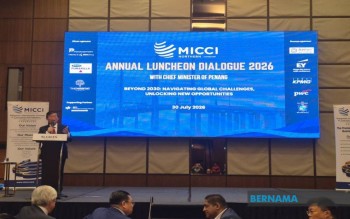
The Malaysian International Chamber of Commerce and Industry has issued a strategic call for businesses across the country to substantially increase their investment in workforce development and technological innovation, emphasising that such measures are now essential for maintaining competitiveness in an increasingly complex global marketplace. The push comes as artificial intelligence, automation and digitalisation fundamentally alter the operational landscape across industries, prompting organisations to rethink their human capital strategies and long-term growth plans. Speaking at the MICCI Northern Branch Annual Luncheon Dialogue 2026 in George Town on July 30, Datuk Brian Tan Guan Hooi outlined how technological transformation presents a dual narrative of disruption and possibility for Malaysian enterprises.
The MICCI Northern Branch chairman stressed that while rapid technological advancement undoubtedly poses challenges for traditional business models and established workforce structures, it simultaneously creates pathways to entirely new industries and employment categories offering substantially higher value-addition. This transformation demands that Malaysian companies move beyond viewing technology adoption as a cost-cutting measure and instead recognise it as an opportunity to unlock new revenue streams and strengthen their market position. The challenge, however, lies in ensuring that the nation's talent pipeline can meet these evolving demands. Companies must go beyond simply hiring employees with relevant academic credentials; they must actively cultivate workforces equipped with technical proficiency, creative problem-solving abilities, effective communication capabilities and most critically, the intrinsic motivation to continuously acquire new skills throughout their careers.
Tan's remarks, delivered to an audience that included Penang Chief Minister Chow Kon Yeow as guest of honour, underscore a growing anxiety among Malaysia's business leadership that educational and training systems have fallen behind industry requirements. The disconnect between what educational institutions produce and what employers actually need represents a significant barrier to competitiveness. For Malaysian firms competing regionally against Singapore, Thailand and Vietnam, and globally against multinational corporations, the ability to develop and retain skilled talent has become a primary differentiator. Without deliberate investment in continuous workforce development programmes, many Malaysian companies risk finding themselves unable to leverage emerging opportunities created by technological disruption.
The emphasis on innovation represents another critical dimension of MICCI's message to its membership. Beyond simply adopting existing technologies, businesses must cultivate internal capacity for developing novel solutions tailored to their specific market contexts. This requires allocating resources not just to technology infrastructure but to fostering a culture that encourages experimentation, tolerates calculated failure and rewards creative thinking. Malaysian enterprises, particularly small and medium-sized enterprises that form the backbone of the economy, often lack the scale to compete on innovation with larger competitors, yet specialisation and niche innovation can provide sustainable competitive advantages.
Tan articulated that businesses must fundamentally shift their strategic perspective from managing immediate operational challenges to systematically building long-term capabilities that position them for sustained growth. This requires patient capital willing to invest in research and development, talent acquisition and organisational transformation—investments that may not yield immediate returns but prove invaluable over three to five-year horizons. In the Malaysian context, where many family-owned businesses dominate the corporate landscape, such forward-thinking approaches sometimes clash with traditional management philosophies focused on maintaining stability and predictability.
The MICCI chairman also emphasised that no single sector can successfully navigate this transformation alone. He called for considerably deeper and more substantive collaboration between government and the private sector, arguing that both parties bring essential but incomplete capabilities to the table. Government possesses the authority to establish regulatory frameworks, direct public investment and shape the foundational infrastructure upon which businesses operate. The private sector, conversely, brings capital, innovation capacity, operational expertise and the employment opportunities that translate policy into real economic outcomes. When these sectors operate in silos or with competing interests, the entire economy suffers; when they collaborate constructively, the multiplier effects can be substantial.
Tan stressed that ongoing dialogue between industry representatives and policymakers remains indispensable for ensuring that government policies, infrastructure investments and support mechanisms actually address the genuine needs of businesses rather than reflecting assumptions disconnected from operational reality. Malaysia's history shows numerous instances where well-intentioned policies have missed their targets because they were designed without sufficient input from those who would implement them. Continuous engagement creates feedback loops that allow governments to adjust course and businesses to understand the reasoning behind policy choices, building mutual understanding and trust.
The MICCI itself, which traces its institutional lineage back to 1837 and celebrates its 189th anniversary this year, positions itself as precisely the kind of intermediary institution capable of bridging the government-business divide. Having served Malaysian commerce for nearly two centuries, the organisation brings historical perspective on how businesses have navigated previous transformations and upheaval. Its role in facilitating dialogue between the public and private sectors, translating industry insights into practical policy recommendations and providing platforms for business leaders to collectively articulate their requirements has become increasingly valuable during periods of rapid change.
For Malaysian policymakers and business executives, the MICCI message carries significant implications. The window for proactively adapting to technological transformation remains open but is steadily closing. Nations and companies that invest aggressively now in talent development and innovation will position themselves to capture disproportionate shares of value creation in the post-2030 economy. Those that delay or pursue incremental adjustments risk finding themselves increasingly marginalised in global supply chains and regional competition. Malaysia's competitive position depends substantially on whether its business community heeds this call and whether government and business can collaborate effectively to create the conditions for such transformation to flourish across the economy.

