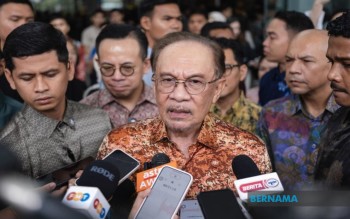
Prime Minister Datuk Seri Anwar Ibrahim has drawn a clear line in Malaysia's tax policy debate, declaring that the government will not resurrect the broad-based Goods and Services Tax despite ongoing discussions about reforming the nation's consumption tax framework. Speaking at the TikTok Shop Summit 2026 here on August 20, Anwar—who also holds the Finance Minister portfolio—emphasised that protecting lower-income Malaysians from increased tax burdens remains non-negotiable, even as the administration explores ways to strengthen tax revenue and improve fiscal efficiency.
The distinction Anwar articulated reflects a fundamental shift in how his government approaches taxation philosophy compared to the previous administration. The GST, which was scrapped in 2018 following widespread public pressure over rising living costs, was designed as a broad-based consumption tax that would have applied universally across income groups and sectors. Anwar's categorical rejection of this mechanism signals that the MADANI government's economic priorities differ markedly from its predecessor's approach, prioritising social protection over aggressive revenue expansion through indirect taxation.
However, the Prime Minister's firmness on rejecting GST principles does not translate to a frozen tax regime. Anwar indicated that the government remains receptive to targeted adjustments within the current Sales and Service Tax structure, which Malaysia implemented as GST's replacement. These refinements could enhance how the SST functions in practice, addressing inefficiencies or gaps that have emerged since its introduction six years ago. This nuanced position suggests the government is seeking middle ground between maintaining tax fairness and addressing legitimate fiscal pressures.
The taxation debate in Malaysia has intensified amid discussions about potential revenue sources beyond conventional measures. Various proposals have circulated, including levies on electronic payment transactions designed to broaden the tax base and capture economic activity in the digital realm. Such proposals reflect the challenge facing middle-income governments attempting to fund public services and infrastructure while managing voter expectations about cost-of-living pressures. For Malaysia, where income inequality remains a persistent concern, these discussions carry particular weight.
Anwar's emphasis on protecting the poorest segment of the population reflects broader MADANI governance philosophy, which has marketed itself as more socially conscious than previous administrations. The decision to retain SST rather than revert to GST aligns with campaign messaging that prioritised the welfare of ordinary Malaysians over fiscal optimisation favoured by technocrats. This approach resonates with lower and middle-income voters who bore the brunt of increased prices during the GST period.
The government's openness to incorporating certain GST components—while rejecting its foundational principles—indicates flexibility in how consumption taxes might evolve. Policymakers could theoretically adopt specific administrative mechanisms or targeted applications from the GST model without implementing the universal broad-based approach that Anwar has ruled out. This suggests potential future refinements that maintain progressivity while improving efficiency and compliance.
Understanding the Malaysian tax context requires appreciating the political sensitivity surrounding any consumption tax in a country where affordability concerns loom large. The 2018 GST abolition represented not merely a policy shift but a public referendum on the government's commitment to ordinary households. Any serious attempt to reintroduce broad-based consumption taxation would face formidable political resistance and could undermine public confidence in the MADANI administration's stated social priorities.
For Southeast Asian observers, Malaysia's tax trajectory offers insights into the delicate balance between fiscal sustainability and social legitimacy. Governments across the region face similar pressures: the need to strengthen tax bases and improve public finances while managing voter anxiety about living costs and income adequacy. Malaysia's experience suggests that tax policy cannot succeed purely through technocratic design; political viability and public acceptance remain essential components.
The government's willingness to refine SST implementation also acknowledges that the current system, while politically popular, contains inherent inefficiencies. The SST applies selectively to certain goods and services rather than comprehensively, creating avoidance opportunities and complexity. Strategic adjustments could potentially improve revenue collection without imposing the equity concerns that plagued GST, though identifying such measures requires careful policy design and stakeholder consultation.
Anwar's statements at the TikTok summit represent more than routine political commentary; they constitute a binding policy commitment that shapes future economic governance. By explicitly rejecting GST reintroduction, the Prime Minister has constrained his administration's policy space, making it politically difficult to reverse course without provoking accusations of betrayed promises. This self-imposed constraint reflects confidence that SST modifications can adequately serve fiscal requirements.
Looking ahead, the real challenge for Malaysian policymakers involves identifying specific SST improvements that enhance progressivity, expand the tax base, and improve administrative efficiency simultaneously. Whether those goals prove compatible without resorting to broader consumption taxes will determine whether the government's current tax framework suffices for medium-term fiscal sustainability. The coming years will reveal whether SST refinements can deliver the revenue growth and fairness objectives that the MADANI government has committed to pursuing within its stated boundaries.

