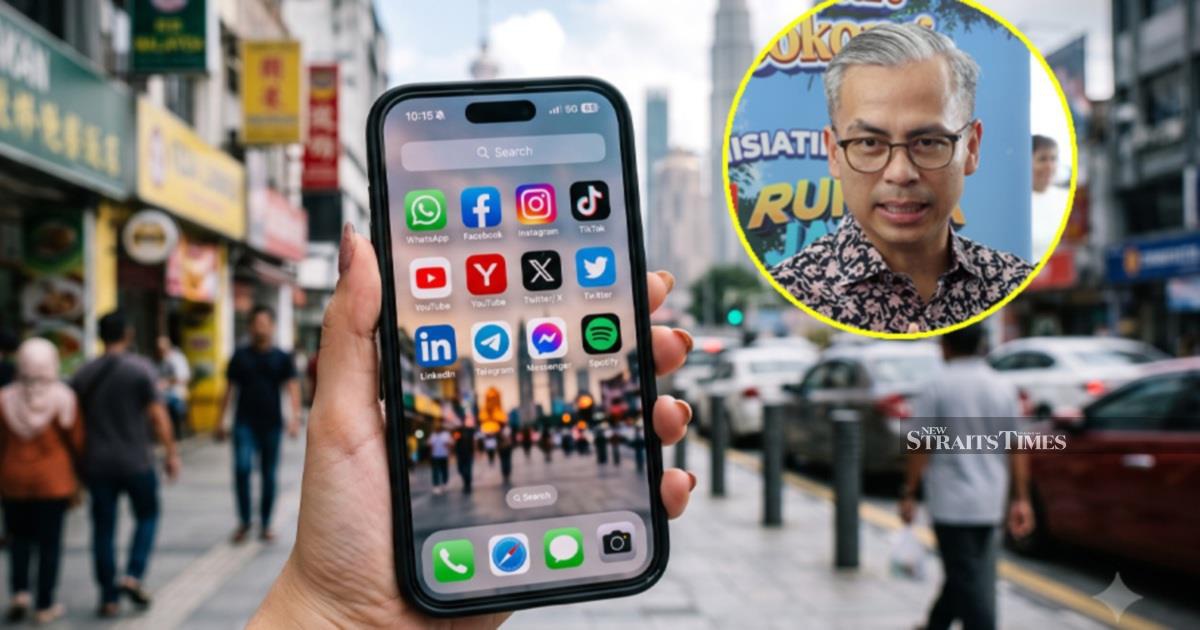
Malaysia's Communications Ministry has unearthed an extensive network of fraudulent social media accounts deployed to sow discord across the nation's digital landscape. Communications Minister Datuk Seri Fahmi Fadzil announced the discovery of over 1,800 inauthentic accounts, many of which have been systematically amplifying inflammatory content centred on Malaysia's most sensitive constitutional and social boundaries: race, religion, and royalty (3R). The revelation underscores the escalating sophistication of coordinated inauthentic behaviour on social platforms and highlights the vulnerability of Malaysian online discourse to manipulation campaigns that exploit deep-rooted societal tensions.
The 3R framework represents sacred ground in Malaysia's foundational social contract. Constitutional provisions protecting Malay-Muslim privileges, coupled with the institution of the royal families across the federation, form pillars of national stability. Religion—particularly Islam's special position—occupies similarly protected status. When bad-faith actors deliberately weaponise discussions around these topics through fake accounts, they do not merely peddle falsehoods; they deliberately inflame sentiment on matters where genuine disagreement has historically threatened communal peace. The concentration of fraudulent activity on 3R content suggests a calculated strategy to destabilise intercommunal relations precisely where Malaysian society remains most fragile.
The mechanics of such disinformation campaigns typically involve coordinated networks of inauthentic accounts that artificially amplify divisive narratives. A single inflammatory post, when boosted by hundreds of fake accounts appearing to engage authentically, generates the illusion of spontaneous grassroots sentiment. Malaysian audiences, encountering such amplified content repeatedly across their feeds, may assume it reflects genuine public opinion, when in reality it represents the manufactured signal of coordinated bad actors. This distortion of the information ecosystem's basic integrity poses risks far beyond mere misinformation—it can erode trust in legitimate discourse and push genuine citizens toward polarised extremes.
The discovery raises significant questions about platform accountability and border-crossing challenges in digital governance. Major social media companies—Facebook, Twitter, TikTok, and Instagram—operate globally but face inconsistent pressure to moderate content and remove fake networks according to local sensitivities. What constitutes a "sensitive" topic in Malaysia may differ from thresholds set in Silicon Valley or other jurisdictions. Despite repeated commitments from tech platforms to combat inauthentic behaviour, the persistence and scale of Malaysia's fake account ecosystem suggests that global enforcement remains patchy and reactive rather than proactive. Malaysian regulators detect these networks only after they have already circulated divisive material widely.
The timing of this disclosure carries particular relevance for Malaysia's digital governance framework. The government has previously signalled intent to strengthen online safety mechanisms while navigating the thorny balance between protecting free expression and preventing harmful speech. The Communications Ministry's capacity to identify 1,800 fake accounts reflects strengthened monitoring capabilities, yet the sheer volume suggests the tip of a much larger iceberg. If Malaysian authorities are detecting these networks now, many others may already be operating undetected, continuing to degrade the quality and trustworthiness of public conversation.
International precedent demonstrates that state actors, rival political factions, and commercial operators all maintain capacity to deploy fake account networks for strategic advantage. During elections in established democracies, such campaigns have shifted voter perception and behaviour. In polarised societies, they have fanned communal violence. Malaysia's recent experience with political turbulence and communal sensitivities makes it a plausible target for both international disinformation actors and domestic bad-faith players seeking to destabilise institutions or gain electoral or social advantage.
The response from the government must balance transparency with security. Disclosing the discovery of fake accounts serves a legitimate public interest—citizens deserve to understand the health of their information environment and recognise potential manipulation. However, revealing precise methodologies or platform vulnerabilities exploited by bad actors risks enabling more sophisticated campaigns. The Communications Ministry faces pressure to share sufficient detail with the public to encourage media literacy while restraining information that might serve would-be manipulators.
Tech platforms bear primary responsibility for cleaning their networks, yet Malaysia cannot depend entirely on external actors. Regional coordination among Southeast Asian governments on standards for platform accountability has strengthened in recent years, though implementation remains inconsistent. Malaysia might leverage multilateral forums and bilateral pressure on major platforms to establish faster response mechanisms specifically for content exploiting 3R sensitivities—a distinctly Malaysian concern that global platforms may not automatically prioritise.
For ordinary Malaysians, the discovery carries a sobering lesson about digital hygiene. When encountering inflammatory content on social media, especially around 3R topics, users should interrogate source credibility, cross-reference claims against established news outlets, and resist the impulse to share content designed to provoke emotional reaction. The persistence of fake account networks proves that bad actors bet on Malaysian citizens unconsciously amplifying their disinformation. Breaking that chain requires individual vigilance alongside institutional safeguards.
The broader implication for Malaysian society is clear: the digital realm has become a contested space where actors hostile to national stability can inflict real damage on social cohesion without ever coordinating in the physical world. The identification of 1,800 fake accounts represents success in detection, yet the underlying vulnerability remains. Malaysia's path forward requires sustained investment in monitoring capabilities, cooperation with platforms, public education about digital manipulation, and rigorous protection of the democratic spaces where citizens can debate contentious issues without manipulation distorting the conversation.

