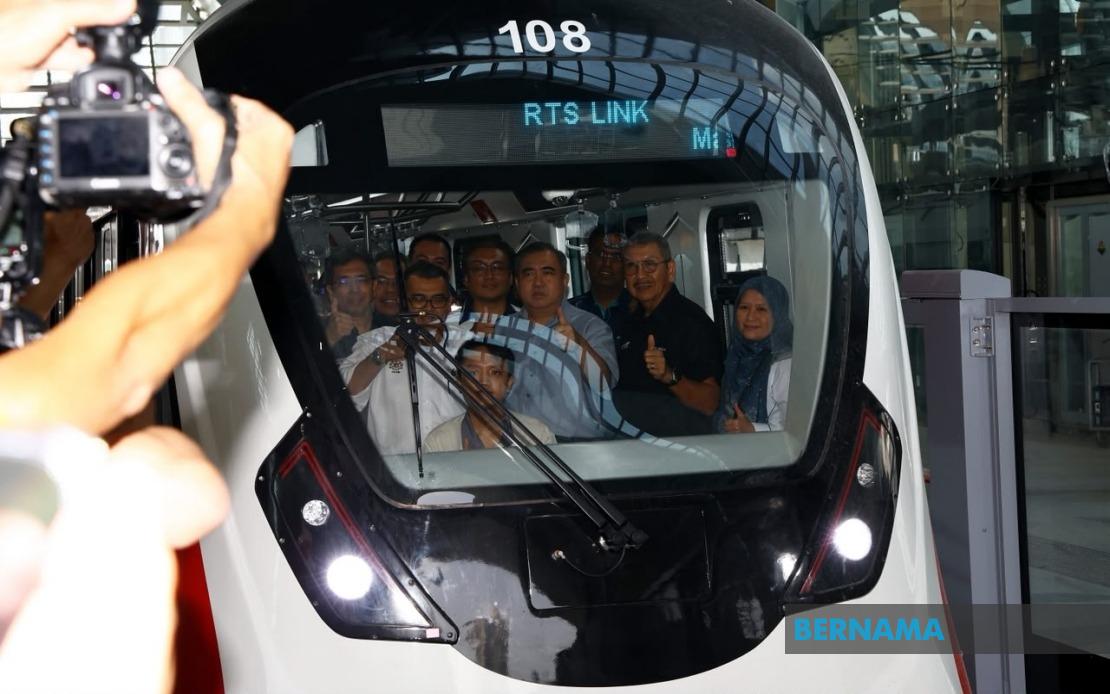
The Malaysian government is investing RM60 million in a dedicated pedestrian bridge to link the Bukit Chagar RTS Link Station directly to the KTMB Komuter service, marking a significant step towards creating a seamless cross-border transit experience. Transport Minister Anthony Loke announced the project after inspecting the construction site in Johor Bahru, confirming that the Ministry of Economy has approved the initiative and the Ministry of Transport will oversee execution. The bridge represents a practical response to operational challenges identified during the planning phase of the Rajah-Woodlands Two-Way RTS Link, which begins operations on January 1, 2025.
Currently, commuters using KTMB Komuter services who wish to access the Bukit Chagar RTS Link must navigate through JB Sentral, adding unnecessary distance and time to their journeys. The proposed bridge will eliminate this circuitous routing by enabling direct pedestrian access between the two terminals. This connectivity enhancement addresses a critical gap in the region's integrated transport infrastructure, particularly for daily commuters travelling between Johor Bahru and Singapore. The approximately 12-month construction timeline positions the bridge for completion well after the RTS Link's opening, suggesting a phased approach to infrastructure deployment rather than delaying the cross-border service itself.
The RTS Link is engineered to handle substantial passenger volumes, with capacity reaching 10,000 passengers per hour in each direction. The ability to accommodate this throughput depends heavily on efficient feeder services and seamless transfers at the Bukit Chagar terminus. By integrating the Komuter network directly into the station complex, the government reduces congestion at JB Sentral and distributes passenger flows more effectively across the broader transportation network. This design principle reflects international best practices in multi-modal hub development, where various transit modes converge around a central interchange point.
Beyond the bridge itself, the government is pursuing an ambitious expansion of bus services through the Stage Bus Service Transformation (SBST) 2.0 programme. This initiative will introduce a minimum of 200 additional buses to serve residential and commercial areas throughout Johor Bahru, with routes designed to funnel passengers directly to Bukit Chagar. The Ministry of Finance is finalising financial arrangements with the operator, ensuring that the bus network expansion synchronises with the RTS Link's launch. This coordinated rollout demonstrates a comprehensive approach to last-mile connectivity, addressing how passengers will reach the Bukit Chagar hub from dispersed locations across the city.
The integration strategy extends beyond buses and Komuter services. Loke emphasised that Bukit Chagar will function as a comprehensive multi-modal transport hub, incorporating JB Sentral, e-hailing services, and other public transport options within a unified ecosystem. This architectural vision transforms the station from a simple interchange into a central mobility hub that accommodates diverse travel preferences and income levels. Users can transition seamlessly between taxis, ride-sharing applications, buses, commuter rail, and the RTS Link within a single coordinated environment. For Malaysian travellers and cross-border commuters, this integration substantially reduces friction and decision-making around transport choices.
The technical implementation phase of the RTS Link project is progressing steadily toward operational readiness. The physical structures—including the station building, the Customs, Immigration and Quarantine (CIQ) complex, and associated infrastructure—have reached completion. The project has now entered the rigorous testing and commissioning phase, during which engineers conduct system integration testing to ensure all mechanical, electrical, and software components function harmoniously. This phase includes fault-free runs and trial operations that simulate real-world conditions, establishing confidence that systems will perform reliably when handling actual passenger traffic.
From a Malaysian and regional perspective, the RTS Link represents a landmark achievement in cross-border infrastructure cooperation. The project directly addresses transportation challenges faced by Johor Bahru residents who commute to Singapore for employment, education, or commerce. The high capacity and frequency of RTS Link services—projected to carry significantly more passengers than existing alternatives—will reduce travel times and provide greater reliability than road-based alternatives, which are increasingly subject to congestion. For Singapore, the link enhances access to Johor's growing economic zones and residential areas, supporting the broader vision of an integrated Johor-Singapore economy.
The RM60 million bridge investment demonstrates that the government recognises potential integration gaps and is willing to allocate additional resources to address them. Rather than launching the RTS Link with suboptimal connections, decision-makers have approved supplementary infrastructure to maximise the project's effectiveness. This approach reflects learning from previous transport development projects where inadequate feeder services or poor inter-modal connections limited the adoption of flagship transit investments. The bridge essentially represents insurance against the RTS Link operating below its potential due to transferable factors within the control of Malaysian authorities.
For businesses and investors in the Johor Bahru region, the convergence of improved public transport infrastructure—including the RTS Link, expanded bus services, and enhanced Komuter connections—creates compelling opportunities. Companies currently hesitant to locate in areas with inadequate transit access may reconsider their positioning. The multi-modal hub at Bukit Chagar positions the area as increasingly attractive for office development, retail expansion, and residential growth. The improved labour mobility facilitated by efficient cross-border transit reduces talent acquisition costs for employers while expanding job accessibility for workers across both sides of the causeway.
The testing and commissioning phase represents a critical proving ground for operational reliability. International experience demonstrates that the gap between successful technical commissioning and actual passenger operations can be substantial. The project team must validate not only that individual systems function correctly but that they interact properly under peak-demand conditions. The CIQ complex, in particular, requires flawless coordination between Malaysian and Singapore authorities to maintain service quality and prevent queuing that could cascade into passenger dissatisfaction. The January 1, 2025 launch date is firm, and any shortcomings in testing will require rapid resolution rather than schedule adjustment.
Looking forward, the RTS Link serves as a template for deeper Malaysia-Singapore infrastructure integration. Successful operation of this cross-border transit corridor will likely stimulate discussions around additional connectivity projects, whether rail-based, bus rapid transit, or toll-free road improvements. The investment in feeder services like the RM60 million bridge and SBST 2.0 demonstrates that both governments recognise that flagship infrastructure requires supporting systems to realise its potential. For Malaysian policymakers, the lesson is clear: major transport investments demand complementary investments in first and last-mile connectivity to ensure actual usage patterns match theoretical projections.

