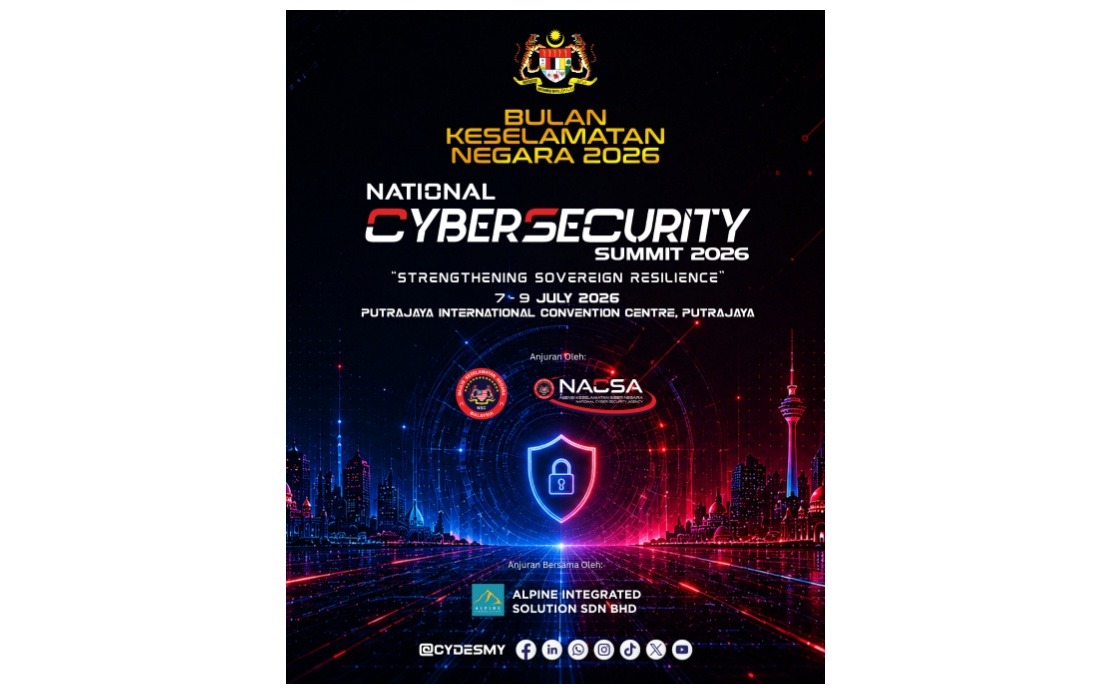
Malaysia's cybersecurity landscape will take centre stage next month when the National Cyber Security Agency (NACSA), operating under the Prime Minister's Department's National Security Council (MKN), convenes the National Cyber Security Summit 2026 at the Putrajaya International Convention Centre (PICC) from July 7 to 9. The three-day gathering represents a pivotal moment for the country's ongoing efforts to fortify its digital infrastructure against an expanding range of sophisticated threats.
The timing of the summit carries particular significance given Malaysia's recent legislative advancement in this domain. Just days before the event, the Dewan Rakyat passed the Cybercrimes Bill 2026 on July 1, marking a watershed moment in the nation's legal framework for digital security. This new legislation emerges directly from the implementation of the Malaysian Cyber Security Strategy (MCSS) 2025-2030, a comprehensive national roadmap designed to guide Malaysia's cybersecurity priorities and investments over the coming years. The alignment between the new bill and the summit demonstrates a coordinated governmental approach to addressing digital threats.
Organised under the banner "Strengthening Sovereign Resilience," the summit positions cyber preparedness as integral to Malaysia's national sovereignty and economic stability. This thematic focus reflects a broader Southeast Asian concern about digital vulnerability in an era where cyber attacks increasingly target critical infrastructure, financial systems and governmental operations. By emphasising sovereignty alongside resilience, Malaysia signals its determination to develop indigenous capabilities and reduce dependence on external actors for cybersecurity solutions.
The scale of participation underscores the event's regional and international importance. The summit will accommodate 3,000 participants drawn from multiple constituencies, including government officials, private sector representatives, academics and technology professionals. Among these will be 96 speakers and panellists spanning government agencies, enforcement bodies, technology companies, universities and the broader cybersecurity community. The presence of 122 exhibiting companies—78 from Malaysia and 44 international firms representing seven countries—indicates strong international interest in Malaysia's cyber market and its security challenges.
The summit's substantive programming reflects the complexity of contemporary cybersecurity challenges. Organisers have structured 41 high-impact sessions encompassing multiple specialised tracks: forums dedicated to the Malaysian Cyber Security Strategy, a dedicated cyber crime focus area, an Information and Communications Technology Security Officers convention, initiatives promoting women in cybersecurity fields, and technical workshops addressing cutting-edge security issues. This architecture ensures that the summit addresses both strategic policy questions and technical implementation concerns.
Beyond the traditional conference format, NCSS 2026 will serve as the launching platform for three consequential national initiatives that will shape Malaysia's cybersecurity trajectory. Prime Minister Datuk Seri Anwar Ibrahim is scheduled to unveil the National Security Policy (DKN) 2026-2030, establishing the overarching security framework that contextualises cyber defence within broader national security architecture. Equally significant is the introduction of the National Cryptography Policy (MyKriptografi) and its accompanying action plan spanning 2026-2030, recognising that encryption capabilities form the technical backbone of cybersecurity resilience across both government and commercial sectors.
The introduction of the Artificial Intelligence Systems Cybersecurity Framework (AISCF) carries particular weight given the rapidly expanding integration of artificial intelligence across Malaysian enterprises and government operations. As AI systems become increasingly embedded in critical processes, the framework will establish guidelines for securing these systems against novel attack vectors and ensuring that AI implementations do not themselves introduce vulnerabilities. This proactive approach positions Malaysia among early movers in addressing AI-specific security challenges.
The summit's integration with National Security Month (BKN) amplifies its messaging beyond the immediate conference audience. By situating the cyber security summit within a broader national security awareness campaign, the government reinforces public understanding of digital threats while elevating cybersecurity consciousness across the population. This educational dimension proves particularly valuable in Southeast Asia, where cybersecurity literacy remains unevenly distributed and awareness campaigns can drive behavioural change in both organisational and individual contexts.
The presence of 250 locally distinguished guests alongside the broader delegate population reflects Malaysia's effort to embed cybersecurity concerns into elite policy networks and corporate decision-making structures. When board members, senior government officials and prominent academics attend such events, cybersecurity concerns gain elevated status within institutional hierarchies, often translating into increased budget allocations and executive attention to digital risk management.
For Malaysia's regional position, the summit demonstrates the nation's aspirations to serve as a cybersecurity hub within Southeast Asia. The participation of international companies and speakers from multiple countries creates knowledge-sharing opportunities while positioning Malaysian expertise on the regional stage. As cyber threats increasingly recognise no borders and attacks frequently originate from or transit through multiple jurisdictions, regional cooperation mechanisms and shared standards—advanced through events like NCSS 2026—become essential to collective security.
The summit's emphasis on public-private partnership reflects modern cybersecurity's inherent complexity. Critical infrastructure, financial systems and healthcare networks exist in hybrid governance spaces where government authority and private sector efficiency must operate in concert. NCSS 2026's structure, which brings together officials, corporate leaders and security practitioners, acknowledges this reality and creates forums where such collaboration can be negotiated and strengthened.
Looking forward, the outcomes from the summit—whether measured through new policy commitments, industry initiatives, or international cooperation agreements—will likely reverberate through Malaysian cybersecurity practices well beyond July 2026. The combination of new legislation, national policies and strategic frameworks launched during the event establishes reference points that will guide institutional behaviour and resource allocation across Malaysia's public and private sectors for years to come. For organisations operating in Malaysia or managing assets with Malaysian exposure, tracking the summit's outcomes becomes essential for understanding the regulatory and operational environment ahead.

