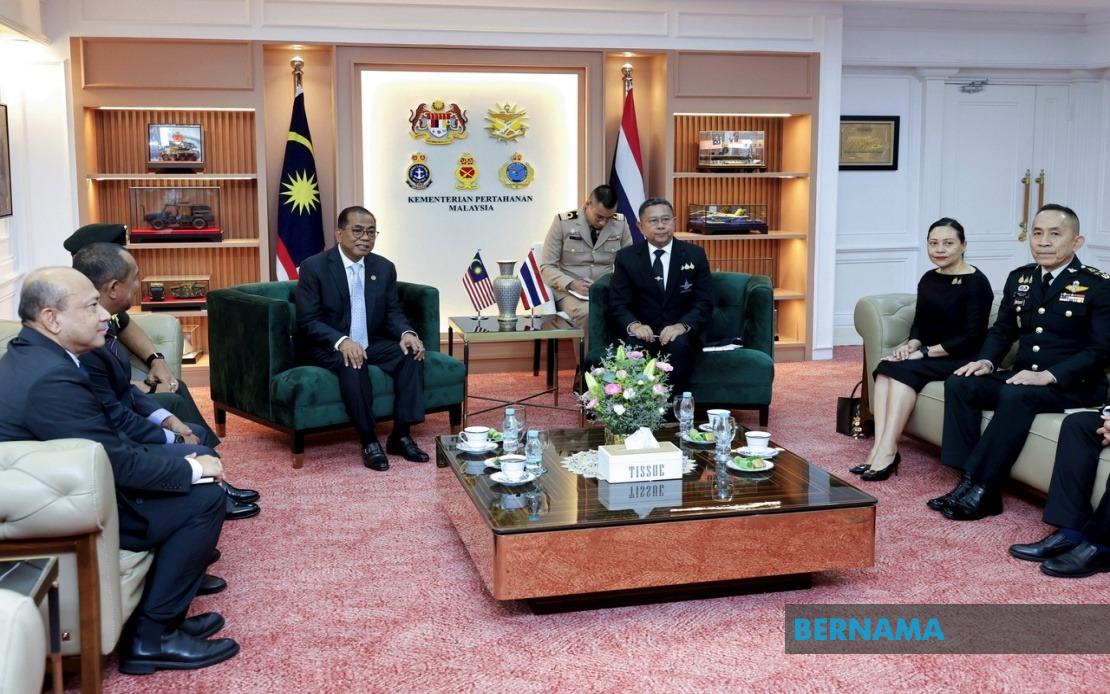
Malaysia has signalled its readiness to forge stronger partnerships with Thanut Suvarnananda, who recently assumed leadership of the Royal Thai Government's Peace Dialogue Panel, as both nations intensify their push toward lasting stability in Thailand's volatile southern provinces. The commitment emerged during official discussions between Malaysian Defence Minister Datuk Seri Mohamed Khaled Nordin and visiting Thai Defence Minister Lieutenant General Adul Boonthumjaroen, underscoring how neighbouring countries continue to calibrate their diplomatic machinery around one of Southeast Asia's most intractable conflict zones.
Malaysia's embrace of Thanut's appointment reflects the strategic importance Kuala Lumpur assigns to Thailand's internal peace process. Mohamed Khaled articulated this measured optimism by framing the appointment as an opportunity to accelerate consensus-building and institutional coordination on cross-border issues. The Defence Minister's remarks suggest that Malaysia views personnel changes within Thai governance structures not as mere administrative shuffles, but as potential catalysts for resetting negotiating dynamics and injecting fresh momentum into stalled peace initiatives. His confidence appears grounded in the belief that new leadership brings different perspectives and enhanced political capital to overcome longstanding impasses.
Central to Malaysia's approach is the role played by Datuk Rabin Basir, who serves as Malaysia's appointed facilitator for the Southern Thailand Peace Dialogue. This intermediary position allows Kuala Lumpur to maintain productive engagement without overstepping the boundaries of Thai sovereignty. The distinction matters considerably in a region where nations remain acutely sensitive to external interference in domestic affairs. By positioning itself as a facilitator rather than a protagonist, Malaysia navigates the delicate balance between offering meaningful regional support and respecting Bangkok's ultimate authority over its own security and political frameworks.
Mohamed Khaled was notably explicit about the circumscribed nature of Malaysia's involvement, stressing that while the country actively supports peaceful resolution efforts, operational military matters and internal security remain exclusively Thailand's domain. This clarification carries particular weight given historical sensitivities surrounding cross-border conflicts and the militarisation of civilian spaces. For Malaysian observers and policymakers, the statement reassures domestic constituencies that regional cooperation does not entail surrendering decision-making authority or assuming responsibilities that properly belong to sovereign governments.
Beyond the headline issue of southern Thailand's peace process, the two Defence Ministers identified complementary security priorities requiring enhanced bilateral coordination. Smuggling along the Malaysia-Thailand frontier has emerged as a persistent challenge, with illicit trafficking networks exploiting porous border areas to move contraband and potentially facilitate movement of militant operatives. The agreement to intensify these interdiction efforts through the Malaysia-Thailand General Border Committee signals recognition that transnational crime and security threats demand sustained, multilevel responses. Such cooperation reflects the practical reality that uncontrolled border regions create vacuums that hostile actors readily exploit.
The scheduled 57th General Border Committee Meeting, which Malaysia will host this year, represents a formal opportunity to institutionalise these commitments. The anticipated agenda encompasses border security infrastructure, collaborative military operations, socio-economic initiatives in frontier communities, and disaster preparedness mechanisms. This breadth reflects how contemporary border management extends far beyond traditional military surveillance to encompass development, humanitarian concerns, and resilience-building. The inclusion of socio-economic development initiatives particularly suggests that both governments recognise that durable security requires addressing root causes of instability, including economic marginalisation and limited livelihood opportunities in border zones.
Malaysia has also positioned itself as a champion of the so-called ASEAN Way in addressing Bangkok's territorial disputes with Cambodia. By supporting Thailand's preference for bilateral negotiations conducted through peaceful dialogue rather than confrontational posturing, Malaysia reinforces a regional norm of conflict de-escalation. The decision to inform the Philippines, designated as ASEAN Chair for 2026, about this stance demonstrates strategic planning and an effort to ensure that forthcoming regional leadership will encourage mediation rather than antagonism. For Southeast Asian stability more broadly, such quiet diplomacy can prove more effective than public pressure in building consensus around non-coercive approaches to disputed boundaries.
The alignment of Malaysian and Thai positions ahead of the ASEAN Defence Ministers' Meeting and its expanded variant represents procedural coordination that often receives insufficient attention. Such pre-meeting synchronisation allows countries to present coherent blocs, influence agenda-setting, and amplify messages about regional security priorities. For Malaysia, establishing this alignment with a key neighbour enhances its diplomatic weight within ASEAN councils and signals to the association's wider membership that Southeast Asian powers maintain shared commitments to institutionalised dialogue mechanisms and peaceful dispute resolution.
A particularly significant development emerging from the bilateral engagement concerns the planned Memorandum of Understanding on defence industry cooperation. This initiative transcends immediate security challenges to address longer-term structural questions about military modernisation and technological self-sufficiency. By strengthening defence manufacturing partnerships, Malaysia and Thailand can reduce dependence on external suppliers, develop indigenous capabilities tailored to regional contexts, and create economic opportunities within their respective defence sectors. Such initiatives also carry subtle geopolitical messaging about Southeast Asian technological advancement and reduced vulnerability to supply chain disruptions or coercive economic pressure from external powers.
For Malaysia specifically, these developments reflect a foreign policy orientation that treats regional stability as a prerequisite for national prosperity. Thailand's southern conflict, while geographically distant from peninsular Malaysia, nonetheless generates security implications including potential spillover effects, refugee flows, and militant recruitment networks. By investing in Thai peace efforts, Malaysia advances its own security interests while positioning itself as a constructive regional player committed to institutional cooperation. The pattern also demonstrates how bilateral defence dialogue increasingly encompasses non-traditional security domains, from border management to development cooperation, reflecting evolved understanding of what constitutes contemporary security threats and responses.

