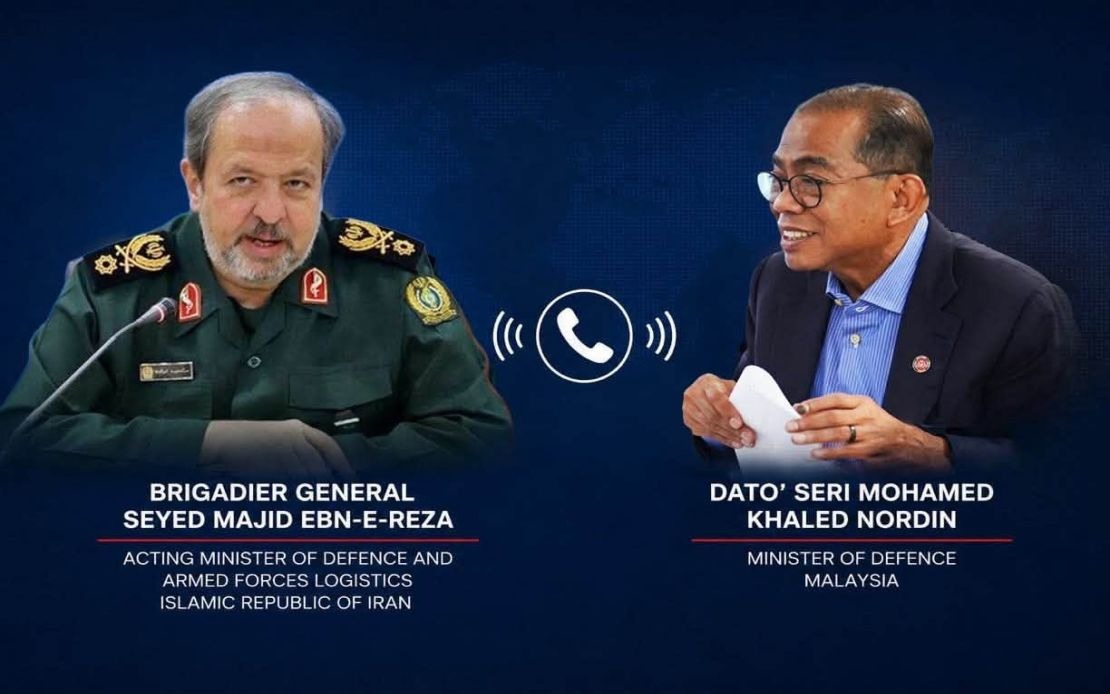
Malaysia is moving to formalise and expand its defence relationship with Iran, marking a significant step in deepening military-to-military engagement between the two nations. Defence Minister Datuk Seri Mohamed Khaled Nordin conveyed this intent during a telephone discussion with Iran's Acting Minister of Defence and Armed Forces Logistics, Brigadier General Seyed Majid Ebn-e-Reza, underscoring the shared strategic interests that bind the two countries together.
Central to Malaysia's approach is the pursuit of a formal Memorandum of Understanding on defence cooperation, which would institutionalise the partnership and provide a structured framework for military collaboration. Such an instrument would move beyond ad hoc engagement to establish clear mechanisms for sustained cooperation across multiple defence domains. The finalisation of this MoU represents Malaysia's seriousness in elevating bilateral defence relations from the diplomatic level to practical military coordination, potentially covering areas such as training, technology exchange, and joint exercises.
The Malaysian government has also extended an invitation to Iran to participate in the Langkawi International Maritime and Aerospace Exhibition next year, positioning the regional defence showcase as a platform for broader engagement. LIMA, one of Asia's premier defence exhibitions, attracts military delegations and defence contractors from across the globe, making it an ideal venue for Iran to demonstrate its military capabilities while fostering networking opportunities with Malaysian counterparts. This participation would symbolise Iran's integration into the regional defence dialogue and signal Malaysia's openness to closer partnerships within the Indo-Pacific strategic environment.
Beyond the operational aspects of defence cooperation, Datuk Seri Mohamed Khaled expressed Malaysia's sympathy regarding the loss of Iranian military personnel, security officials, and civilians caught in the ongoing West Asian conflict. This acknowledgment reflects Malaysia's humanitarian concerns and its balanced approach to regional security matters, where the country seeks to maintain dialogue channels with multiple stakeholders while prioritising civilian welfare and regional stability.
The Malaysian Defence Minister reiterated his government's hope for sustained ceasefire arrangements and the continuation of diplomatic initiatives aimed at resolving tensions through negotiation rather than military escalation. Malaysia's emphasis on dialogue and peaceful resolution aligns with the country's historical position as a neutral actor capable of engaging constructively with diverse parties in regional disputes. This diplomatic stance contrasts with more confrontational approaches and positions Malaysia as a voice for restraint within Southeast Asia.
Datum Seri Mohamed Khaled also highlighted Iran's self-reliant approach to defence development, acknowledging the country's capacity to independently design and manufacture defence systems. This recognition of Iranian military prowess carries implications for Malaysia's own defence industry ambitions, particularly as Southeast Asian nations seek to reduce dependency on external suppliers and develop indigenous capabilities. Iran's experience in developing indigenous defence technologies under international constraints offers potential lessons for Malaysian defence planners considering domestic production pathways.
The discussion also touched upon a matter of critical importance to Malaysia's economic and strategic interests: the security of maritime passages, particularly the Strait of Hormuz. As a trading nation heavily dependent on global commerce, Malaysia has a vested interest in ensuring unobstructed maritime routes, especially through one of the world's most economically vital chokepoints. Malaysia's appreciation of Iran's cooperation in safeguarding maritime security during regional conflicts underscores the practical dimensions of the relationship beyond traditional military concerns.
The timing of this initiative occurs within a broader context of Malaysia's strategic recalibration in an increasingly multipolar world. As traditional great powers compete for influence in Southeast Asia and the Indian Ocean region, Malaysia's cultivation of relationships with nations like Iran reflects a pragmatic foreign policy that seeks to avoid excessive dependency on any single power bloc. By engaging constructively with Iran while maintaining relationships with other regional and global actors, Malaysia positions itself as a bridge-builder capable of facilitating dialogue across dividing lines.
For Malaysia, deepening defence cooperation with Iran carries several strategic dimensions. First, it diversifies Malaysia's defence partnerships and reduces reliance on a limited set of traditional suppliers and partners. Second, it enhances Malaysia's soft power by positioning the country as a neutral, multilateral actor committed to regional stability. Third, it opens potential avenues for technology transfer and knowledge-sharing in areas where Iran has developed significant expertise, particularly in asymmetric warfare countermeasures and indigenous defence production. Finally, it strengthens Malaysia's diplomatic leverage in multilateral forums where Middle Eastern and Asian interests intersect.
The proposed MoU would likely establish mechanisms for regular high-level military engagement, facilitate defence personnel exchanges, and potentially enable joint research initiatives in mutually beneficial areas. Such frameworks typically include provisions for addressing security concerns through consultation, thereby reducing the risk of misunderstanding or escalation. For Malaysia, a structured relationship reduces uncertainty while providing flexibility to adjust engagement levels based on evolving circumstances and national interests.
The Defence Minister's comments also reflect Malaysia's pragmatic approach to international relations in the Middle East and broader Muslim world. Despite geopolitical complexities and varying positions on regional conflicts, Malaysia recognises the value of maintaining functional relationships with diverse actors. This approach enables Malaysia to play a constructive role in international forums, facilitate dialogue between conflicting parties, and advance Malaysian interests without becoming entangled in others' disputes.
Looking forward, the successful conclusion of the defence cooperation MoU would mark a watershed moment in Malaysia-Iran relations. It would signal Malaysia's intention to engage Iran as an important strategic partner while maintaining its broader commitments to regional stability and multilateral cooperation. For Southeast Asia more broadly, such partnerships demonstrate the region's capacity to engage with various global actors independently, shaping its own security architecture rather than being shaped entirely by external powers. Malaysia's approach offers a model of strategic autonomy that balances openness with prudence, engagement with selectivity, and multilateralism with national interest.

