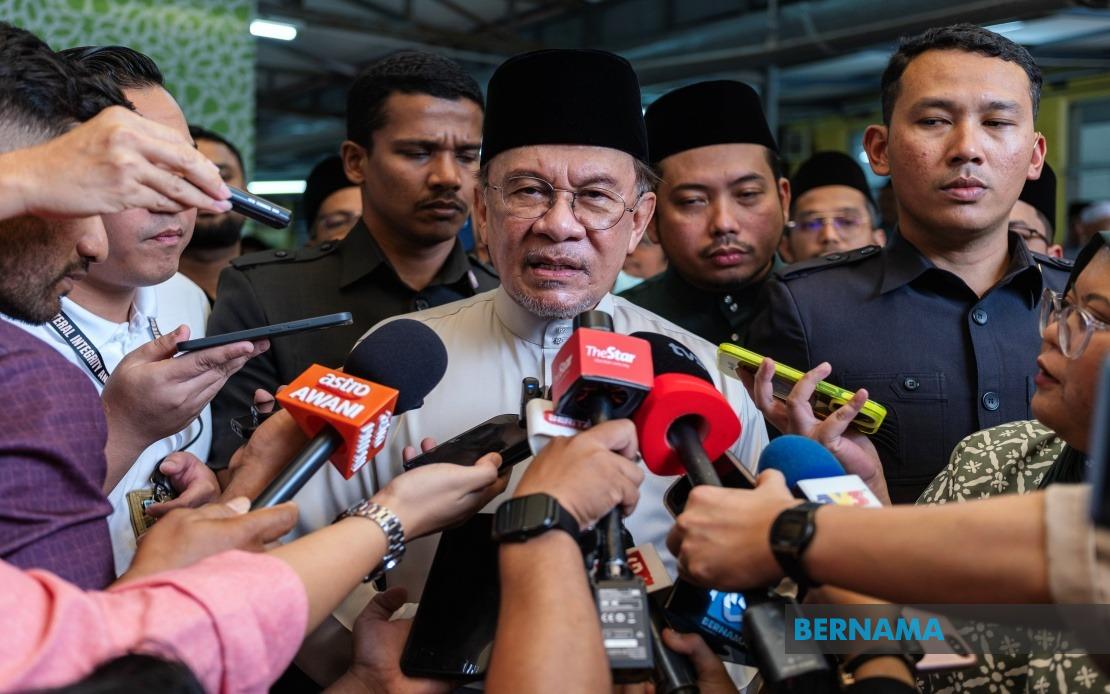
Malaysia will not waver in its position regarding fugitive businessman Low Taek Jho, commonly known as Jho Low, regardless of any moves by the United States to consider him for a presidential pardon, Prime Minister Datuk Seri Anwar Ibrahim declared on Friday. The statement comes as international media reports suggest that Jho Low may be among approximately 250 individuals under consideration for clemency by US President Donald Trump as part of celebrations marking America's 250th Independence Day.
Anwar made his remarks after attending Friday prayers at Masjid As-Sodiqin in Taman Kobena, emphasizing that while the US possesses the sovereign right to make its own decisions, such developments would have no bearing on Malaysia's legal and diplomatic approach to the matter. The Prime Minister's comments reflect the government's determination to maintain consistency in its long-running pursuit of accountability related to the 1Malaysia Development Berhad (1MDB) scandal, in which Jho Low played a central role in one of the world's most significant financial fraud cases.
The businessman has remained a fugitive for years, evading Malaysian authorities who have pursued multiple charges against him connected to the massive embezzlement scheme that depleted sovereign wealth funds. His case has become emblematic of Malaysia's broader commitment to tackling high-level financial crimes and recovering billions in misappropriated public money. The Malaysian government has consistently pursued extradition and legal action against Jho Low across various jurisdictions, making any pardon from a major ally a particularly sensitive matter for the country's leadership.
Anwar's unequivocal stance underscores a fundamental principle that has guided Malaysia's response to the 1MDB affair since the change of government in 2018: adherence to the rule of law and international legal frameworks, regardless of external pressures or geopolitical considerations. The Prime Minister framed the issue in terms of Malaysia's independent judicial authority and its refusal to be swayed by decisions made in other nations, no matter how influential those nations may be in global affairs. His comments suggest that the government views the potential pardon consideration not as grounds for recalibration of Malaysia's position, but rather as a test of the country's resolve to pursue justice through legitimate channels.
The timing of these pardon reports, coinciding with American Independence Day celebrations on July 4, adds a layer of diplomatic sensitivity to bilateral relations between Malaysia and the United States. While Anwar's remarks carefully avoided any accusation or criticism of the US, they implicitly affirmed that Malaysia reserves the right to pursue its own legal and diplomatic objectives independently. This measured but firm approach reflects the delicate balance the Malaysian government must maintain: preserving the important strategic partnership with Washington while protecting national interests in recovering assets and ensuring accountability for those responsible for one of the largest corruption scandals in recent history.
Political observers in the region have noted that Jho Low's case remains deeply sensitive in Malaysia, particularly given its connection to the tumultuous political transitions of recent years and its ongoing impact on public discourse around governance and institutional accountability. The businessman's activities and the subsequent investigations exposed significant vulnerabilities in Malaysia's financial oversight systems and international anti-corruption mechanisms. For the current government under Anwar, maintaining an uncompromising stance on such matters carries substantial symbolic weight, signaling to both domestic audiences and international partners that Malaysia remains committed to transparency and accountability in public administration.
Apart from the Jho Low matter, Anwar disclosed that he has received notice of a proposed one million ringgit contribution from the United States directed toward the restoration and preservation of Tugu Negara, the National Monument. This initiative is intended to align with Malaysia's National Day celebrations in 2025, marking a year of particular significance for the nation. The restoration project represents a symbolic gesture of bilateral cooperation and shared commitment to preserving national heritage, and the Prime Minister indicated that the proposal would be formally deliberated during the Cabinet's next weekly meeting.
The National Monument has held profound significance in Malaysian national consciousness since its dedication in 1966, commemorating the sacrifices made during the struggle for independence and the early period of nation-building. The structure requires ongoing maintenance and restoration to preserve its architectural integrity and historical value for future generations. The American contribution, if approved, would add an international dimension to what is fundamentally a domestic heritage conservation effort, underscoring how nations can cooperate on cultural preservation even while maintaining distinct positions on other political matters.
The cabinet's consideration of this proposal will likely proceed separately from discussions regarding Jho Low and broader law enforcement cooperation between the two countries. The dual nature of Anwar's announcements—simultaneously asserting Malaysia's independence on a sensitive legal matter while acknowledging American generosity toward national heritage—illustrates the nuanced choreography required in maintaining productive bilateral relationships. Malaysia continues to value its partnership with the United States across multiple domains, from defense and security cooperation to trade and educational exchange, while insisting on the right to pursue its own judicial and diplomatic objectives without external interference.
Looking forward, Malaysia's handling of the Jho Low matter will continue to serve as a test case for how developing nations assert their sovereignty in pursuing accountability for transnational financial crimes, particularly when powerful nations may have different policy preferences. The government's resolve, as articulated by Anwar, sends a clear signal to both its own citizens and the international community that Malaysia regards the recovery of stolen public assets and the prosecution of those responsible as non-negotiable priorities, grounded in fundamental principles of justice and the rule of law that transcend temporary diplomatic considerations or geopolitical calculations.

