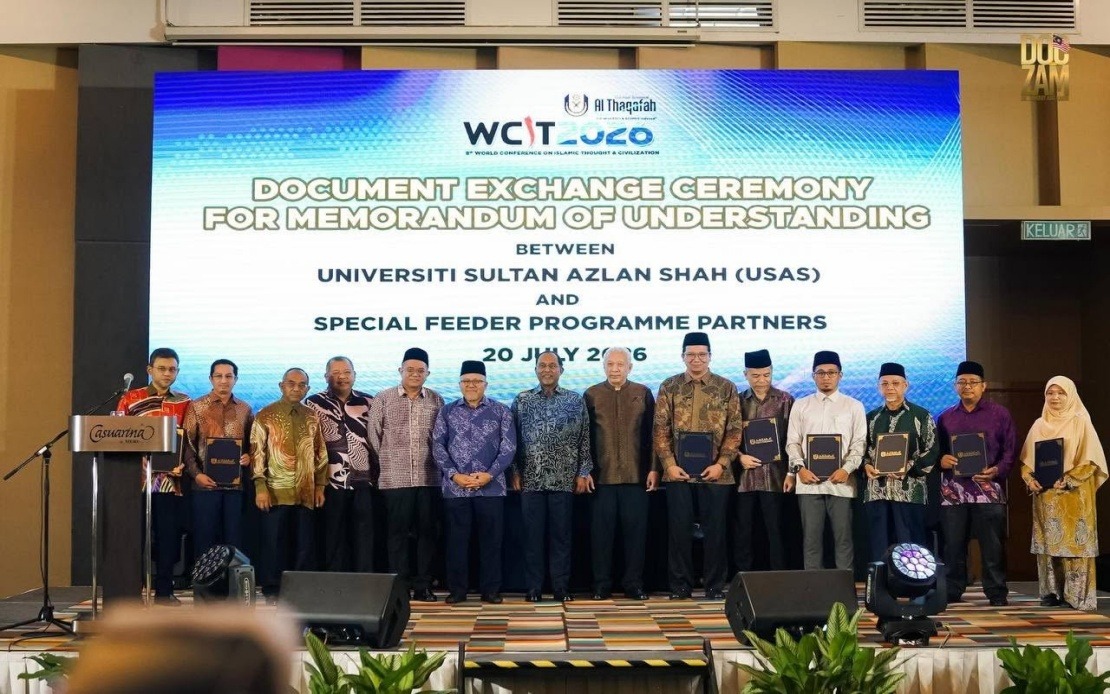
Malaysia is cementing its ambition to serve as a pivotal forum for intellectual exchange and academic advancement in the Islamic world, with Higher Education Minister Datuk Seri Dr Zambry Abdul Kadir outlining the country's broader vision during the opening of the 8th World Conference on Islamic Thought and Civilisation (WCIT2026). The three-day gathering, hosted by Universiti Sultan Azlan Shah, represents a significant moment for Malaysia to demonstrate its capacity to convene leading academics, researchers, and thinkers from across the globe around shared intellectual challenges facing contemporary Muslim societies and humanity at large.
The minister articulated a framework that extends beyond Malaysia's traditional role in Southeast Asian affairs, positioning the nation as a deliberate bridge between diverse scholarly perspectives and a catalyst for building durable international networks. This aspiration reflects a strategic calculation that higher education and knowledge production have become central to how nations establish soft power and cultural influence in an increasingly multipolar world. By hosting WCIT2026, Malaysia signals that it understands the premium now attached to hosting prestigious academic conferences and attracting elite intellectual networks—elements that directly enhance a nation's global standing and attractiveness to researchers and students worldwide.
Datuk Seri Dr Zambry's remarks at the inaugural dinner, which drew more than 180 international delegates, underscored a departure from what he characterised as mere nostalgia for past Islamic civilisational achievements. Instead, he argued that contemporary Muslim societies must ground their future progress in rigorous knowledge creation, sustained research investment, technological innovation, and institutional excellence in higher education. This framing is significant because it acknowledges the intellectual and material foundations required for meaningful advancement, moving beyond rhetoric to address the concrete infrastructure—universities, research facilities, funding mechanisms—that underpins competitive knowledge economies.
The minister's insistence that education transcend the boundaries of political contestation, regional conflict, and technological tribalism addresses a real tension in contemporary academic life. His assertion that knowledge constitutes a shared human heritage rather than a possession of any single nation or civilisation carries particular resonance in Southeast Asia, where countries compete intensely for regional academic prestige whilst also recognising mutual benefits from collaborative research. For Malaysia specifically, this stance positions the country as a neutral and principled venue for scholarship, an approach that could enhance its attractiveness to international academics who might otherwise face pressures from their home governments.
The historical examples Datuk Seri Dr Zambry invoked—the destruction of Baghdad's intellectual infrastructure, the fall of Granada, the devastation in Sarajevo, and ongoing destruction in Palestine—serve a dual analytical function. First, they underscore the vulnerability of civilian knowledge institutions during periods of conflict and instability, a concern that resonates across the developing world and particularly in regions experiencing political turbulence. Second, they implicitly argue that preserving and strengthening universities and research capacity today constitutes a form of civilisational resilience and future-building, an argument that should appeal to policymakers concerned with long-term national development.
For Malaysian stakeholders, the WCIT2026 platform offers concrete opportunities. Universities across the country gain access to international scholarly networks and potential collaboration opportunities. Graduate students and early-career researchers benefit from exposure to leading thinkers and the possibility of establishing academic partnerships that can advance their own work. The hosting of such a conference also generates economic activity through accommodation, catering, and associated services, though these material benefits pale beside the intangible value of enhanced institutional reputation and soft power projection.
Regionally, Malaysia's commitment to positioning itself as a hub for Islamic thought dialogue has implications that extend across Southeast Asia and beyond. In an era when intellectual traditions and civilisational narratives increasingly shape geopolitical competition, a Malaysian-centred platform for discussing Islamic thought offers an alternative to other regional competitors. It suggests that Malaysia seeks to move beyond being merely a transit hub for commerce or a nation-state pursuing conventional economic development, toward becoming a centre of cultural and intellectual significance within Islamic and global academic spheres.
The emphasis on generating resolutions and new ideas that serve the ummah and global community reflects an understanding that legitimacy in contemporary knowledge production requires demonstrated relevance to practical challenges. Conferences that produce only academic papers but no actionable insights risk irrelevance. By framing WCIT2026 as a vehicle for generating solutions to pressing problems facing Islamic societies and the broader world, Datuk Seri Dr Zambry positions the gathering as serious intellectual labour rather than ceremonial performance. This approach aligns with growing pressures on universities globally to demonstrate that knowledge production yields tangible benefits beyond academia itself.
The broader context suggests Malaysia is pursuing a deliberate strategy to leverage its geographical position, Islamic heritage, and institutional capacity to establish itself as a major node in global knowledge networks. This ambition requires sustained investment not only in hosting conferences but in building world-class research institutions, attracting top-tier faculty from around the world, and creating ecosystems where innovation and scholarship flourish. The WCIT2026 gathering represents a visible milestone in this longer journey, a moment when Malaysia places itself on the international academic map and signals its willingness to engage as a serious interlocutor in shaping contemporary Islamic thought and responding to global challenges through rigorous scholarly work.

