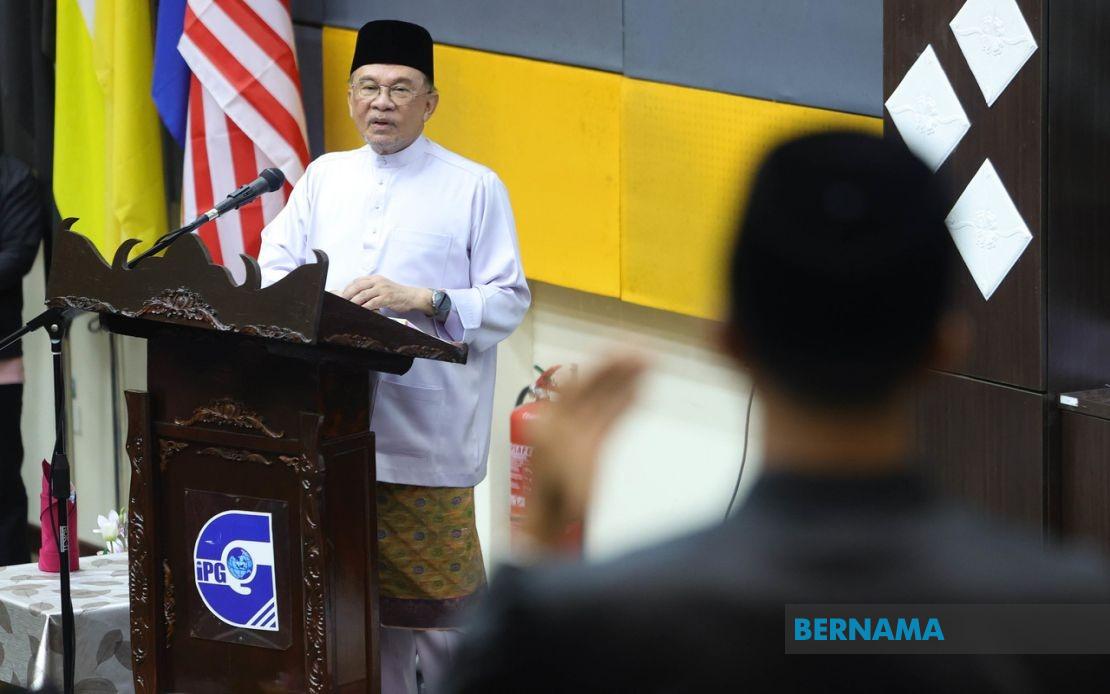
Malaysia's education landscape must evolve to produce educators who possess dual competencies: mastery of cutting-edge technologies and an unwavering commitment to ethical principles and human values, Prime Minister Datuk Seri Anwar Ibrahim stressed in Nilai on July 17. Speaking at an education forum attended by Education Minister Fadhlina Sidek and IPGKPT director Dr Kartini Abdul Mutalib, Anwar articulated a vision for the nation's teaching workforce that goes beyond technical proficiency to encompass the moral and cultural dimensions essential for national development.
The rapid pace of global technological disruption demands that Malaysia's educational infrastructure adopt a fundamentally different approach, the Prime Minister cautioned. Maintaining existing curricula and pedagogical methods while the world undergoes transformative change risks leaving Malaysian students and educators behind in the competition for innovation and economic advancement. The alternative—a system that continuously evolves and adapts—requires institutions willing to embrace new frameworks and methodologies that reflect contemporary realities. This adaptability, Anwar suggested, forms the cornerstone of whether Malaysia can position itself as a competitive player in the global knowledge economy during the coming decades.
However, Anwar drew a critical distinction between technological competence and genuine educational excellence. The mere accumulation of technical skills, he argued, represents an incomplete foundation for teaching and learning. Without concurrent development of character, ethical grounding, and humanistic values among both educators and students, technical mastery becomes divorced from purpose and direction. The Prime Minister encapsulated this philosophy in his assertion that Malaysia must "reach for the skies while keeping our roots on the ground"—a formulation that captures the tension between forward momentum and cultural continuity that characterises modern Malaysian society.
This balanced approach reflects broader anxieties about the trajectory of technological adoption in developing nations. As countries increasingly integrate artificial intelligence, data analytics, and automated systems into educational delivery, policymakers worldwide grapple with questions about whether such tools fundamentally alter the nature of learning itself. Anwar's position suggests that Malaysia should adopt technology strategically while preserving the ethical and relational dimensions of education that cannot be algorithmically replicated. Religion, culture, morality, and values-based instruction deserve equal institutional commitment alongside STEM disciplines.
The Prime Minister's remarks carry particular weight given Malaysia's ongoing efforts to position itself as a regional technology hub while maintaining its multicultural character. Singapore and South Korea have pursued aggressive technology-driven education strategies, yet both countries have also emphasised ethical frameworks and national values in their curricula. Anwar's intervention suggests Malaysia should similarly refuse a false choice between technological advancement and cultural preservation, instead weaving both imperatives into coherent educational policy.
Beyond technical and moral dimensions, Anwar identified education's capacity to either unite or divide a plural society as fundamental to national security and cohesion. He cautioned explicitly against allowing teachers or students to harbour prejudicial sentiments toward other racial or religious communities, framing such attitudes as antithetical to education's highest purposes. In a multiracial democracy where historical grievances and contemporary tensions occasionally resurface, this warning addresses genuine vulnerabilities within the system.
Anwar's emphasis on tolerance and mutual respect as foundational to educational quality moves beyond platitude to strategic necessity. Countries experiencing significant racial or religious polarisation face concrete obstacles to implementing effective educational reform: divided communities struggle to agree on curricula, teachers in antagonistic environments cannot focus fully on instruction, and students absorb corrosive social divisions alongside academic content. Conversely, institutions characterised by genuine intercommunal respect generate positive feedback loops where diverse perspectives enrich learning and social cohesion reinforces institutional stability.
The invocation of stability and national security in connection with religious and racial harmony points to deeper implications of educational policy in Southeast Asia. Several regional peers have experienced political instability and social fragmentation when educational systems either failed to cultivate cross-community understanding or actively reinforced divisive narratives. Anwar's framing suggests that Malaysia's educators bear not merely pedagogical but also civic responsibility for the nation's long-term trajectory.
Implementing this dual mandate—technical excellence alongside ethical grounding and communal harmony—presents substantial institutional challenges. Teacher training programmes must expand to encompass both STEM competencies and values-based education. Curriculum designers must identify space for moral and religious instruction without displacing technical content. Educational leaders must develop hiring and evaluation systems that recognise ethical dimensions of teaching practice. These reforms require sustained investment, institutional coordination, and political will.
The remarks also implicitly acknowledge that Malaysia cannot simply import educational models wholesale from technologically advanced nations, many of which operate in different demographic and cultural contexts. A bespoke approach that integrates global best practices in technology education with distinctly Malaysian understandings of ethics, religion, and multiracial coexistence offers a more sustainable path forward. This localisation of educational strategy, tailored to national conditions and values, represents a form of sophisticated policy development rather than defensive traditionalism.
Anwar's stated priority hierarchy—education first, followed by adaptive capacity—positions learning as the foundation upon which Malaysia's competitive position depends. This sequencing reflects mature thinking about development trajectories: without educational excellence, technological investment yields limited returns; without the capacity to adapt, education becomes obsolescent rapidly. The Prime Minister appears to be signalling that Malaysia's next chapter requires neither pure technological enthusiasm nor nostalgic retreat, but rather thoughtful integration of innovation with enduring values that have enabled multiracial societies to function effectively.
The challenge ahead lies in translating these aspirational statements into concrete policy, resource allocation, and institutional change. Teacher recruitment and compensation systems must attract individuals capable of straddling technical and humanistic domains. Universities and teacher colleges require mandate and funding to develop curricula that genuinely integrate these elements rather than treating them as separate silos. Educational administrators need support systems that enable them to evaluate progress against both technical benchmarks and ethical indicators. How effectively Malaysia's education establishment rises to these interconnected challenges will substantially determine the nation's economic competitiveness and social stability over the coming generation.

