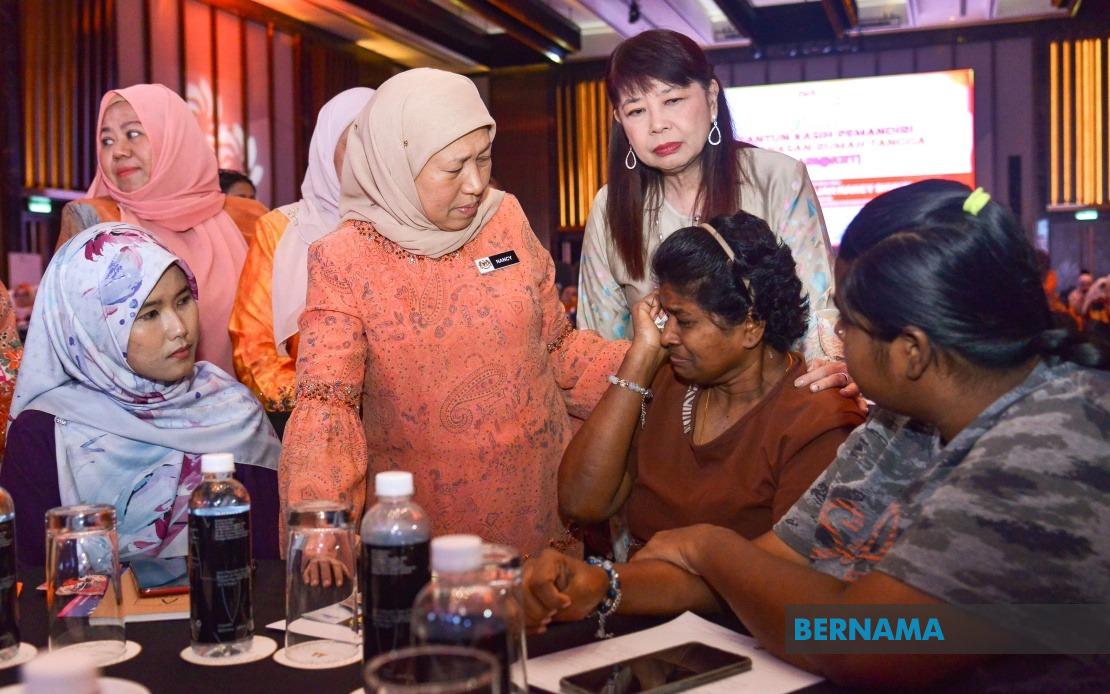
Malaysia's Ministry of Women, Family and Community Development has unveiled a comprehensive initiative aimed at rehabilitating survivors of domestic violence across the country. Termed SARI@KRT: Road to Eliminate Violence Against Women (EVAW) 2026, the programme represents a coordinated national response to address the escalating crisis of intimate partner violence, with plans to reach at least 1,400 beneficiaries through structured interventions in every state and federal territory.
Minister Datuk Seri Nancy Shukri articulated the government's philosophy underpinning the initiative during its official launch in Kuala Lumpur, emphasising that survivor support extends beyond merely publicising awareness campaigns. The ministry's approach centres on restoring psychological resilience and rebuilding victim confidence by demonstrating that pathways to safety and stability exist within established institutional frameworks. By positioning the state as an active facilitator of victim empowerment rather than a passive observer, the government signals a shift toward proactive intervention in family violence prevention and survivor recovery.
The programme structure ensures geographic equity by targeting a minimum of 100 participants within each state, allowing for tailored delivery mechanisms that account for local resources and demographic realities. This distributed model contrasts with centralised approaches that have historically proved ineffective in reaching marginalised populations in rural or underserved areas. The allocation of resources across all fourteen Malaysian states and federal territories demonstrates recognition that domestic violence affects communities nationwide, transcending socioeconomic boundaries.
Psychological support constitutes a cornerstone of SARI@KRT, reflecting evidence-based understanding that trauma recovery requires specialist counselling and psychosocial intervention. Survivors often experience complex post-traumatic stress, shame, and social stigma that complicate their ability to rebuild autonomous lives. By integrating mental health services alongside legal representation and economic support, the programme acknowledges the multidimensional nature of domestic violence recovery and the interconnectedness of psychological wellbeing, legal protection, and financial independence.
Economic empowerment represents an innovative dimension of this initiative, recognising that financial dependence frequently traps survivors in abusive relationships by eliminating viable exit options. When individuals lack income-generating capacity or business skills, leaving a violent partner becomes economically catastrophic, particularly for women responsible for dependent children. Through vocational training, entrepreneurship support, and employment assistance, the government addresses a fundamental structural barrier to survivor autonomy and long-term safety.
Recent statistics underscore the urgency of this intervention. The Royal Malaysia Police recorded 4,014 domestic violence cases during the first half of 2024, representing an increase from 3,678 cases in the equivalent period of 2023. This nine percent year-on-year escalation demands immediate policy attention and resource allocation. Johor emerged as the geographic hotspot with 721 reported incidents, followed by Selangor with 614 cases and Perak with 405, suggesting that rapid urbanisation and demographic pressures in these growth corridors may correlate with elevated family violence incidence.
While rising case numbers appear alarming, Minister Shukri contextualised the increase as potentially reflecting heightened public awareness and diminishing victim reticence rather than necessarily indicating worsening violence prevalence. Enhanced reporting mechanisms, greater institutional responsiveness, and reduced social stigma surrounding disclosure may encourage previously silent victims to seek official assistance. This interpretation aligns with international research demonstrating that crime statistics often rise following awareness campaigns and institutional reforms that lower reporting barriers.
The underlying causes of domestic violence require sustained examination. Communication dysfunction and relational misunderstanding accounted for 1,967 reported cases, constituting nearly half of all incidents. Substance abuse contributed to 444 cases, whilst financial stress featured in 378 recorded disputes. This taxonomy suggests that economic vulnerability intertwines significantly with family violence, a reality requiring integrated responses addressing both immediate safety and underlying socioeconomic precarity. The correlation between financial strain and escalated intimate partner violence has become increasingly evident in Southeast Asian studies examining pandemic-era family dynamics.
Financial abuse emerged as a particularly concerning pattern warranting specific policy attention. Minister Shukri identified situations wherein spouses with adequate income deliberately withhold financial support, compelling partners to independently sustain household operations and childcare expenses. This form of coercive control, whilst less visible than physical violence, perpetuates profound psychological harm and economic vulnerability. Legal frameworks must recognise financial withholding as an actionable form of abuse rather than merely a personal property dispute, a conceptual shift requiring legislative refinement and judicial education across Malaysian courts.
The ministry has established practical support mechanisms including special allowances enabling survivors to attend child maintenance proceedings and court hearings. Such provisions address a frequently overlooked barrier to justice: many impoverished survivors cannot afford transportation, childcare, or lost wages incurred through court attendance. By eliminating these financial obstacles, the government removes gatekeeping barriers that have historically prevented marginalised victims from accessing legal remedies and securing financial provision for dependent children.
Successful implementation of SARI@KRT depends on robust interagency coordination spanning police, courts, social welfare, health services, and civil society organisations. Isolated sectoral responses prove insufficient; comprehensive victim support requires seamless information-sharing and service integration. The Royal Malaysia Police must identify eligible survivors through investigation processes, health providers must assess trauma and psychosocial needs, whilst economic agencies connect participants with employment and business development opportunities. Building these institutional synergies presents considerable administrative challenges, particularly across states with varying bureaucratic capacity.
The programme's alignment with the 2026 Eliminate Violence Against Women agenda positions Malaysia within regional and international violence prevention frameworks. Southeast Asian governments increasingly acknowledge that domestic violence represents a development barrier and public health crisis warranting substantial resource investment. By establishing a named, structured, and time-bound initiative, Malaysia signals serious commitment to victim support beyond rhetorical commitment, though programme sustainability beyond 2026 and adequate funding allocation remain critical questions meriting ongoing scrutiny from civil society monitors and parliamentary oversight bodies.

