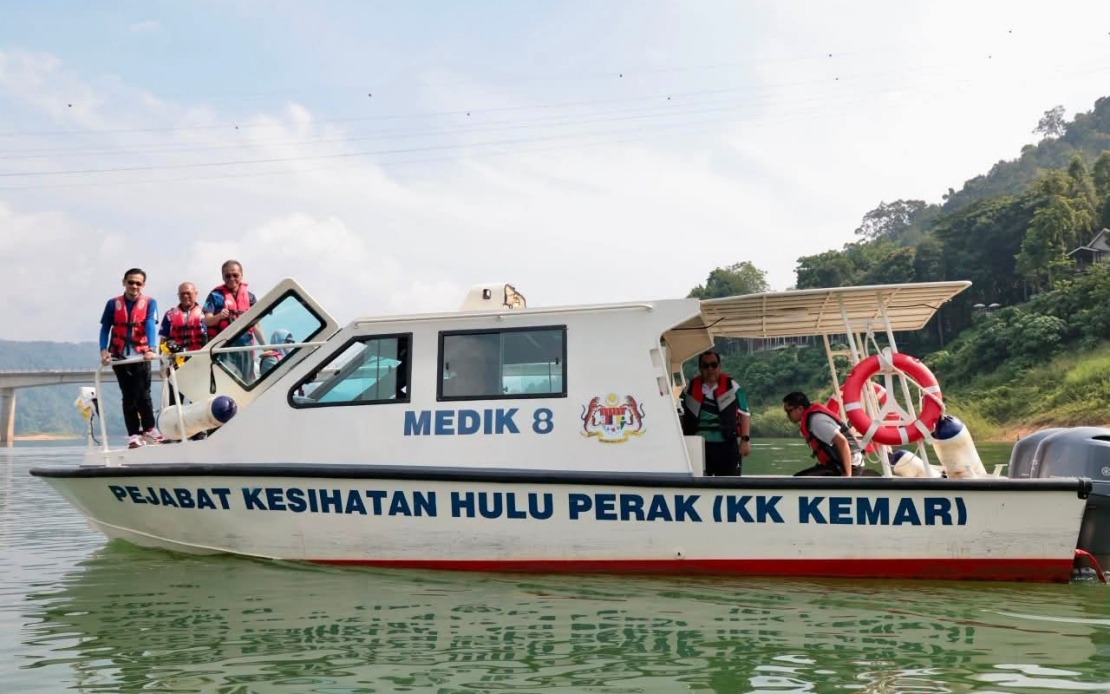
The Malaysian Ministry of Health has taken a significant step towards bridging healthcare disparities in remote communities by introducing an additional specialised boat service in Hulu Perak. Health Minister Datuk Seri Dr Dzulkefly Ahmad formally launched Medic Boat 8 at the Belum Rainforest Resort jetty during a working visit to the region, marking an expansion of the government's mobile healthcare infrastructure tailored to the unique geographical challenges of interior Peninsular Malaysia.
The newly deployed vessel represents a RM350,000 investment specifically designed to serve the Kemar Resettlement Scheme in Gerik, where more than 4,500 Orang Asli residents live in communities with limited land access. For these indigenous populations, waterways function not merely as transport corridors but as essential lifelines connecting scattered settlements to essential services. The 12-passenger multipurpose design reflects careful consideration of the terrain and community needs, enabling both routine medical consultations and emergency interventions across river networks that would otherwise isolate vulnerable populations during health crises.
The introduction of Medic Boat 8 expands the Ministry's existing aquatic medical fleet from six vessels to seven, creating a more comprehensive coverage network across Malaysia's riverine territories. This incremental approach to service expansion demonstrates recognition that healthcare accessibility in isolated communities requires dedicated infrastructure beyond conventional clinic facilities and road-based ambulance services. For Orang Asli populations who have historically experienced gaps in health service delivery, the deployment signals a policy shift toward meeting communities where they are rather than expecting them to navigate complex transport arrangements during medical emergencies.
Minister Dzulkefly emphasised the government's commitment to the Malaysia MADANI framework, which prioritises universal healthcare access regardless of geographic or economic barriers. His statement underscores an important principle: that technological and financial resources invested in healthcare infrastructure carry limited value without corresponding dedication from frontline medical personnel willing to operate under challenging field conditions. The minister specifically acknowledged the courage and professionalism of doctors, nurses, and boat operators who regularly navigate unpredictable river currents and severe weather to deliver care to scattered communities.
The healthcare workers operating these services face genuine occupational hazards that extend beyond typical clinical environments. River navigation during monsoon seasons, equipment maintenance in humid tropical conditions, and the physical demands of reaching multiple settlements across waterways demand exceptional commitment. Recognition of these conditions from ministerial leadership serves not only to boost morale but also to validate the significance of their contributions to achieving equitable health outcomes across the nation.
Geographically, Hulu Perak's interior presents particular challenges for conventional healthcare delivery. The region's topography, dense forest coverage, and reliance on river transport have historically created substantial barriers to timely medical intervention. For acute conditions requiring rapid response—such as childbirth complications, acute infections, or traumatic injuries—the time differential between river-based and road-based transport can prove critical to patient outcomes. By positioning medical boats strategically within river networks, the Ministry addresses response time limitations that would otherwise constrain treatment options for emergency cases.
The Orang Asli communities served by this initiative represent some of Malaysia's most vulnerable populations in terms of health indicators and service accessibility. Indigenous groups in interior settlements frequently experience higher rates of communicable diseases, maternal and child health complications, and limited access to preventive health services. Targeted interventions like Medic Boat 8 directly address these disparities by ensuring that distance and terrain do not become determinants of health outcomes.
Funding medical boat services requires sustained budgetary commitment beyond initial capital expenditure. Ongoing operational costs encompassing fuel, maintenance, crew training, and medical supply chain logistics represent continuous fiscal demands. The RM350,000 investment figure reflects only the vessel's procurement cost, with actual annual operational expenses potentially matching or exceeding this amount depending on deployment frequency and operational scope. Policymakers must ensure that political commitment to this service extends beyond ceremonial launches to include reliable funding cycles.
The initiative also demonstrates how government agencies can adapt service delivery models to accommodate regional heterogeneity within Malaysia. A uniform approach to healthcare infrastructure—relying exclusively on fixed clinics and road ambulances—would prove fundamentally inadequate for communities organised around water-based transport. Conversely, the boat service model would prove inefficient in urban or suburban contexts with established road networks. This represents pragmatic federalism in healthcare design.
For Southeast Asian observers, Malaysia's approach to reaching indigenous populations in remote terrain offers instructive lessons. Regional neighbours facing comparable challenges with interior indigenous communities and limited transport infrastructure might examine whether similar marine-based medical delivery models could enhance health service coverage. Adaptation would require careful consideration of local geography, existing transport patterns, and community structures, but the underlying principle—deploying infrastructure matching actual population distribution and accessibility patterns—holds broader relevance.
The Medic Boat 8 launch occurs within broader context of Malaysia's healthcare system gradually expanding coverage to marginalised communities. Whether through rural clinic upgrades, mobile health clinics, or increasingly, water-based services, policy momentum appears oriented toward systematically identifying and addressing coverage gaps. However, evidence of equitable outcome improvements requires long-term tracking of health metrics among served populations.
Community engagement and trust-building with Orang Asli populations remain essential for maximising utilisation of expanded health services. Transport access alone cannot guarantee improved outcomes if cultural factors, language barriers, or historical mistrust of government health institutions discourage service uptake. Successful healthcare provision to indigenous communities typically requires concurrent investment in culturally sensitive service design and community health worker models that bridge institutional and cultural contexts.

