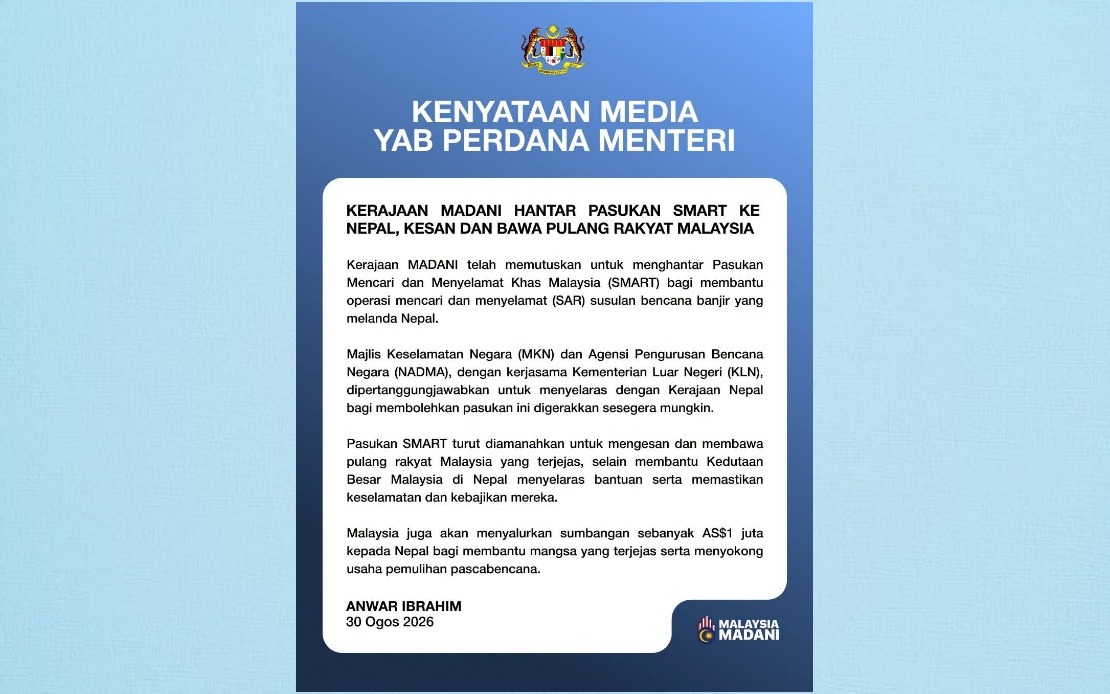
Malaysia is mobilising its disaster response capabilities to assist Nepal following severe flash floods and landslides that devastated the country, with Prime Minister Datuk Seri Anwar Ibrahim announcing the deployment of the Special Malaysian Disaster Assistance and Rescue Team (SMART) to bolster search and rescue operations. The decision reflects the MADANI Government's commitment to regional humanitarian cooperation and demonstrates Malaysia's readiness to respond swiftly when neighbouring countries face natural disasters of significant magnitude.
The coordination effort involves multiple government agencies working in concert to facilitate the team's rapid deployment. The National Security Council and the National Disaster Management Agency have been tasked with liaising directly with Nepalese authorities to ensure smooth deployment procedures and operational coordination on the ground. This multi-agency approach underscores the complexity of international disaster response, where diplomatic channels, security protocols, and emergency management frameworks must align seamlessly to maximise effectiveness.
Beyond immediate rescue operations, the SMART team has been given a dual mandate that extends to locating and assisting Malaysians caught in the disaster zone. The Foreign Ministry confirmed that 55 Malaysian nationals remain uncontactable following the August 26 catastrophe in Rasuwa district, a mountainous region particularly vulnerable to flash flooding and landslide activity. For these individuals and their families anxiously awaiting news, the arrival of a Malaysian-led rescue contingent offers tangible hope that dedicated efforts are underway to account for their whereabouts and facilitate their evacuation if necessary.
The Malaysian Embassy in Nepal will benefit from enhanced logistical and operational support provided by the SMART team, allowing diplomatic staff to focus on broader coordination, consular assistance, and welfare management of affected Malaysian nationals. This partnership between military-trained rescue personnel and civilian diplomatic infrastructure creates a comprehensive support network that addresses both immediate survival needs and longer-term repatriation and medical care requirements.
Concurrently, Malaysia is contributing US$1 million in financial assistance to Nepal, a sum directed toward immediate relief efforts and longer-term recovery and reconstruction initiatives. Financial contributions remain crucial to disaster response because they enable affected governments to procure essential supplies, establish emergency shelters, restore critical infrastructure, and support vulnerable populations who have lost their homes and livelihoods. For Nepal, a developing nation already grappling with significant infrastructure challenges, such international support can substantially accelerate the recovery timeline and mitigate secondary humanitarian crises arising from prolonged displacement and resource scarcity.
The timing of Malaysia's response reflects the urgency inherent in large-scale natural disasters, where the window for locating survivors narrows rapidly. Flash floods combined with landslides create particularly treacherous conditions for rescue teams, as secondary ground collapses pose ongoing hazards to both rescue workers and stranded individuals. The deployment of SMART, a unit trained and equipped for precisely such challenging environments, represents a significant commitment of national resources and personnel expertise.
Regionally, Malaysia's swift response reinforces its position as a responsible member of the Asian community willing to shoulder burden-sharing responsibilities during crises. Southeast Asian nations frequently experience similar weather-related disasters, and regional disaster preparedness increasingly depends on mutual aid agreements and demonstrated willingness to assist neighbouring countries. By acting decisively now, Malaysia is both fulfilling humanitarian obligations and strengthening regional relationships that may prove invaluable should Malaysian communities face comparable challenges in future.
The scale of the Nepal disaster warrants international attention and response. Rasuwa district experienced particularly severe impacts from the August 26 weather events, with multiple settlements damaged and transportation networks disrupted. The mountainous terrain that characterises much of Nepal complicates both immediate rescue efforts and the delivery of humanitarian assistance, as road access becomes severely limited when landslides destroy critical infrastructure. Malaysian rescue personnel familiar with tropical and mountainous terrain can apply relevant expertise to this distinctly challenging operational environment.
For Malaysian families with relatives or friends in Nepal, the government's proactive response provides reassurance that their concerns are being taken seriously at the highest levels. The deployment of SMART and the allocation of significant financial resources signal that finding missing nationals and supporting disaster recovery are national priorities. Consular officials will maintain regular communication channels with affected families while coordinating with international partners to piece together information about individuals still unaccounted for.
The contribution also reflects Malaysia's understanding that natural disasters transcend borders and national interests in ways that demand collective human responses. While 55 missing Malaysians constitute Malaysia's primary concern, Nepal's total casualty figures and displacement numbers extend into the thousands, affecting a nation with far fewer resources for independent recovery. Malaysian assistance, combined with support from other international partners, creates a foundation upon which Nepal can rebuild critical systems and support its traumatised population.
Looking forward, the success of this deployment will likely inform Malaysia's approach to future regional disasters and may strengthen the case for expanded cooperation mechanisms among Southeast Asian nations in disaster response and management. The SMART team's experiences in Nepal will yield valuable lessons about cross-border coordination, interoperability with foreign rescue services, and the challenges of operating in varied geographical and political contexts. These insights will contribute to evolving best practices in the region's collective approach to managing natural disasters.

