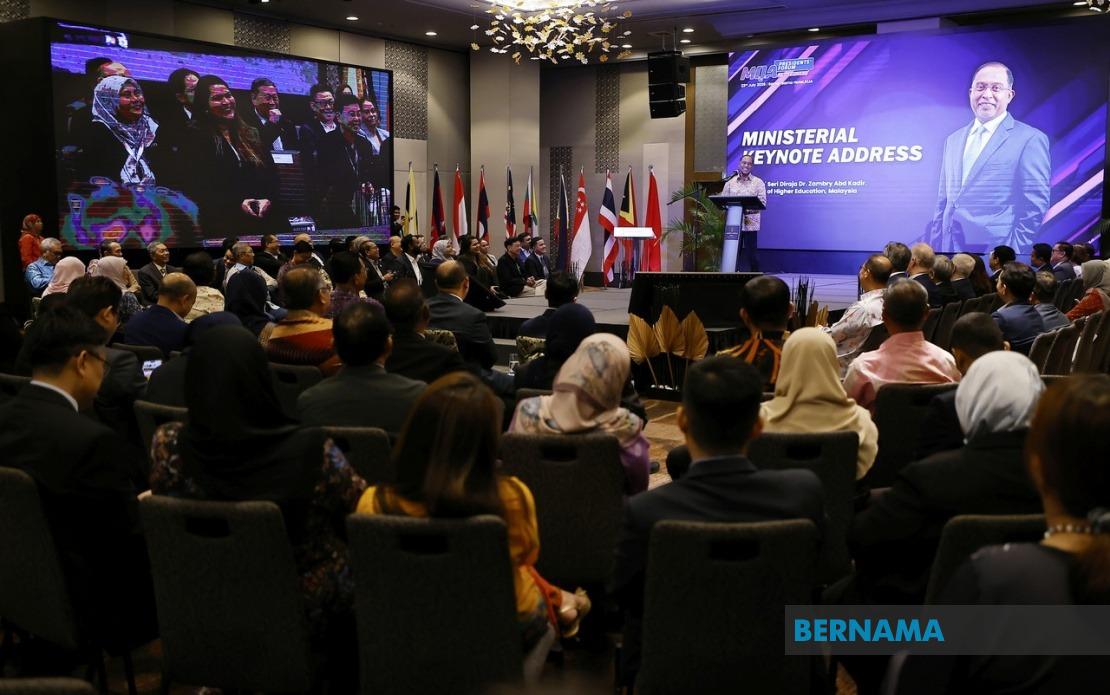
Higher Education Minister Datuk Seri Dr Zambry Abd Kadir has reaffirmed the government's commitment to preserving academic freedom and encouraging intellectual discourse across Malaysia's university system. Speaking at a public lecture in Putrajaya on July 23, Zambry outlined how tertiary institutions must serve as intellectual forums where competing viewpoints can be examined and contested through reasoned argument and mutual respect. This stance represents an important signal to the academic community about the boundaries within which scholarly inquiry can operate in the country.
The minister's remarks came during a lecture by Columbia University's Prof Dr Joseph A. Massad on the subject of Muslim Identity in a Globalised World, an event that itself exemplifies the kind of cross-border intellectual exchange Malaysia seeks to encourage. By hosting international scholars to address topics of global significance, Malaysian universities can position themselves as serious participants in worldwide academic conversations rather than merely recipients of external knowledge. Zambry's presence and remarks underscore the ministry's view that such engagement strengthens rather than threatens the local higher education sector.
Zambry emphasized that academic institutions function best when characterised by civility, evidence-based reasoning, and genuine consideration of opposing perspectives. Rather than framing academic freedom as an absolute right without constraint, he deliberately paired it with the concept of intellectual responsibility. This framing suggests the government sees freedom in universities not as licence for unaccountable expression, but as a carefully balanced commitment to serious scholarly work conducted according to professional standards and ethical norms. For Malaysian academics and students, this distinction carries practical implications for how they might approach sensitive or contentious research questions.
The minister's reference to Malaysia's plural and multicultural society adds important context to these statements. A country with significant populations of different religions, ethnic groups, and political perspectives faces genuine challenges in maintaining open discourse without inflaming communal tensions. Zambry's suggestion that informed dialogue and scholarly engagement offer pathways to mutual understanding acknowledges these real sensitivities while arguing that universities should serve as spaces where differences are engaged intellectually rather than avoided entirely. This approach positions academic institutions as potential bridges between Malaysia's diverse communities rather than flashpoints for conflict.
Zambry's observation that Malaysians have historically embraced the principle of respecting divergent viewpoints invokes a particular national narrative about tolerance and pragmatism. The formulation "we agree to disagree" reflects a colloquial Malaysian approach to managing disagreement without requiring complete consensus. Whether this characterisation matches the actual lived experience of all Malaysians is debatable, but rhetorically it establishes common ground and appeals to existing national values. By grounding the case for academic freedom in this framework, Zambry attempts to present it not as a Western import but as consistent with Malaysian identity and practice.
The minister's acknowledgment that differing opinions are inevitable, particularly in an era dominated by artificial intelligence and social media, reflects awareness of contemporary challenges to controlled academic discourse. Digital platforms and algorithmic content distribution create environments where complex scholarly positions can be flattened into polarised positions and spread rapidly without nuance. Universities consequently face pressure to moderate discourse while maintaining their core function as places where difficult ideas are explored. Zambry's comments suggest the ministry recognises this tension without necessarily providing detailed solutions.
The commitment to welcoming distinguished international scholars represents a strategic investment in Malaysia's soft power and intellectual reputation. When prominent academics from institutions like Columbia University visit Malaysian campuses, it signals that the country's universities operate at a level worthy of such engagement. This attracts talent, generates research collaborations, and positions Malaysia as part of the global knowledge economy. For students and early-career researchers in Malaysia, access to international scholarly networks through visiting lecturers and collaborative projects can meaningfully expand their intellectual horizons and career prospects.
The Higher Education Ministry's public commitment to these principles, articulated by a senior minister at a high-profile event, carries more weight than routine policy statements. By personally delivering remarks on academic freedom, Zambry places ministerial authority behind the concept and suggests these commitments enjoy substantive support within government. This matters for institutional leaders across Malaysia's university system, as it provides them with a degree of political cover when defending research projects or hosting speakers on sensitive topics, provided such work meets the standards of intellectual responsibility Zambry outlined.
However, the minister's formulation also leaves considerable ambiguity about where precise boundaries lie. What constitutes "civility" in debate? How is "evidence" defined in contested fields like social science and humanities? When might intellectual responsibility require self-censorship? These questions remain unanswered in public statements, creating space for different interpretations by university administrators, academics, and government officials. This ambiguity may itself reflect pragmatic governance, allowing flexibility in application rather than rigid rules, though it can also create uncertainty for those working in sensitive research areas.
For Malaysia's position within Southeast Asian academic networks and global knowledge production, ministerial statements affirming academic freedom matter significantly. Other nations and institutions assess local commitment to scholarly values when deciding whether to establish partnerships or encourage their scholars to relocate to Malaysia. The government's public positioning on these issues thus has practical consequences for institutional development and the country's competitiveness in higher education. As Malaysia aims to become a regional education hub, international academic community perceptions directly influence success.

