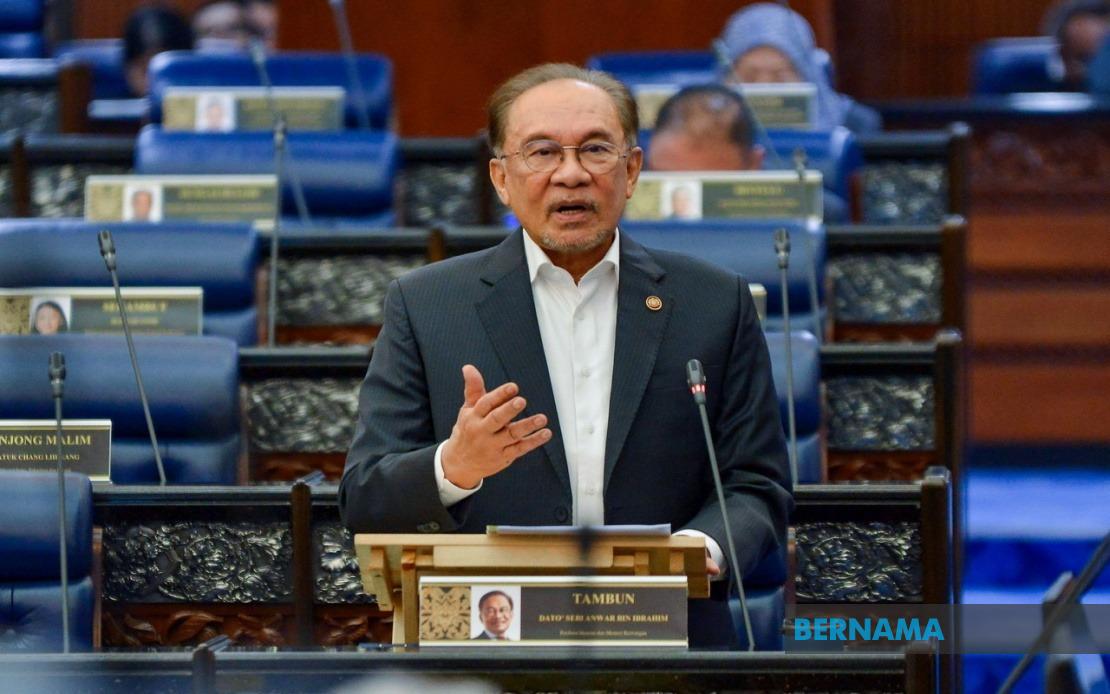
Malaysia will persist in employing diplomatic negotiations and the provisions of the 1982 United Nations Convention on the Law of the Sea as its cornerstone strategy for addressing maritime boundary disputes with neighbouring states, Prime Minister Datuk Seri Anwar Ibrahim declared in Parliament. Speaking in the Dewan Rakyat in response to a parliamentary question about maritime security and boundary management, Anwar underscored the government's conviction that sustained dialogue rather than confrontation offers the most viable pathway toward resolving competing territorial claims across Southeast Asian waters.
The Prime Minister acknowledged that whilst Malaysia recognises the International Maritime Organization's important role in global maritime governance, the IMO itself operates within the constraints and legal architecture established by UNCLOS 1982. This framework, he explained, provides the essential scaffolding upon which all maritime discussions should rest. However, Anwar was candid about the limitations inherent in any international legal instrument, noting that different nations interpret the convention's provisions through distinct lenses shaped by their historical experiences, geographical positions, and strategic interests. This interpretative divergence means that UNCLOS alone, whilst foundational, cannot unilaterally settle every boundary question that arises between states.
Regarding the South China Sea specifically, Anwar highlighted that ASEAN member states have collectively embraced UNCLOS as their negotiating framework whilst simultaneously engaging with China to complete and implement a Code of Conduct designed to contain tensions and prevent military escalation. This dual-track approach reflects the region's recognition that binding legal frameworks must be complemented by binding political commitments to reduce ambiguity and manage behavioural expectations. The Prime Minister acknowledged, however, that discussions involving the Philippines present particular complexities due to unresolved historical claims, particularly the long-standing Sabah sovereignty question that intersects multiple territorial and maritime assertions.
With other ASEAN partners, Malaysia has deliberately chosen the path of protracted negotiation over litigation or coercive posturing, Anwar explained. He characterised this approach as one of patience and resilience, acknowledging that multiple rounds of talks are often necessary and that temporary deadlocks are inevitable features of maritime diplomacy. When negotiations stall, the Malaysian government's strategy involves stepping back from the table, allowing diplomatic temperatures to cool, and subsequently resuming discussions with renewed perspectives. This cyclical approach, whilst potentially lengthy, preserves relationships and keeps boundaries of dispute from hardening into irreversible conflict.
Anwar drew attention to Malaysia's practical experience with Joint Development Authorities established with Thailand and Vietnam as evidence that economic cooperation and shared resource management need not require either party to surrender or definitively establish their sovereignty claims. These arrangements represent a pragmatic middle ground where both nations acknowledge their competing legal positions whilst choosing to bracket those disagreements in favour of tangible benefits derived from collaborative development. The Vietnam model particularly demonstrates this principle: the disputed maritime area remains classified as contested without prejudice to either country's ultimate sovereignty position, yet both Malaysia and Vietnam have successfully established mechanisms for joint exploration and revenue-sharing that generate mutual economic advantage without requiring resolution of the underlying boundary dispute.
The Prime Minister catalogued Malaysia's maritime boundary engagement across an expansive portfolio of neighbours, identifying unresolved maritime questions involving Brunei, Thailand, Indonesia, Singapore, the Philippines, and China. Rather than viewing this constellation of disputes as a comprehensive strategic vulnerability, Anwar presented it as a testament to Malaysia's commitment to resolving issues through consistent diplomatic engagement rather than military posturing or unilateral assertion of claims. The government's foundational principle, he stressed, holds that escalation of maritime disputes into broader regional tensions serves no party's long-term interests and undermines the prosperity that maritime commerce and cooperation generate.
On the Brunei front, Anwar reported meaningful progress in boundary negotiations, with only a limited number of unresolved areas remaining outstanding. These remaining issues involve the Sarawak state government directly, reflecting Malaysia's federal structure wherein states retain interests in maritime boundaries adjacent to their territorial waters. This institutional complexity adds another layer to negotiations, requiring coordination between the federal government and state authorities to achieve coherent positions. Discussions with Indonesia similarly centre on areas affecting Sabah, and the Prime Minister stressed that these talks occur in close consultation with the Sabah leadership, ensuring that state-level concerns shape the negotiating positions Malaysia advances at the bilateral level.
The emphasis on dialogical engagement over confrontational approaches reflects Malaysia's position as a mid-sized maritime power whose interests are fundamentally served by stability and the rule of law rather than by destabilising assertions of power. Anwar's parliamentary statements thus reinforce a strategic posture wherein Malaysia attempts to shape the regional environment through institutional frameworks, negotiated arrangements, and demonstration of good faith rather than through military capability or territorial aggression. For regional observers, particularly those in Southeast Asia concerned about maritime security and the management of overlapping claims, the Malaysian position signals a preference for incremental, consensus-based solutions that preserve relationships whilst managing disputes.
The Prime Minister's articulation of Malaysia's maritime strategy carries implications that extend beyond bilateral disputes. By anchoring Malaysia's approach in UNCLOS and negotiation, Anwar positions the country as a defender of international law and multilateral processes at a moment when great power competition increasingly threatens to displace rules-based frameworks with spheres of influence and coercive assertion. Malaysia's experience with successful joint development authorities offers a template that other states might emulate, suggesting that maritime disputes need not be zero-sum competitions but rather can be converted into frameworks for mutual benefit. This framing invites other regional players to consider whether their interests are better served by cooperation than by escalation, implicitly challenging the assumption that maritime boundaries must be definitively resolved before productive engagement can commence.

