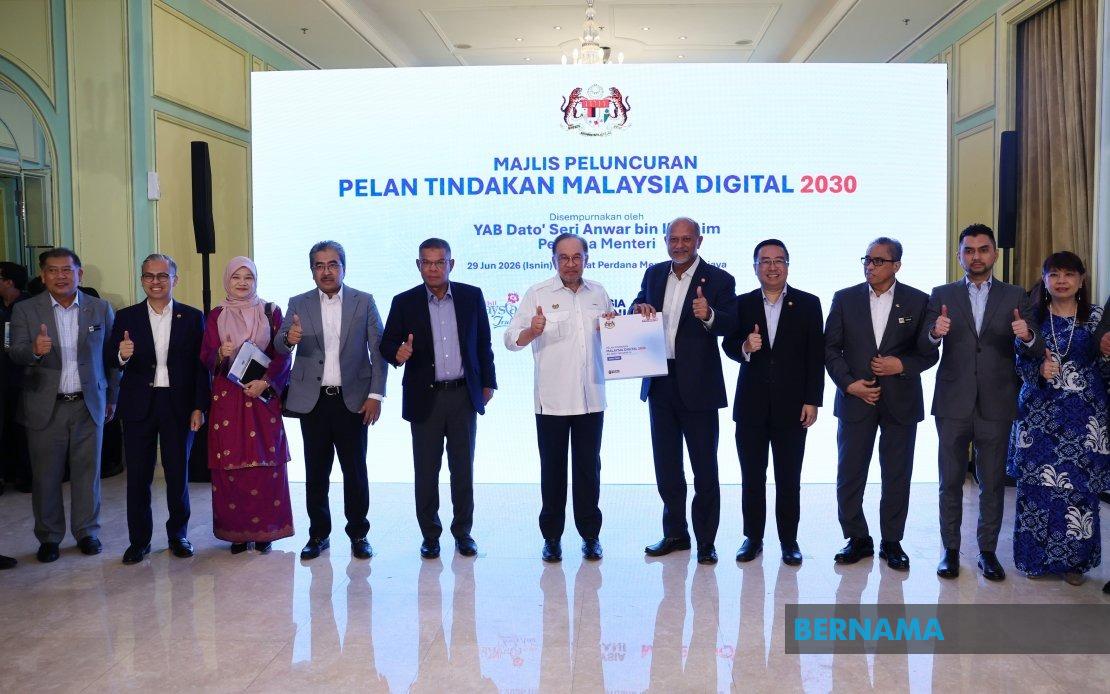
Prime Minister Datuk Seri Anwar Ibrahim has launched Malaysia Digital 2030 (MD2030), a sweeping national blueprint for the 2026-2030 period that represents a fundamental recalibration of how Malaysia approaches technological development. Rather than continuing to import and adopt foreign digital solutions, the framework commits the government to building homegrown innovation capacity and positioning the country as a producer of artificial intelligence and digital technologies. The plan's unveiling in Putrajaya underscores the administration's determination to embed digital transformation across every sector of the economy and government, signalling that this agenda extends far beyond the technology ministry into all aspects of national governance.
The strategic architecture underpinning MD2030 rests on seven interconnected pillars, each stewarded by a different government ministry under a coordinated whole-of-government approach. Chief Secretary to the Government Tan Sri Shamsul Azri Abu Bakar will oversee the Government pillar focused on digitising public service delivery. Investment, Trade and Industry Minister Datuk Seri Johari Abdul Ghani leads the Economy pillar, while Communications Minister Datuk Fahmi Fadzil heads Infrastructure. The remaining pillars address Talent through Human Resources Minister Datuk Seri R. Ramanan, Society under Women, Family and Community Development Minister Datuk Seri Nancy Shukri, Trust and Security under Digital Minister Gobind Singh Deo, and Innovation led by Science, Technology and Innovation Minister Datuk Chang Lih Kang. This multi-ministerial coordination structure reflects the complexity of embedding digital capabilities across traditional government bureaucracies.
The quantified ambitions embedded in MD2030 are substantial and demand rigorous execution. Malaysia aims to elevate the digital economy's contribution to gross domestic product to 30 per cent by the end of the decade—a significant leap that would position digital as a primary driver of national growth. Simultaneously, the plan targets creation of 500,000 high-value digital jobs, addressing both the scale and quality dimensions of employment in technology sectors. The government has committed to generating RM4.5 billion in cost savings through digitising public sector operations, essentially financing parts of the transformation through efficiency gains. Additionally, the administration pledges to deliver 95 per cent of government services through fully integrated online platforms accessible end-to-end, fundamentally reshaping how citizens and businesses interact with state institutions.
The Economy pillar represents perhaps the most ambitious dimension of MD2030, tasking Malaysia with evolving from technology consumer to regional digital innovation and trade hub. This pillar emphasises promotion of "Made by Malaysia" digital products and services, a deliberate counterweight to the historical dominance of imported technology solutions. The strategy identifies High Growth High Value (HGHV) sectors as priority zones for accelerated technology adoption, suggesting that manufacturing, healthcare, financial services, and other capital-intensive industries will receive particular policy attention. Equally important is the framework's emphasis on unlocking Malaysia's data assets, digital intellectual property, and related value chains—recognising that as global companies extract data from Malaysian operations, the country must develop capacity to monetise its own information resources and technology innovations.
Infrastructure development forms the physical foundation upon which all digital innovation must rest, and MD2030 accordingly prioritises nationwide rollout of high-quality internet connectivity. The plan acknowledges that digital transformation cannot succeed if significant portions of the population lack reliable broadband access, a particular concern for rural Malaysia where connectivity remains inconsistent. Beyond basic connectivity, the framework envisions development of Malaysia's digital infrastructure ecosystem including data centres, cloud computing facilities, and smart city technologies. These investments will attract foreign companies seeking reliable infrastructure partners and create domestic champions in infrastructure provision, reducing Malaysia's dependency on overseas digital infrastructure providers.
The Talent pillar directly addresses one of Malaysia's most significant challenges in achieving digital economy ambitions: developing a workforce with the skills, experience, and mindset demanded by artificial intelligence and advanced technology sectors. MD2030 commits to establishing a comprehensive national talent policy framework alongside agile workforce transition mechanisms that enable existing workers to retrain and shift toward digital roles. The plan explicitly aims to position Malaysia as a regional and global magnet for digital talent, suggesting visa policies, research partnerships, and compensation frameworks that would attract skilled professionals from Singapore, Thailand, and beyond. For Malaysian readers, this pillar carries particular relevance as it directly impacts employment opportunities and career trajectories across the economy.
Inclusion and equitable access emerge as explicit priorities within the Society pillar, reflecting recognition that digital transformation risks widening socioeconomic divides if not carefully managed. The government plans to institutionalise a Malaysian Digital Inclusion Index, creating formal mechanisms to track progress on extending digital opportunity across income levels, geographic regions, and demographic groups. Rural community empowerment receives specific attention, with commitments to deploy socially impactful digital solutions in underserved areas. This dimension distinguishes MD2030 from narrowly technocratic digital strategies that focus exclusively on innovation and GDP contribution while overlooking populations left behind by technological change.
Trust and security represent the structural sinews holding this transformation together, and the Trust and Security pillar accordingly aims to operationalise the National Data Commission while developing a comprehensive National Digital Trust and Data Security Strategy spanning 2026-2030. The emphasis on balancing security with innovation reflects the tension inherent in digital development—overly restrictive security frameworks can stifle entrepreneurship and technological experimentation, while lax governance invites privacy breaches and cyber threats. Malaysia's position as a regional crossroads and growing technology hub makes this balance particularly delicate, especially given rising geopolitical tensions around data sovereignty and technology standards.
The Innovation pillar attempts to close a historical gap in Malaysia's technology ecosystem: the transition from research to commercialisation. The plan envisions building a robust Research, Development, Commercialisation, Innovation and Economy (RDCIE) ecosystem that transforms Malaysian research output into market-ready products and services. This addresses a longstanding inefficiency whereby Malaysian universities and research institutions produce credible scientific work but struggle to convert discoveries into commercial ventures or intellectual property. Success in this pillar would potentially reshape Malaysia's position in global technology value chains, moving beyond contract manufacturing toward ownership of proprietary technologies.
Digital Minister Gobind Singh Deo has characterised MD2030 as evidence of Malaysia's readiness to transition from technology consumer to respected digital innovation producer, emphasising that the Digital Ministry will ensure implementation across all relevant agencies in a coordinated manner. The ministry designated the National AI Office (NAIO), GovTech Malaysia, the Malaysia Digital Economy Corporation (MDEC), CyberSecurity Malaysia, MyDIGITAL Corporation, and the Malaysia Centre for the Fourth Industrial Revolution (MYCentre4IR) as key implementation partners, creating an institutional ecosystem dedicated to executing the strategy. This multi-agency approach distributes responsibility across specialised institutions rather than concentrating power within a single ministry.
The vision articulated by MD2030 describes a Malaysia where artificial intelligence integrates seamlessly across sectors, data functions as a strategic national asset, intelligent and autonomous systems become operational norms, and citizens thrive alongside technology rather than being displaced by it. Realising this vision demands not merely technological investment but substantial shifts in regulatory frameworks, workforce capabilities, and public understanding of digital tools. For Southeast Asia more broadly, MD2030 represents an attempt by a middle-income nation to leapfrog development stages by positioning itself as a technology originator rather than consumer—a strategy that carries both significant potential and execution risks. Success could establish Malaysia as the region's digital innovation centre, attracting investment and talent while creating valuable exports. Failure to deliver on specific targets could undermine public confidence in longer-term digital transformation efforts.
The MADANI Government has positioned MD2030 as a commitment to ensuring digital transformation benefits all Malaysians equitably, particularly articulating concern for inclusive and inclusive benefits distribution. This framing suggests awareness that rapid technological change often concentrates wealth and opportunity among already-advantaged populations unless deliberate policy interventions ensure broader participation. The coming five years will reveal whether Malaysia's governance structures can simultaneously pursue cutting-edge innovation, inclusive opportunity, security and privacy protections, and responsive public services—a governance challenge as significant as the technological one.

