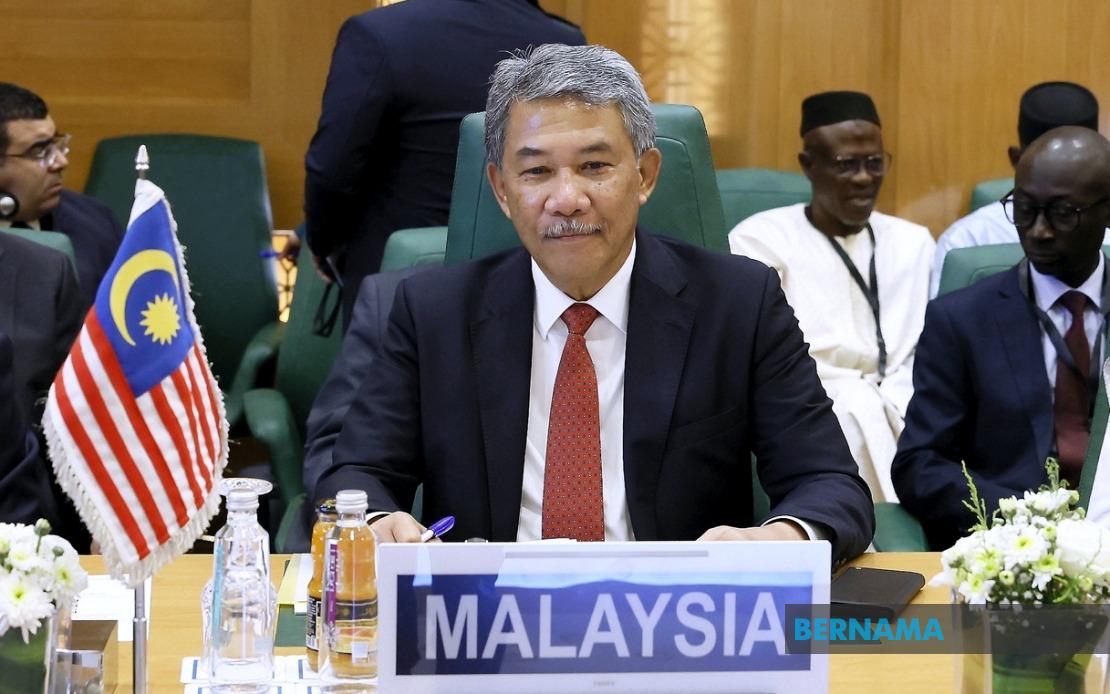
Foreign Minister Datuk Seri Mohamad Hasan delivered a forceful rebuke of Israeli settlement activities at an extraordinary meeting of OIC foreign ministers in Jeddah on August 27, calling for collective action from the 57-member bloc to counteract what he characterised as systematic territorial encroachment. The appeal represents Malaysia's sustained diplomatic effort to mobilise the Islamic world against what Kuala Lumpur views as irreversible changes to Palestinian territorial integrity through ongoing colonisation efforts.
The centrepiece of Malaysia's concerns centres on Israel's US$2.3 billion settlement scheme, which encompasses the controversial E1 project designed to connect existing settlements and create a physical barrier fragmenting the West Bank. This expansion strategy, according to Mohamad's analysis, deliberately dismantles the territorial contiguity essential for establishing a functioning Palestinian state. By strategically positioning settlements across the landscape, Israel effectively converts disparate Palestinian communities into isolated enclaves incapable of cohesive governance or economic integration.
Malaysia grounded its position firmly on the International Court of Justice Advisory Opinion issued on July 19, 2024, which addressed the legal status of Israeli occupation. The foreign minister explicitly invoked this authoritative international legal pronouncement to strengthen the normative foundation for OIC member states' collective stance. This judicial determination provides legitimacy to what would otherwise appear as purely political positioning, lending weight to Malaysia's assertion that opposition to settlements reflects not merely Arab-Islamic sentiment but adherence to established international law.
Beyond land confiscation, Mohamad highlighted the interconnected challenge of settler violence and forced Palestinian displacement, particularly in Jerusalem. The foreign minister emphasised that systematic evictions of Palestinian families, combined with restrictions on Muslim and Christian access to holy sites, constitute deliberate efforts to alter the demographic and religious character of the city. These actions, he argued, represent an assault on the historical custodianship traditions and violate the sanctity that Jerusalem holds across multiple faith communities.
The minister specifically condemned an incursion by Israeli officials and far-right figures into the Al-Aqsa Mosque compound on July 23, characterising such provocations as destabilising and religiously inflammatory. Such incidents, Malaysia contends, transcend routine security concerns and instead reflect ideological determination to establish Jewish control over spaces historically significant to Islamic devotion. By raising these incidents on the OIC platform, Malaysia seeks to amplify awareness among Muslim-majority nations of threats to Islamic heritage sites.
Mohamad's address also pivoted toward the humanitarian catastrophe in Gaza, invoking figures documenting over 70,000 Palestinian deaths and describing the territory as devastated by continuous military operations. He criticised the international community's failure to enforce ceasefire demands despite nearly three years of diplomatic appeals, suggesting that without forceful OIC intervention, the cycle of destruction would persist indefinitely. This framing positions the OIC as a last institutional arbiter capable of influencing outcomes when other diplomatic mechanisms have failed.
The foreign minister articulated Malaysia's vision for Palestinian statehood explicitly anchored to the June 4, 1967 borders with East Jerusalem designated as the capital—a formulation consistent with Organisation of Islamic Cooperation consensus positions. By reiterating this specific territorial framework, Malaysia signals unwillingness to endorse any settlement that concedes territories captured during the 1967 Six-Day War, rejecting pragmatic compromise approaches that some regional actors have entertained. This stance reflects domestic Malaysian political expectations and broader constituency demands within the Muslim world.
A crucial dimension of Malaysia's intervention concerned institutional protection for Palestinian authority structures. Mohamad urged OIC members to strengthen Palestinian institutions, reconstruct damaged infrastructure, and provide financial and technical support for governance capacity. This institutional approach reflects recognition that territorial recovery alone proves insufficient without corresponding Palestinian administrative capability, suggesting Malaysia's understanding that state-building requires multifaceted support beyond political rhetoric.
The foreign minister also raised concerns regarding United Nations mechanisms, specifically demanding Security Council enforcement of international law and protection of the United Nations Relief and Works Agency for Palestine Refugees in the Near East mandate. He condemned Israel's seizure of UNRWA facilities and legislative moves introducing mandatory death penalties for Palestinians, signalling that Malaysia views such actions as deliberately dismantling the international architecture designed to protect vulnerable populations. This focus on institutional destruction indicates Malaysian concern that Israel seeks to eliminate international mechanisms constraining its actions.
Hardeyed analysis suggests Malaysia's diplomatic activism serves multiple constituencies simultaneously. Domestically, opposition to Israeli policies resonates deeply among Malaysian Muslims and aligns with ruling coalition rhetoric. Regionally, Malaysia positions itself as voice for Palestinian causes within Southeast Asian contexts where such advocacy proves less emphatic. Internationally, the foreign minister's prominence at OIC forums enhances Malaysia's standing within the Islamic world while reinforcing its role as consequential middle-power diplomatic actor.
The two-state solution framework that Mohamad emphasised remains theoretically endorsed by international consensus yet functionally appears increasingly distant given settlement expansion and Palestinian institutional fragmentation. Malaysia's insistence on this formulation, despite observable deterioration in conditions making it achievable, reflects commitment to internationally recognised templates even when practical pathways grow obscured. This tension between rhetorical commitment and underlying realities characterises much OIC diplomatic engagement on Palestinian matters.
Looking forward, Malaysia's appeal to collective OIC action faces implementation challenges given varying member state capacities and diplomatic priorities. While rhetorical solidarity proves manageable, coordinated economic sanctions, diplomatic isolation, or institution-building support requires sustained commitment transcending symbolic gestures. Malaysia's effectiveness ultimately depends on translating Jeddah statements into concrete policy measures across the OIC membership, a transition historically proving difficult for multilateral Islamic organisations.

