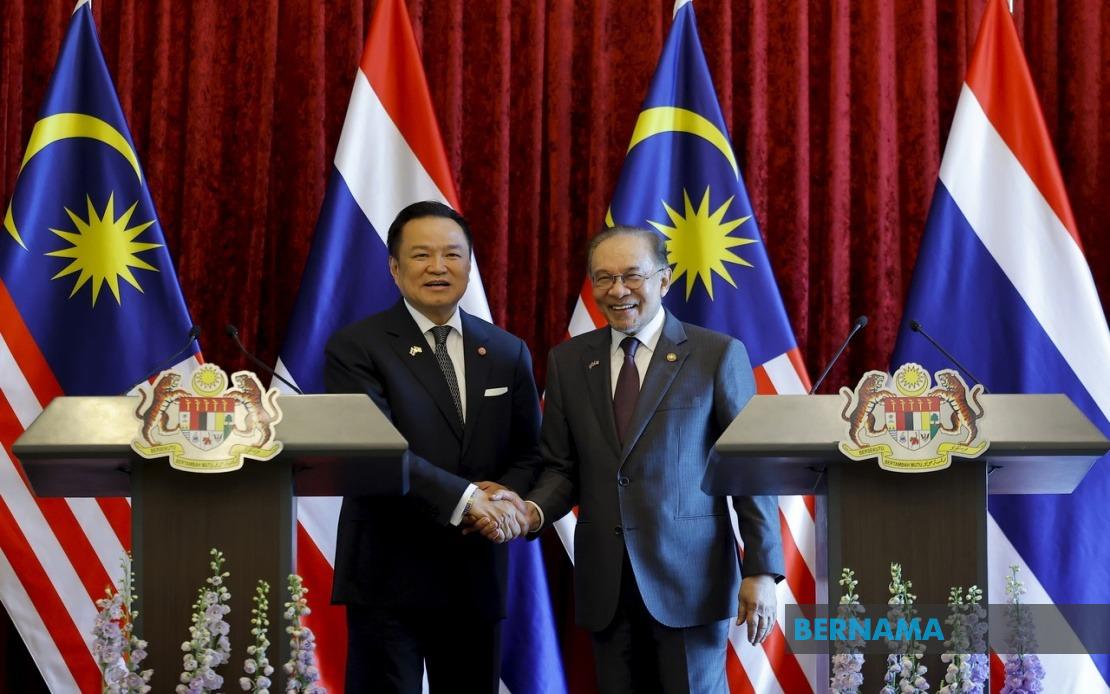
Malaysia and Thailand have charted an ambitious roadmap to deepen economic integration and regional connectivity, pledging to accelerate multiple border development initiatives with an overarching goal of achieving USD30 billion in bilateral trade within the next three years. The strategic commitment emerged from substantive discussions between Prime Minister Datuk Seri Anwar Ibrahim and his Thai counterpart Anutin Charnvirakul in Putrajaya on July 9, where both leaders acknowledged the untapped potential within their longstanding relationship and resolved to unlock new avenues for shared prosperity.
The bilateral agenda centres on three interconnected pillars designed to facilitate seamless movement of goods, services, and people across the Malaysia-Thailand border. First, both governments have committed to expediting construction and development of critical border connectivity infrastructure that will reduce transit times and logistics costs for cross-border commerce. This encompasses road and rail networks that will enhance the physical linkages between the two nations, creating more efficient trade corridors that benefit businesses on both sides and contribute to broader Southeast Asian supply chain resilience.
Second, Malaysia and Thailand have agreed to proceed with establishing special border economic zones that will serve as catalysts for regional industrial development. These zones are envisioned as free-trade and investment hubs where businesses can operate under streamlined regulatory frameworks, attracting manufacturing facilities and distribution centres that leverage the geographic proximity of both countries. Such initiatives have proven successful in other regional contexts and offer substantial employment generation potential in border communities that have historically remained economically marginalised.
Third, both nations committed to streamlining immigration and customs procedures to reduce bureaucratic friction at border crossings. Simplified visa protocols, harmonised tariff classifications, and integrated digital customs systems will facilitate faster processing of travellers and freight, ultimately reducing the hidden costs embedded in cross-border transactions. This modernisation reflects evolving best practices within ASEAN and positions the Malaysia-Thailand border as a model for efficient regional trade facilitation.
Prime Minister Anwar emphasised that the meeting outcome represented genuine progress on substantive issues, stressing that Malaysia and Thailand share profound interconnections spanning history, culture, commerce, and investment flows. His characterisation of these ties as foundational underscores recognition that the bilateral relationship extends far beyond government interactions into deep civil society, business, and people-to-people dimensions. The acknowledgement that "more needs to be done" signals willingness from both capitals to revisit historical friction points and reconstruct cooperation frameworks for contemporary circumstances.
The USD30 billion trade target by 2027 represents a significant leap from current volumes, requiring approximately 15-20 percent annual growth depending on baseline figures. Achieving this objective necessitates not merely removing barriers but actively encouraging private sector engagement through incentive structures and confidence-building measures. The target thus functions as a powerful indicator of political commitment, signalling to Malaysian and Thai businesses alike that bilateral commerce will receive sustained policy priority and institutional support.
A particularly significant feature of the engagement is the planned visit to Bukit Kayu Hitam and Sadao tomorrow, which Anwar characterised as extending beyond conventional capital-city diplomacy into ground-level border communities. This geographic choice carries symbolic weight, demonstrating that the trade agenda and infrastructure development have direct relevance to ordinary residents in peripheral areas. Border towns like Bukit Kayu Hitam and Sadao have historically been transit points rather than economic beneficiaries, and this visit signals intent to transform them into drivers of regional development.
The Prime Minister's observation that Anutin's personal commitment to strengthening ties motivated the visit reflects Thailand's strategic orientation toward deepening mainland Southeast Asian integration. For Malaysia, the engagement offers opportunities to enhance the competitiveness of northern states such as Kedah and Perlis, which have suffered relative economic stagnation compared to the Klang Valley and Selangor. Accelerated border development could catalyse investment into these regions, creating employment and reversing decades of internal migration toward more prosperous western corridors.
From a broader Southeast Asian perspective, the Malaysia-Thailand initiative gains significance as an example of practical ASEAN cooperation translating lofty ambitions into concrete infrastructure and regulatory reform. The region has long articulated aspirations for seamless connectivity, yet execution has frequently faltered due to bureaucratic inertia, resource constraints, and competing priorities. The clear bilateral commitment, embodied in the USD30 billion target and specific project timelines, demonstrates that progress becomes possible when governments allocate political capital to overcome institutional friction.
The special border economic zones represent innovation beyond traditional free-trade agreements, offering experimental spaces where both nations can test harmonised regulations and identify best practices applicable across ASEAN. Success in these designated zones could provide blueprints for replication elsewhere, potentially accelerating broader regional economic integration. Additionally, these zones may attract multinational enterprises seeking to establish production networks that exploit proximity to both Malaysian and Thai markets while accessing labour and raw material resources across the border.
The customs and immigration streamlining agenda addresses a persistent frustration for businesses operating across the Malaysia-Thailand border. Digital integration of customs systems, mutual recognition of business registrations, and harmonised standards for goods classification will reduce compliance costs and uncertainty that currently deter smaller enterprises from engaging in cross-border trade. Such facilitation measures particularly benefit small and medium enterprises that lack dedicated regulatory compliance teams and often forgo cross-border opportunities due to perceived complexity.
Successfully executing this ambitious agenda requires sustained commitment beyond the current political leadership. Both governments must establish institutional mechanisms ensuring continuity regardless of electoral cycles or personnel changes. Joint committees with private sector representation, regular review mechanisms, and transparent progress reporting will maintain momentum and build stakeholder confidence. The initial diplomatic breakthrough evident in Putrajaya must translate into bureaucratic action at customs agencies, immigration authorities, and development corporations tasked with implementing projects.
For Malaysian policymakers and business interests, this cooperation framework opens substantial opportunities to rebalance economic geography and enhance trade relationships with a crucial neighbour. Success depends on transparent execution, meaningful consultation with affected communities, and credible commitments to follow through on announced initiatives. The next three years will determine whether this bilateral ambition transforms into tangible improvements in cross-border commerce and shared prosperity along one of Southeast Asia's most historically significant but economically underutilised frontiers.

