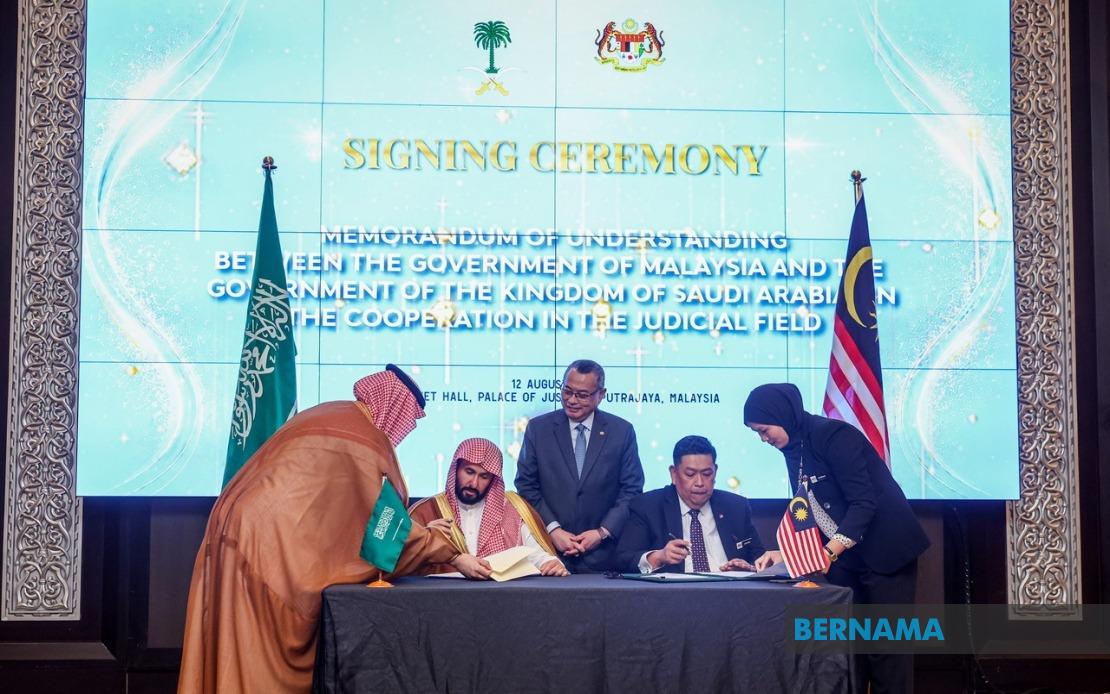
Malaysia and Saudi Arabia have taken a significant step toward deepening their institutional relationship by formalizing judicial cooperation through a comprehensive memorandum of understanding signed at the Palace of Justice in Putrajaya on August 12. The agreement, inked by Chief Registrar of the Federal Court Azhaniz Teh Azman Teh and Saudi Arabian Minister of Justice Sheikh Dr Waleed Mohammed Alsmani, represents a structured commitment to enhancing the efficiency and standards of the justice systems in both countries. Chief Justice Tun Wan Ahmad Farid Wan Salleh witnessed the signing, underscoring the significance of the bilateral arrangement within Malaysia's judicial hierarchy.
The memorandum establishes a comprehensive framework encompassing multiple dimensions of judicial cooperation that extend beyond traditional legal exchanges. The agreement specifically identifies civil case management as a priority area, recognizing that both nations can benefit from sharing methodologies and best practices in how courtrooms handle the growing volume of civil disputes. This focus is particularly relevant as Malaysian courts grapple with case backlogs and efficiency challenges that affect access to justice for ordinary citizens and businesses alike.
A cornerstone of the agreement centres on judicial technology and digitalisation, areas where both nations are advancing their court systems. Malaysia's experience with its e-Court platform, which has gradually transformed how cases are filed, managed, and adjudicated, represents a significant asset for knowledge transfer. Saudi Arabia's parallel efforts to modernize its judicial infrastructure make this dimension mutually beneficial, as each country can learn from the other's implementation strategies, challenges overcome, and technological lessons learned during the transition to digital court systems.
The exchange of practical experience and publicly available judicial information forms another pillar of the cooperation framework. This mechanism enables judges, court administrators, and legal professionals from both countries to access comparative data on case outcomes, sentencing patterns, and procedural efficiency metrics. For Malaysian legal professionals, understanding Saudi Arabia's approach to various legal matters—particularly in areas where Islamic law intersects with civil procedure—could yield valuable insights for Malaysia's own dual legal system.
Institutional visits and regular exchanges provide the human dimension to this formal agreement. These mechanisms facilitate direct engagement between judicial officers, creating opportunities for relationship-building and deeper understanding of each other's systems beyond what written materials alone could convey. Such face-to-face interactions often prove invaluable for identifying unexpected areas of common interest and potential collaboration.
The timing of this agreement during Sheikh Dr Waleed's official visit to Malaysia demonstrates the diplomatic priority both governments place on judicial relations. Unlike trade or defence agreements that frequently capture headline attention, judicial cooperation tends to work quietly in the background, gradually raising standards and building institutional capacity. The bilateral relationship reflects a broader pattern of increasing engagement between Malaysia and Saudi Arabia across multiple sectors, with the judiciary now explicitly positioned as a domain for structured partnership.
Among the specific topics discussed during accompanying dialogue sessions was Malaysia's judicial approach to handling sexual offences against children, an area where developing robust legal frameworks and effective prosecution strategies remains a critical challenge across Southeast Asia and the Middle East. Malaysia's experiences with specialized courts and procedural protections for child witnesses can provide valuable reference points for Saudi Arabia's ongoing judicial reforms. Conversely, Saudi Arabia's approach to certain aspects of family law and child protection may offer perspectives relevant to the Malaysian context.
The e-Court system emerged as a particular focus of knowledge-sharing during the visit. Malaysia's gradual digitalization of its judiciary has transformed court operations, improved transparency, and enhanced access to justice through online filing and case tracking mechanisms. For Saudi Arabia, Malaysia's experience navigating the technical, logistical, and cultural aspects of implementing such systems holds considerable practical value. Both nations face similar challenges in ensuring that technological advancement does not disadvantage citizens lacking digital literacy or reliable internet access.
The Office of the Chief Registrar's characterization of this agreement as an "important milestone" reflects recognition that formal judicial cooperation between nations remains relatively uncommon compared to other bilateral arrangements. The structured platform it establishes positions both countries to move beyond ad-hoc exchanges toward sustained institutional engagement. This systematic approach to knowledge-sharing and cooperation helps ensure that advances in one jurisdiction can be thoughtfully adapted for application in another.
For Malaysian stakeholders in the legal profession, the agreement opens avenues for comparative legal study and professional development opportunities. Lawyers, judges, and court administrators may find increasingly accessible channels for engaging with Saudi Arabian counterparts, attending conferences or training programmes, and participating in research collaborations. Such professional networks strengthen the expertise available within Malaysia's judicial system and enhance the country's standing within regional and Islamic legal discourse.
The agreement also carries implications for Malaysia's broader regional positioning. As Southeast Asia's primary Muslim-majority nation with a sophisticated common law-influenced judicial system, Malaysia occupies a unique position bridging Islamic legal traditions and common law frameworks. Formal cooperation with Saudi Arabia, home to Islam's holiest sites and a significant player in Islamic jurisprudence, reinforces Malaysia's role as a bridge between different legal cultures and a hub for comparative Islamic and secular law studies.
Looking forward, the success of this judicial cooperation will depend on substantive implementation of the framework's various components. Regular dialogue forums, reciprocal institutional visits, and concrete collaborative projects on specific legal challenges will determine whether the memorandum translates aspirational cooperation into tangible improvements in both nations' judicial systems. Given the formal commitment from senior judicial leadership on both sides, implementation appears likely to proceed with appropriate seriousness.

