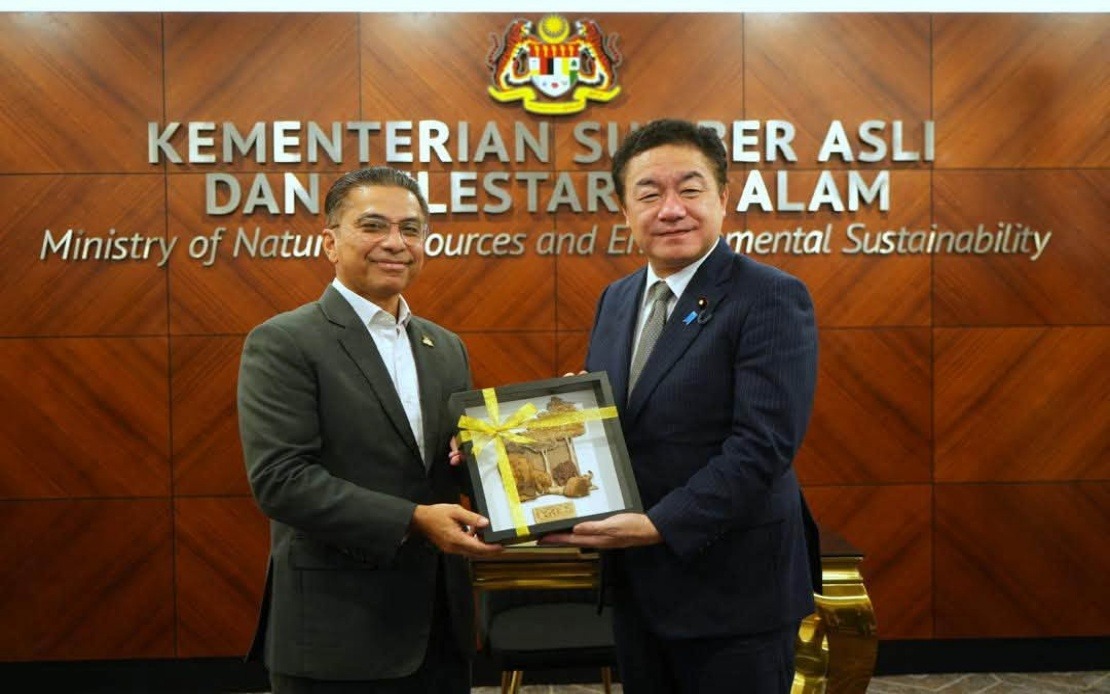
Malaysia and Japan have reaffirmed their commitment to expanding collaborative efforts across rare earth elements, critical minerals, and climate action, signalling the deepening of a strategic partnership that carries significant implications for the region's green transition and supply chain resilience. The development emerged from a formal courtesy visit to the Ministry of Natural Resources and Environmental Sustainability by Japan's Parliamentary Vice-Minister of Economy, Trade and Industry Komori Takuo, underlining Tokyo's serious engagement with Kuala Lumpur on sectors critical to both nations' long-term economic and environmental objectives.
Deputy Natural Resources and Environmental Sustainability Minister Syed Ibrahim Syed Noh led Malaysia's side during the Putrajaya discussions, which were designed to review progress on commitments made during the bilateral summit held in June under the Malaysia-Japan Comprehensive Strategic Partnership framework. The meeting representation—including Datuk Khalid Mohamed as deputy secretary-general for Natural Resources and officials from the Foreign Ministry—reflected the cross-government importance assigned to these negotiations. Japan's delegation, headed by Ambassador Shikata Noriyuki, brought together senior officials from the Ministry of Economy, Trade and Industry, demonstrating Tokyo's institutional commitment to advancing the partnership.
A central focus of the discussions centred on Malaysia's evolving relationship with Japan in the critical minerals sector, an area of acute strategic interest given global supply chain sensitivities. Malaysia explicitly reiterated its position on implementing a moratorium covering the export of unprocessed rare earth materials, a policy designed to anchor downstream processing and value-addition activities within Malaysian borders. This stance reflects a broader regional trend among Southeast Asian nations seeking to capture greater economic value from natural resource endowments rather than exporting raw commodities to foreign refineries. Japan, which faces severe resource constraints and depends heavily on imported critical minerals for its manufacturing and defence industries, has demonstrated flexibility in accepting Malaysia's domestic processing requirements, a pragmatic approach that suggests Tokyo views long-term partnership stability as preferable to short-term supply advantages.
The Ministry of Natural Resources acknowledged Japan's instrumental role in facilitating technology transfer and technical cooperation through established institutional channels, particularly the Japan International Cooperation Agency and the Japan Organisation for Metals and Energy Security. These organisations have become significant vectors for Japanese expertise reaching Malaysian stakeholders in the extraction and processing of rare earth elements. The acknowledgment reflects Malaysia's recognition that sustainable development of its REE sector requires not merely access to capital and markets, but also absorption of sophisticated technical knowledge that Japan has accumulated over decades of industrial development. This dynamic illustrates how Malaysia's resource nationalism is being tempered by pragmatic recognition that value-added processing requires sustained external technical collaboration.
Beyond minerals, the discussions achieved a notable milestone on climate cooperation through the finalisation of draft negotiations on a Memorandum of Cooperation covering the Joint Crediting Mechanism. This framework, grounded in Article 6.2 of the Paris Agreement, represents an innovative approach to carbon market cooperation that allows countries to jointly pursue emissions reduction projects while trading the resulting carbon credits. Expected completion by year-end, the mechanism is intended to mobilise investment flows into low-carbon technologies across Malaysia, addressing a persistent financing gap that has constrained the nation's clean energy deployment. For Japanese investors and technology providers, the framework opens pathways to finance renewable energy projects, energy efficiency upgrades, and industrial decarbonisation initiatives within Malaysia at potentially lower cost than purely domestic Japanese deployment.
The carbon crediting arrangement directly supports Malaysia's Nationally Determined Contribution under the Paris Agreement, the voluntary emissions reduction targets that each signatory has committed to achieve. Malaysia's NDC commits the nation to reducing greenhouse gas emissions by 45 percent by 2030 relative to 2005 levels, an ambitious target that requires substantial investment in renewable energy infrastructure, grid modernisation, and industrial transformation. The Joint Crediting Mechanism provides a financial instrument to accelerate this transition by converting carbon abatement into tradeable assets that attract international capital. For Malaysia, this represents a sophisticated approach to climate finance that avoids the debt servicing burdens associated with traditional loan-based climate funding.
The Malaysian ministry's framing of the cooperation as combining Japan's technological prowess in green industries with Malaysia's natural resource endowments suggests an integrated vision of the partnership. Japan's advanced capabilities in renewable energy systems, battery technology, hydrogen production, and industrial efficiency align logically with Malaysia's abundant solar resources, biomass potential, and industrial base. This complementarity creates scope for joint development of technologies suited to tropical Southeast Asian conditions, from floating solar systems for reservoir deployment to biomass conversion facilities optimised for palm-based feedstocks. Such technology co-development could position Malaysia as a regional hub for green innovation, with Japanese technical leadership and investment capital catalysing the transformation.
The strategic timing of these discussions warrants attention. Occurring against a backdrop of intensifying geopolitical competition for influence over critical mineral supplies and clean technology development, the Malaysia-Japan initiative reflects a coordinated response by two middle powers to secure their respective economic futures. Japan, facing demographic decline and resource scarcity, seeks stable, diversified sources of critical inputs and technology deployment opportunities abroad. Malaysia, endowed with rare earth resources but requiring technology and capital, benefits from partnership with a technologically advanced nation that respects its sovereign resource management decisions. This mutually reinforcing arrangement contrasts with more exploitative historical patterns of resource extraction in Southeast Asia, suggesting a maturation of regional diplomacy toward more equitable partnerships.
The implications for broader Southeast Asian regional dynamics are considerable. Malaysia's ability to negotiate terms preserving domestic processing of rare earth elements, rather than accepting exporter status, establishes a precedent that elevates expectations among other ASEAN members regarding fair terms for resource extraction partnerships. If the Malaysia-Japan model proves economically successful, producing competitive processed REE output and attracting green technology investment, other regional nations may demand comparable treatment in their own bilateral negotiations. Conversely, if Malaysia's moratorium on raw REE exports creates economic inefficiencies or supply chain disruptions, the model could face pressure. The outcome will likely shape how future resource partnerships across Southeast Asia are structured, particularly regarding the balance between national resource sovereignty and international market efficiency.
The climate cooperation dimension extends these implications further. A successfully implemented Joint Crediting Mechanism between Malaysia and Japan could establish a template that other ASEAN members adopt in bilateral climate negotiations. This would gradually transform how climate finance flows to Southeast Asia, shifting from grant-based or concessional loan structures toward market-based mechanisms that treat emissions reductions as tradeable commodities. Such a shift would make climate action more attractive to private capital while reducing dependence on multilateral climate finance institutions that often impose governance conditions alongside funding. For Malaysia specifically, becoming a demonstration case for successful Article 6.2 implementation could enhance its standing in global climate negotiations and potentially position the nation as a preferred partner for climate-linked technology and investment from other developed nations.

