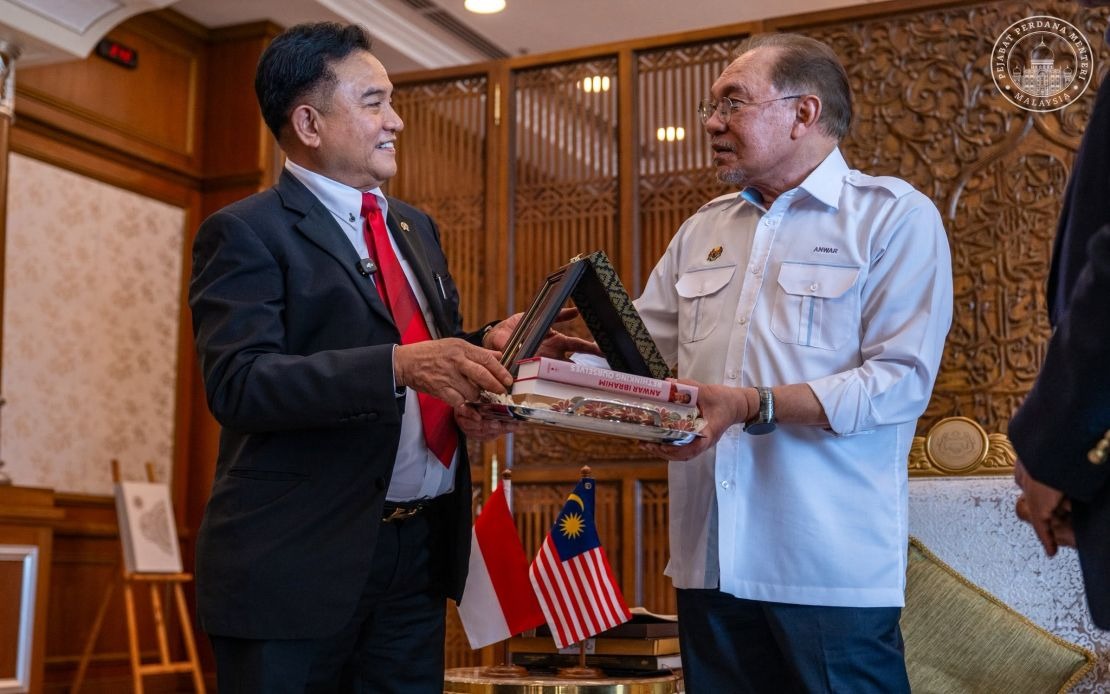
Prime Minister Datuk Seri Anwar Ibrahim has underscored Malaysia and Indonesia's mutual commitment to deepening cooperation across legislative frameworks, governance structures, and numerous strategic domains of common concern. The reaffirmation came during a courtesy visit to his Putrajaya office by Indonesia's Coordinating Minister for Legal, Human Rights, Immigration and Correction, Prof Dr Yusril Ihza Mahendra, marking a formal engagement between the two neighbouring nations on institutional collaboration.
The bilateral meeting reflects the ongoing prioritisation of linkages between Southeast Asia's two largest Muslim-majority nations, whose combined economic and political influence shapes regional dynamics. As Malaysia's Prime Minister and Finance Minister, Anwar's direct involvement in the dialogue underscores the significance assigned to the engagement by Kuala Lumpur. The choice of interlocutor on Indonesia's side—a senior coordinating minister overseeing legal affairs, human rights, immigration and correctional matters—indicates Jakarta's strategic focus on institutional and administrative coherence in this partnership.
During their discussions, both leaders examined concrete pathways to expand institutional cooperation, moving beyond general goodwill statements toward operationalised mechanisms for legislative harmonisation and governance alignment. Such coordination carries tangible implications for Malaysian and Indonesian citizens, particularly in matters affecting cross-border movement, legal harmonisation in commercial transactions, and standardised approaches to human rights protections. The portfolio held by Prof Dr Yusril—spanning legal frameworks, human rights oversight, immigration administration, and correctional systems—touches multiple dimensions of citizen engagement that demand bilateral attention.
Legislative cooperation between the two nations remains relatively underdeveloped despite their geographic proximity and cultural affinities. Malaysia and Indonesia maintain distinct legal systems shaped by different colonial histories and constitutional traditions, yet growing economic integration and people-to-people mobility create practical pressures for alignment. Enhanced cooperation in this domain could facilitate smoother business operations for firms operating across both countries, reduce procedural friction in cross-border investments, and create more coherent regulatory environments for industries spanning manufacturing, finance, and digital services.
Governance cooperation extends beyond formal legal mechanisms to encompass shared approaches in public administration, anti-corruption efforts, and institutional capacity-building. Both nations face comparable challenges in strengthening public institutions, managing bureaucratic efficiency, and addressing governance deficits. Exchange of best practices, training programmes for civil servants, and collaborative study of institutional innovations could yield mutual benefits. Such initiatives would position Malaysia and Indonesia as partners in institutional development rather than competitors, creating positive demonstration effects across Southeast Asia.
The emphasis on human rights and immigration administration—key components of Prof Dr Yusril's portfolio—reflects contemporary bilateral concerns. Both nations grapple with irregular migration flows, human trafficking networks, and the protection of migrant workers' rights. Coordinated legislative approaches and harmonised administrative procedures could strengthen enforcement capabilities and provide better protections for vulnerable populations, including the substantial numbers of Indonesian migrant workers in Malaysia. Similarly, human rights frameworks require ongoing dialogue to ensure consistent standards and effective remedial mechanisms.
Correctional system cooperation represents another significant dimension of the partnership. Both countries maintain substantial prison populations and face comparable challenges in rehabilitation, prisoner management, and post-release reintegration. Technical cooperation in this area—including exchange of expertise, joint training initiatives, and collaborative research on rehabilitation methodologies—could enhance effectiveness while reducing recidivism rates. This dimension of cooperation often receives less public attention than diplomatic or trade matters, yet it impacts citizen welfare tangibly.
The broader context for this engagement includes Malaysia and Indonesia's shared roles in ASEAN and their importance to regional stability and development. As the association's two most economically advanced Southeast Asian members, their institutional cooperation sets precedents for regional governance standards. Strengthened bilateral mechanisms can serve as models for other ASEAN partnerships, contributing to the association's broader agenda of institutional development and coordinated regional governance.
Anwar's statement emphasizing the "close fraternal relations" between the nations invokes the historical and cultural dimensions underpinning the partnership. Both countries share Islamic heritage, Malay linguistic roots, and post-colonial experiences that create foundation for solidarity. However, contemporary cooperation must transcend fraternal sentiment to deliver concrete institutional outcomes benefiting citizens through improved public services, clearer legal frameworks, and more efficient cross-border administration.
The engagement also occurs within Malaysia's broader foreign policy context under Anwar's leadership, which has emphasised regional partnerships and multilateral engagement. Strengthening ties with Indonesia aligns with this orientation while addressing bilateral concerns arising from maritime boundaries, shared environmental challenges, and economic competition. Regular high-level dialogue ensures such issues receive political attention before tensions escalate.
Moving forward, substantive outcomes will depend on translating these bilateral commitments into specific collaborative projects, resource allocations, and institutional arrangements. Both nations would benefit from establishing joint working groups focused on priority legislative areas, creating regular forums for administrative exchange, and developing capacity-building programmes for civil servants. Such mechanisms would transform political commitment into operational reality, delivering tangible improvements in governance quality and institutional effectiveness.
The meeting between Anwar and Prof Dr Yusril signals renewed diplomatic momentum in bilateral relations at a senior level, positioning institutional cooperation as a key pillar of Malaysia-Indonesia engagement. Sustained commitment to this agenda could reshape administrative practices, improve citizen services, and establish the two nations as exemplars of effective institutional cooperation within Southeast Asia's evolving political economy.

