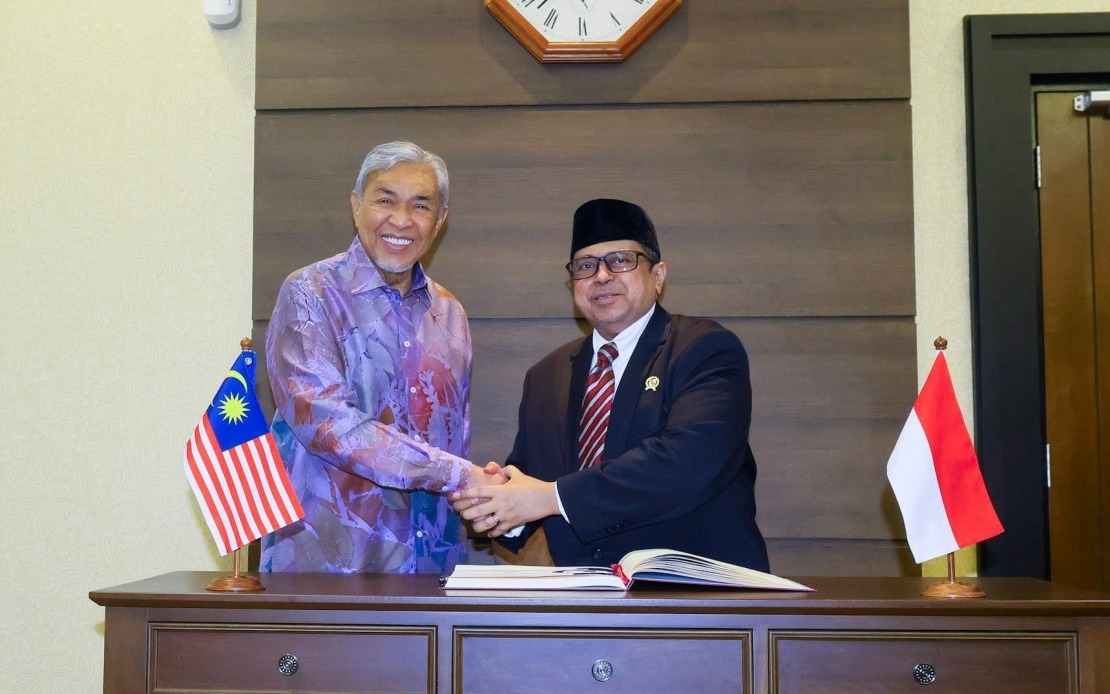
Malaysia and Indonesia are moving to substantially strengthen their partnership across the halal sector, with Deputy Prime Minister Datuk Seri Dr Ahmad Zahid Hamidi signalling ambitious plans to create multilateral frameworks that would elevate halal commerce across Southeast Asia and beyond. The discussions, held at Parliament during a visit by Indonesia's Ambassador to Malaysia Raden Datuk Mohammad Iman Hascarya Kusumo and Dr Ahmad Haikal Hassan, head of Indonesia's Halal Product Assurance Organising Body, underscore the strategic importance both nations place on positioning themselves as leaders in the rapidly expanding global halal economy.
The cooperation agenda extends well beyond the halal sector, encompassing trade facilitation, rural development initiatives, and human capital programmes that reflect the broader economic relationship between the two largest Muslim-majority economies in Southeast Asia. By focusing on multiple dimensions simultaneously, Malaysian and Indonesian policymakers are seeking to create interlocking benefits that reinforce each sector's development trajectory. This comprehensive approach recognises that halal industry success depends on robust supporting infrastructure, skilled workforces, and effective logistics networks—areas where both nations have complementary strengths and mutual interests.
At the core of the proposed framework sits the Malaysia-Indonesia Halal Council, a bilateral body designed to serve as the primary mechanism for coordinating standards, resolving technical issues, and identifying joint business opportunities. Such councils have proven effective in other ASEAN contexts, providing neutral ground for government agencies, private sector players, and certification bodies to collaborate on harmonising regulations without surrendering national autonomy. For Malaysia, which has long positioned itself as the global halal hub through its certification infrastructure and Islamic finance capabilities, the council represents an opportunity to extend influence while genuinely assisting Indonesia's halal sector maturation.
Beyond bilateral arrangements, the discussions encompassed proposals for an ASEAN Halal Council that would embed halal standardisation within the broader regional integration framework. Such a body would address one of the halal industry's persistent challenges: the proliferation of different certification standards across member states that creates friction for businesses operating across borders. A unified ASEAN approach would theoretically allow companies to obtain single certification recognised throughout the bloc, dramatically reducing compliance costs and accelerating market entry. This aligns with ASEAN's broader economic agenda under frameworks like the ASEAN Economic Community, though sectoral implementation has remained uneven.
The proposed World Halal Development Council signals even more expansive ambitions, positioning Malaysia and Indonesia as convenors in global halal governance. This reflects genuine opportunity: the global halal market continues expanding, driven by Muslim population growth, rising incomes in Muslim-majority regions, and increasing interest from non-Muslim consumers attracted to halal products' perceived safety and ethical standards. By establishing international institutions, Malaysia and Indonesia could shape how halal standards evolve globally, potentially securing commercial advantages for their producers and service providers. However, success would require engaging major non-Muslim trading partners and diverse Islamic jurisprudential traditions, a complex diplomatic undertaking.
Ahmad Zahid's role as chairman of the Malaysia Halal Industry Development Council positions him as a key driver of this agenda domestically. His public commitment to strengthening ties with Indonesia signals that halal sector development remains a priority within the government's economic diversification strategy. Malaysia's historical advantages in halal certification, finance, and logistics have generated substantial export revenues and positioned the nation as a trusted intermediary in global halal commerce. Deepening integration with Indonesia, which possesses significant production capacity and a massive domestic market, could amplify these advantages by creating a larger ecosystem that attracts regional and global investment.
Indonesia brings distinct advantages to this partnership. As the world's largest Muslim-majority nation with a population exceeding 270 million, Indonesia represents an enormous consumer base for halal products and services. Its agricultural and manufacturing sectors produce substantial volumes of halal-eligible commodities, from palm oil to textiles to seafood. However, Indonesia's halal certification infrastructure and international market access remain less developed than Malaysia's, creating natural complementarities. By partnering with Malaysia on standardisation and market access, Indonesian producers could reach international markets more readily while Malaysia gains access to larger production bases and supply chain diversification.
The timing of these discussions reflects broader regional dynamics. Southeast Asia is increasingly asserting its role in global economic governance, and the halal sector offers a domain where the region possesses genuine comparative advantage and institutional expertise. Unlike sectors where developed nations dominate, halal commerce is defined by Islamic principles and practices where Southeast Asian nations are natural authorities. By establishing regional and global councils, Malaysia and Indonesia seek to translate this conceptual advantage into institutional power that shapes international rules.
Trade considerations loom large in the partnership calculus. Harmonised standards eliminate technical barriers that currently constrain bilateral commerce in processed foods, cosmetics, pharmaceuticals, and other halal-sensitive sectors. For Malaysian and Indonesian manufacturers, reducing regulatory fragmentation could unlock significant trade growth. Conversely, unified standards could facilitate investment flows as companies establish operations across borders with reduced compliance uncertainty. Both nations stand to benefit from expanded intra-ASEAN halal commerce, which currently underperforms given the region's Muslim majority and production capacity.
The human capital dimension acknowledges that sectoral excellence requires skilled professionals in certification, quality assurance, Islamic jurisprudence, and business management. Malaysia and Indonesia possess academic institutions and professional bodies with halal expertise, but systematic knowledge-sharing remains limited. Establishing cooperation frameworks creates mechanisms for personnel exchange, training programme coordination, and research collaboration that would deepen both nations' technical capabilities. This long-term investment in human resources reflects recognition that sustainable competitive advantage depends on institutional capacity, not merely regulatory frameworks.
The halal industry's expansion intersects with multiple policy objectives for both nations. For Malaysia, deepening halal sector leadership reinforces its positioning as a global Islamic financial and business hub, complementing the financial services expertise concentrated in Kuala Lumpur. For Indonesia, international halal commerce represents a pathway for upgrading agricultural and manufacturing sectors while capturing additional value from existing production. Both nations see halal commerce as a vehicle for economic development aligned with Islamic values, addressing concerns about ensuring that growth benefits Muslim populations broadly.
Implementing this ambitious agenda will require translating political commitment into concrete institutional arrangements. The proposed councils must develop operational procedures, funding mechanisms, and enforcement capacity to meaningfully harmonise standards rather than becoming merely symbolic bodies. Success hinges on managing tensions between national regulatory autonomy and regional standardisation, between public sector oversight and private sector participation, and between immediate commercial interests and longer-term institutional development. How Malaysia and Indonesia navigate these challenges will determine whether their halal partnership becomes a genuine regional integration success story or remains largely aspirational.
Looking forward, the Malaysia-Indonesia halal partnership could serve as a model for broader sectoral cooperation across ASEAN. By demonstrating that institutional frameworks can create mutual benefits while respecting national sovereignty, the initiative might encourage similar arrangements in other industries. For global halal commerce, Malaysian and Indonesian leadership through these councils could establish standards and practices that reflect Southeast Asian perspectives rather than merely importing standards from Western certification systems or Middle Eastern traditions.

