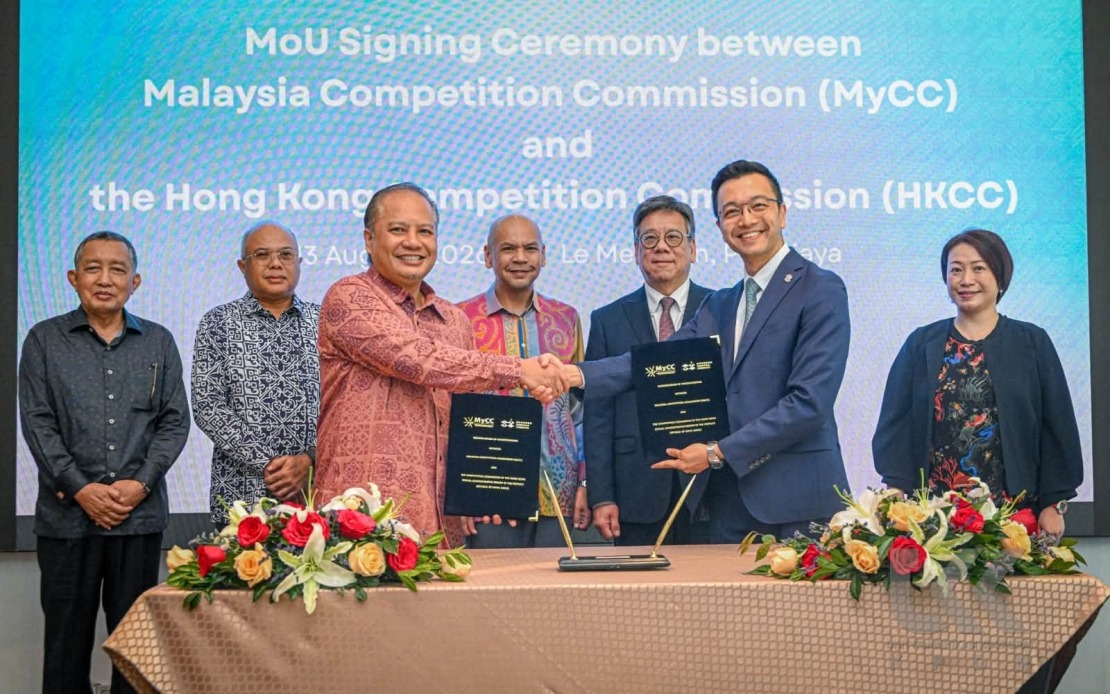
The Malaysia Competition Commission (MyCC) and Hong Kong Competition Commission (HKCC) have established a fresh partnership framework designed to enhance their ability to tackle anti-competitive behaviour and cross-border market violations. Announced on August 13, the Memorandum of Understanding reflects growing recognition among regional authorities that modern competition challenges frequently transcend national boundaries, requiring coordinated responses and shared expertise.
Domestic Trade and Cost of Living Minister Datuk Armizan Mohd Ali characterised the agreement as evidence of Malaysia's strategic positioning within the global competition enforcement ecosystem. This represents the fourth such bilateral understanding for MyCC, joining previous partnerships with the Türkiye Competition Authority, Korea Fair Trade Commission, and the Philippine Competition Commission. The expanding network of agreements signals that Malaysia is actively building diplomatic channels with major trading partners and regional peers to create a more cohesive approach to market regulation.
The underlying rationale for such cooperation stems from the interconnected nature of modern commerce. Multinational enterprises, digital platforms, and international supply chains operate across multiple jurisdictions simultaneously, creating enforcement challenges that individual authorities struggle to address in isolation. When anticompetitive conduct occurs in one market but affects businesses or consumers in another, fragmented regulatory responses can prove ineffective. The MyCC-HKCC partnership addresses this fundamental reality by enabling authorities to pool intelligence, coordinate investigations, and present unified positions on complex cases.
According to Minister Armizan, the MoU will facilitate systematic information exchange covering legislative developments, regulatory amendments, and investigative techniques. This dimension proves particularly valuable as competition laws evolve globally. Hong Kong's regulatory framework, shaped by its position as an international financial centre, offers insights relevant to Malaysia's aspirations in fintech and digital commerce. Similarly, Malaysia's experience navigating competition issues within ASEAN's integrated markets provides lessons applicable to Hong Kong's regional engagement strategy.
Capacity building constitutes a second pillar of the agreement, encompassing training initiatives, workshops, formal officer exchanges, and collaborative research projects. These activities extend beyond bureaucratic formality to create genuine professional development opportunities. When competition officials from different jurisdictions work alongside one another through secondments or joint investigations, they develop personal relationships and institutional trust that facilitate informal cooperation on future cases. The intellectual cross-pollination also helps both agencies stay abreast of international best practices and emerging enforcement methodologies.
Cross-border enforcement coordination represents perhaps the most operationally significant aspect of the arrangement. Businesses frequently employ complex structures to circumvent national competition laws, fragmenting operations across jurisdictions to avoid detection or exploit regulatory arbitrage. A Hong Kong-Malaysia framework enables authorities to recognise such patterns more readily and pursue investigations that would prove impossible working unilaterally. This capability holds particular relevance for digital markets, where algorithms and data flows cross borders instantaneously, creating competition concerns that demand transnational enforcement coordination.
For Malaysian consumers and businesses, the implications extend beyond abstract regulatory cooperation. Enhanced competition enforcement theoretically translates into more competitive markets, lower prices for goods and services, and reduced barriers to entry for local firms facing predatory conduct by multinational competitors. The services sector—encompassing telecommunications, aviation, financial services, and logistics—benefits considerably from such arrangements, as many anticompetitive practices involve regional or international dimensions. Small and medium enterprises operating in Malaysia but selling across borders gain protection from coordinated enforcement that deters large incumbents from leveraging market dominance across multiple jurisdictions.
The timing of the announcement reflects broader regional trends toward formalising competition law cooperation. The Association of Southeast Asian Nations has progressively emphasised competition policy harmonisation, recognising that divergent standards create friction in regional trade. While ASEAN competition authorities operate under varying mandates and legal frameworks—reflecting different economic models and political systems—baseline compatibility improves efficiency. Hong Kong's participation in Malaysian discussions, while outside ASEAN, demonstrates that competition cooperation has transcended regional organisational structures.
Minister Armizan emphasised that these bilateral partnerships form part of a comprehensive strategy to maintain Malaysia's competitive edge. The framing reveals a nuanced understanding that competition enforcement serves not merely consumer protection but also broader economic competitiveness. By maintaining rigorous standards against anticompetitive conduct, Malaysia protects its domestic industries from predatory practices while ensuring that foreign investors operate within transparent rules. This institutional credibility proves especially valuable for a middle-income economy seeking to attract sophisticated capital flows and regional headquarters operations.
The agreement also addresses a persistent challenge in competition enforcement: information barriers. When investigations require evidence located overseas or involve conduct occurring in foreign markets, domestic authorities often lack legal tools to compel disclosure. Formal MoUs create channels for requesting information on a reciprocal basis, circumventing diplomatic delays and legal uncertainties. This mechanism proves particularly valuable in investigating cartels, where coordination frequently occurs through communications crossing multiple jurisdictions, and in merger cases, where transaction effects may manifest differently across regional markets.
Looking ahead, the MyCC-HKCC partnership may serve as a template for Malaysia's engagement with other major trading partners and financial centres. Singapore's competition authority, Brunei's nascent regulatory framework, and Thailand's developing enforcement capabilities all represent potential avenues for deepened cooperation. The establishment of functional relationships with Hong Kong—a jurisdiction with sophisticated enforcement experience and significant trading ties to Malaysia—provides a foundation for addressing increasingly complex cases involving both economies' companies and consumers.
The announcement underscores a fundamental shift in how competition authorities conceptualise their mission. Rather than viewing enforcement as an exclusively national prerogative, modern regulators recognise that cooperation amplifies their effectiveness while reducing duplicative expenditure. For Malaysia, this perspective aligns with its broader positioning as a competitive, business-friendly jurisdiction committed to international standards and regional integration.

