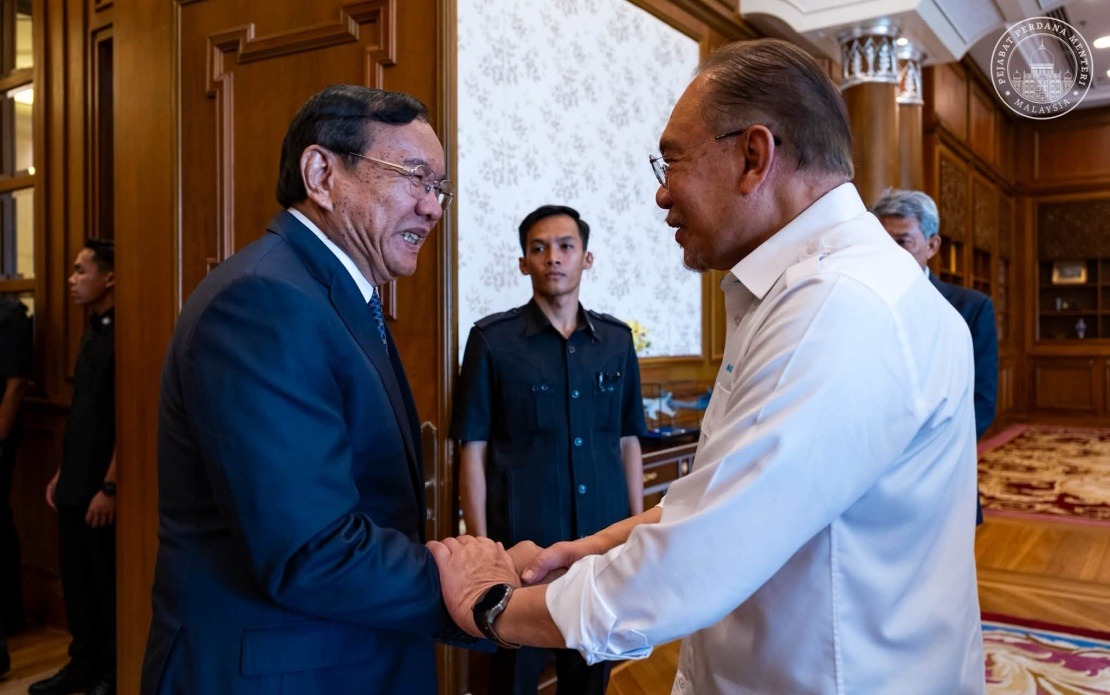
Prime Minister Datuk Seri Anwar Ibrahim has announced a comprehensive framework for expanded bilateral engagement between Malaysia and Cambodia, signalling the two nations' intent to build upon their historical ties with contemporary economic and security partnerships. The fresh commitment encompasses emerging sectors including the digital economy and artificial intelligence alongside traditional areas of mutual interest, reflecting a modernised approach to regional cooperation that acknowledges both nations' development priorities in Southeast Asia's evolving geopolitical landscape.
The announcement followed a courtesy meeting with Cambodian Deputy Prime Minister and Minister of Foreign Affairs and International Cooperation Prak Sokhonn, whose arrival in Kuala Lumpur on August 3 initiated a two-day official visit designed to reinvigorate bilateral mechanisms. Beyond ceremonial protocol, the encounter served as a preparatory session for the Third Malaysia-Cambodia Joint Commission for Bilateral Cooperation, scheduled to convene on August 4 and expected to translate political goodwill into concrete institutional arrangements and collaborative frameworks.
The expanded cooperation agenda addresses sectors of strategic importance to both economies. Malaysia's halal certification leadership and Cambodia's growing interest in halal-compliant supply chains present natural synergies, particularly as Southeast Asian nations increasingly compete for prominence in Islamic economy development. Similarly, joint initiatives in food security reflect shared vulnerabilities in agricultural supply chains and climate resilience, challenges that transcend borders and demand coordinated regional responses. These complementary interests suggest that bilateral cooperation extends beyond diplomatic courtesy toward addressing genuine economic interdependencies.
The digital economy and artificial intelligence components of the partnership framework acknowledge both nations' aspirations within the digital transformation agenda championed across ASEAN. Malaysia's advanced telecommunications infrastructure and Cambodia's emerging tech ecosystem create opportunities for knowledge transfer, investment flows, and joint innovation initiatives that could position both countries advantageously within Southeast Asia's digital corridors. These sectors also align with ASEAN Community Vision 2045 objectives, indicating that Malaysia-Cambodia cooperation serves broader regional integration ambitions.
Cross-border crime prevention emerged as another substantive cooperation pillar, reflecting practical security concerns shared by neighbouring nations. Transnational criminal networks exploiting porous frontiers have consistently challenged law enforcement agencies across Southeast Asia, from human trafficking to narcotics smuggling and cybercrime. Structured bilateral mechanisms addressing these challenges could yield tangible security improvements while building institutional relationships between Malaysian and Cambodian security agencies. This dimension of the partnership underscores that contemporary regional cooperation encompasses not merely trade and investment but also the fundamental challenge of maintaining domestic order against transnational threats.
Human capital development forms the final substantive component of the expanded cooperation framework. Exchange programmes, vocational training initiatives, and educational collaborations facilitate people-to-people connections that underpin sustainable bilateral relations beyond political cycles. Malaysian universities and technical institutes possess capacity to accommodate Cambodian students and professionals, fostering the cross-border talent mobility increasingly vital in knowledge-driven economies. Reciprocal arrangements can similarly benefit Malaysian citizens accessing opportunities within Cambodia's development corridors.
The timing of this partnership deepening carries particular significance given the approaching 70th anniversary of Malaysia-Cambodia diplomatic relations in 2027. Rather than treating such commemorative milestones as retrospective celebrations, both governments are leveraging the occasion to establish contemporary achievements and forward-looking initiatives that will define relations for subsequent decades. This strategic approach transforms anniversary recognition into a catalyst for renewed engagement rather than nostalgic reflection.
Within the broader ASEAN context, Malaysia-Cambodia cooperation demonstrates the organisation's commitment to managing intra-regional ties constructively. As member states navigating geopolitical pressures from major powers and emerging transnational challenges, ASEAN nations benefit from strengthening bilateral relationships that reinforce collective resilience and cohesion. The Malaysia-Cambodia partnership exemplifies how bilateral initiatives, rather than competing with ASEAN unity, can strengthen the regional architecture by deepening interconnections and demonstrating practical benefits of association membership.
For Malaysian policymakers, the Cambodia engagement reflects a diversified diplomatic strategy emphasising depth across multiple Southeast Asian relationships rather than concentrating exclusively on any single partner. Cambodia's geographic position within mainland Southeast Asia, its resources, and its significance within ASEAN decision-making processes justify sustained high-level Malaysian attention. Conversely, Malaysian investment, expertise and market access represent substantial assets from Cambodia's development perspective, creating asymmetries that both sides must navigate carefully to maintain equitable partnership perceptions.
The JCBC mechanism itself represents an institutional framework designed to prevent cooperation initiatives from remaining symbolic announcements. Structured joint commissions create accountability mechanisms, regular review schedules, and working group arrangements that translate political commitments into measurable outcomes. Malaysia's experience establishing similar commissions with other regional and international partners provides institutional templates that can accelerate implementation of agreed frameworks.
Looking ahead, the success of this expanded partnership framework depends substantially on implementation capacity within both governments and private sector participation. Government-to-government commitments require corresponding support from businesses, educational institutions, and civil society organisations that constitute the operational substance of bilateral relations. Malaysian companies exploring Cambodian markets, Cambodian investors accessing Malaysian capital and expertise, and academic institutions pursuing joint research initiatives will ultimately determine whether current political commitments translate into sustained economic integration and people-to-people connectivity that characterises truly successful bilateral partnerships.

