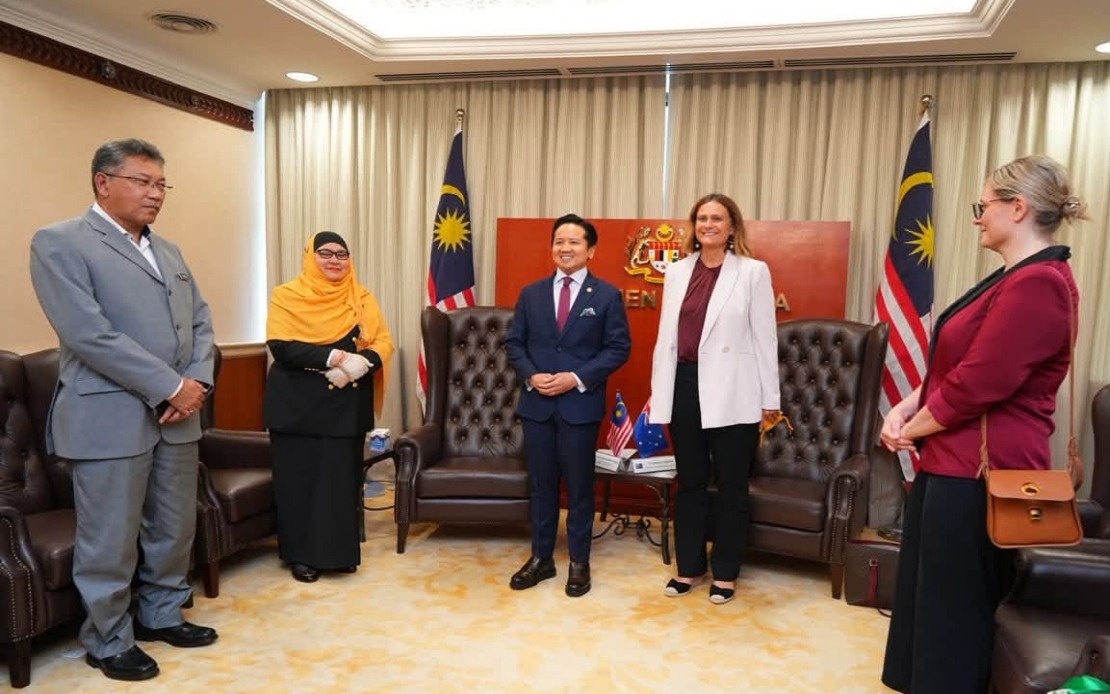
Malaysia and Australia are moving to strengthen their partnership in the rare earth elements and critical minerals sectors, with officials from both nations exploring opportunities to advance domestic manufacturing capabilities and sustainable resource management practices. The Natural Resources and Environmental Sustainability Ministry confirmed that these strategic discussions took place between Minister Datuk Seri Arthur Joseph Kurup and Australian High Commissioner to Malaysia Danielle Heinecke at the Parliament building, underscoring the bilateral commitment to developing critical industries that are increasingly vital for global economic competition.
The timing of this engagement reflects a broader regional realignment around critical minerals, a sector that carries significant geopolitical weight. As global demand for rare earth elements surges due to the clean energy transition, electric vehicle manufacturing, and advanced technology applications, countries are reassessing their supply chains and seeking reliable partners. Malaysia's position as a Southeast Asian hub with existing REE processing infrastructure makes it a natural focal point for such collaborations, while Australia's technical expertise and substantial mineral reserves provide complementary advantages that neither nation could fully leverage alone.
A key focus of the bilateral discussions centred on Malaysia's ambition to develop a comprehensive rare earth value chain spanning midstream to downstream operations. Currently, Malaysia's REE sector concentrates primarily on upstream and midstream activities, leaving significant value-capture opportunities in downstream manufacturing. The planned expansion into neodymium magnet manufacturing represents a deliberate shift toward higher-value processing, aligning with the objectives outlined in the National Mineral Policy 3 (NMP3), which seeks to position Malaysia as a more sophisticated participant in global supply chains rather than merely an exporter of raw materials.
The two nations specifically identified the management of rare earth processing residues as a critical area requiring collaborative solutions. Neutralisation underflow residue (NUF) represents one of the most challenging environmental aspects of REE processing, as it contains hazardous materials that demand sophisticated handling and disposal protocols. By exchanging best practices and technical knowledge on this issue, Malaysia and Australia can address both environmental compliance and operational efficiency concerns simultaneously, potentially reducing costs while strengthening sustainability credentials that increasingly influence investment decisions and trade relationships.
Neodymium magnets represent one of the most strategically important downstream products in the REE ecosystem. These permanent magnets are essential components in wind turbine generators, electric vehicle motors, and numerous defence applications, making them targets for supply chain security strategies among major economies. Currently, global neodymium magnet production remains heavily concentrated in China, which processes approximately 90 percent of the world's rare earth elements and manufactures the majority of permanent magnets. Malaysia's development of domestic magnet manufacturing would not only capture additional value within the country but also contribute to supply chain diversification that many developed nations view as critical for economic and national security.
Beyond the critical minerals focus, the ministerial discussions encompassed broader environmental and climate-related cooperation, reflecting the interconnected nature of modern governance challenges. Hazardous waste management emerged as a shared priority, particularly given the environmental footprint associated with intensive mining and processing operations. Marine ecosystem conservation also featured prominently in conversations, recognising that both nations have significant coastal interests and that extractive industries can create externalities affecting marine environments that extend beyond immediate operational zones.
Malaysia's commitment to the United Nations Climate Change Conference (COP31) framed these discussions within the larger context of meeting global climate targets while maintaining economic growth. This positioning highlights how contemporary mineral policy intersects with climate diplomacy, as the clean energy transition simultaneously increases demand for critical minerals while requiring that their extraction and processing meet stringent environmental standards. The Australian High Commissioner's visit underscored recognition that meeting climate goals requires robust supply chains for the materials underlying renewable energy infrastructure, electric transportation, and grid modernisation.
The broader Malaysia-Australia Comprehensive Strategic Partnership (CSP), established in 2021, provides the institutional framework within which these technical discussions occur. This partnership transcends traditional bilateral engagement by encompassing defence, security, education, and economic dimensions. The critical minerals dialogue represents a natural extension of this framework, particularly as both nations face shared interests in regional stability and economic prosperity amid shifting global power dynamics and supply chain recalibrations.
For Malaysia specifically, advancing the REE sector offers multiple strategic benefits extending beyond immediate export revenue. Developing downstream capabilities strengthens industrial competitiveness across multiple sectors, creates higher-skilled employment opportunities, and positions the country as an increasingly sophisticated manufacturer rather than a commodity exporter. This transformation aligns with Malaysia's broader economic diversification agenda and supports long-term prosperity by capturing greater value from natural resource endowments.
The combination of Australia's technical prowess in managing critical mineral extraction and Malaysia's existing processing infrastructure creates compelling synergies for regional industrial development. By leveraging complementary strengths, both nations can advance manufacturing capabilities that reduce dependence on external suppliers while establishing themselves as reliable partners in global supply chains increasingly subject to geopolitical tensions. This collaboration demonstrates how smaller and medium-sized economies can strengthen their positions through strategic partnerships that enhance collective technological capabilities and market influence.

