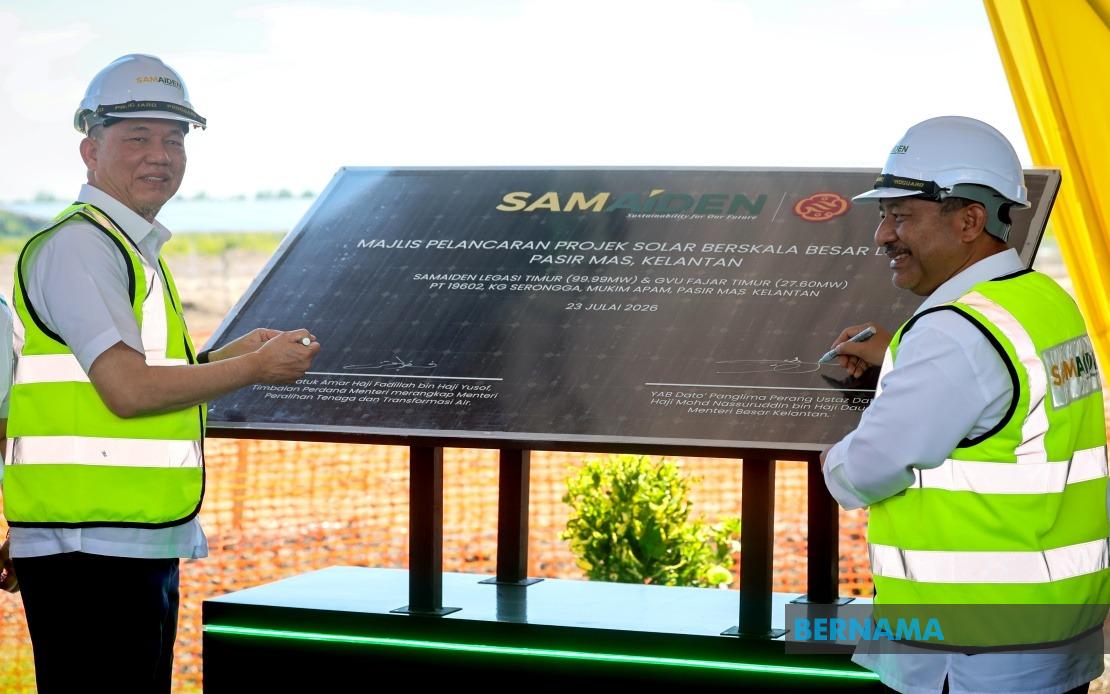
Malaysia's renewable energy infrastructure has crossed a significant threshold, with installed capacity reaching nearly 32 per cent as of June, demonstrating the country's accelerating progress toward its 2030 renewable energy goal. Deputy Prime Minister Datuk Seri Fadillah Yusof made the announcement at the launch of the Large-Scale Solar Project (LSS5) in Pasir Mas, Kelantan, signalling that Malaysia remains firmly positioned to achieve its 35 per cent renewable energy target within the decade. The milestone reflects consistent advancement under the National Energy Transition Roadmap (NETR), a comprehensive framework guiding the nation's shift toward cleaner energy sources and sustainability.
The government had already surpassed an interim benchmark by December 2025, when renewable energy capacity reached 31 per cent, meeting expectations ahead of schedule. Looking further ahead, Malaysia has committed to reaching 70 per cent renewable energy capacity by 2050, establishing a long-term vision for near-total dependence on clean energy generation. These graduated targets demonstrate a measured yet ambitious approach to energy transformation, allowing stakeholders across the public and private sectors to calibrate investments and infrastructure development accordingly. The consistent trajectory from current levels toward both mid-term and long-term objectives suggests that technical and policy frameworks are functioning effectively.
Fadillah, who holds the dual portfolio of Deputy Prime Minister and Minister of Energy Transition and Water Transformation (PETRA), framed energy transition not as an aspirational goal but as a fundamental strategic imperative. He articulated three interconnected rationales underlying this push: ensuring Malaysia's energy security in an increasingly volatile global energy market, fortifying the nation's economic resilience against external shocks, and fulfilling commitments to international climate agreements. This positioning reflects broader global recognition that energy independence and climate responsibility are no longer competing interests but reinforcing priorities. For Malaysia specifically, reducing dependence on imported fossil fuels while maintaining affordable power supply addresses longstanding policy tensions.
The minister emphasized that the government's energy transition strategy rests on three pillars: energy security, cost affordability, and environmental sustainability. This triadic framework acknowledges that rapid renewable expansion cannot come at the expense of grid reliability or electricity prices that strain household and industrial budgets. The NETR therefore commits to developing robust storage systems, grid modernization, and competitive procurement mechanisms that prevent renewable energy from driving up consumer costs. For Malaysian households and businesses already navigating inflationary pressures, affordability assurances represent a critical political and economic consideration.
The LSS5 project in Pasir Mas symbolizes private sector confidence in Malaysia's renewable energy regulatory environment and investment climate. The launch of such large-scale installations signals that international and domestic investors view the government's energy policies as sufficiently stable and predictable to justify substantial capital commitments. This investor confidence, in turn, creates a virtuous cycle: successful projects attract further investment, which accelerates infrastructure development and drives down costs through economies of scale. For Malaysia's broader economic development agenda, particularly efforts to attract high-technology manufacturing and digital economy investments, reliable and affordable renewable electricity represents a competitive advantage in global supply chains.
Kelantan, the host state for the LSS5 project, has been positioned as a focal point for Malaysia's renewable energy expansion. The state's abundant available land, favorable solar irradiance, and demonstrable government support create an attractive investment proposition. Kelantan Menteri Besar Datuk Mohd Nassuruddin Daud articulated aspirations to establish the state as a benchmark for renewable energy development in Southeast Asia, viewing the sector as a catalyst for broader economic diversification. Historically a state with more limited industrial development compared to the industrialized west coast, renewable energy projects offer Kelantan an opportunity to develop a distinctive economic identity around green technology and sustainability.
The economic multiplier effects of the LSS5 project extend beyond electricity generation. Fadillah highlighted employment creation, stimulation of local supply chains, and community development as tangible outcomes expected from the installation and subsequent operation. For rural Kelantan communities, renewable energy projects generate direct construction and maintenance employment while attracting supporting industries in electrical equipment, logistics, and services. These ancillary economic benefits often exceed the direct value of electricity production, creating sustained employment opportunities in regions with limited industrial alternatives.
The Solar ATAP Programme, promoted by PETRA, represents a complementary component of Malaysia's distributed renewable energy strategy. By encouraging homeowners, commercial premises, and religious institutions to install rooftop solar systems, the government distributes generation capacity across the built environment while reducing transmission losses inherent in centralized power plants. This decentralized approach also democratizes renewable energy benefits, allowing households and small businesses to reduce electricity costs and improve energy independence. In a middle-income economy like Malaysia, where residential electricity bills consume meaningful portions of household budgets, distributed solar installations can provide tangible financial relief while supporting national renewable energy targets.
Kelantan's renewable energy potential remains substantially underdeveloped relative to the state's natural advantages. The state government has committed to creating conditions for continued investment through transparent regulatory processes, investor-friendly policies, and strong collaboration between state and federal authorities. This commitment addresses a historical concern that policy uncertainty or inconsistent implementation might discourage large-scale investment in peripheral states. For investors contemplating multi-year commitments in renewable energy infrastructure, assurance of stable regulatory frameworks and supportive government relations proves as important as electricity prices or grid access.
The implications of Malaysia's renewable energy progress extend beyond domestic energy markets to broader Southeast Asian energy transitions. As the region's second-largest economy, Malaysia's successful scaling of renewable infrastructure, particularly solar capacity, establishes technical and commercial templates that neighboring countries can adapt. The NETR demonstrates how a major energy-consuming economy can pursue aggressive decarbonization targets while managing concerns about affordability and energy security. This demonstration effect may accelerate regional consensus around renewable energy expansion and provide practical models for addressing common challenges including grid integration, land use coordination, and investment mobilization.
From a geopolitical perspective, Malaysia's energy transition supports the nation's positioning within global climate negotiations and international climate finance mechanisms. By demonstrating tangible progress toward renewable energy targets, Malaysia strengthens its credibility in international forums and may access preferential terms for climate-related financing and technology transfer. This dimension proves particularly relevant as global capital increasingly incorporates climate and environmental criteria into investment decisions, potentially improving Malaysia's access to green financing for energy infrastructure projects.
The achievement of 32 per cent renewable energy capacity, combined with clear targets and investment momentum, positions Malaysia as a regional leader in energy transition. However, the remaining journey to 35 per cent by 2030 and 70 per cent by 2050 presents formidable technical and financial challenges. Grid modernization, energy storage deployment, workforce training, and sustained capital investment remain critical. The LSS5 project and comparable initiatives represent necessary but insufficient conditions for achieving long-term renewable energy dominance. Sustained political commitment, continued policy refinement, and deepening private sector engagement will determine whether Malaysia's energy transition trajectory translates into genuine transformation or plateaus at intermediate levels of renewable penetration.

